There is a moment on every long superyacht voyage when the question stops being abstract. The guests have taken their showers, the galley has cooked dinner, the deck crew has washed down the teak, and the freshwater tanks are dropping faster than the captain would like. The nearest port might be a day away, and the sea all around is water nobody can drink. It is the oldest problem in seafaring, and on a modern superyacht it has an elegant answer humming away below deck: a machine that turns the ocean itself into drinking water.
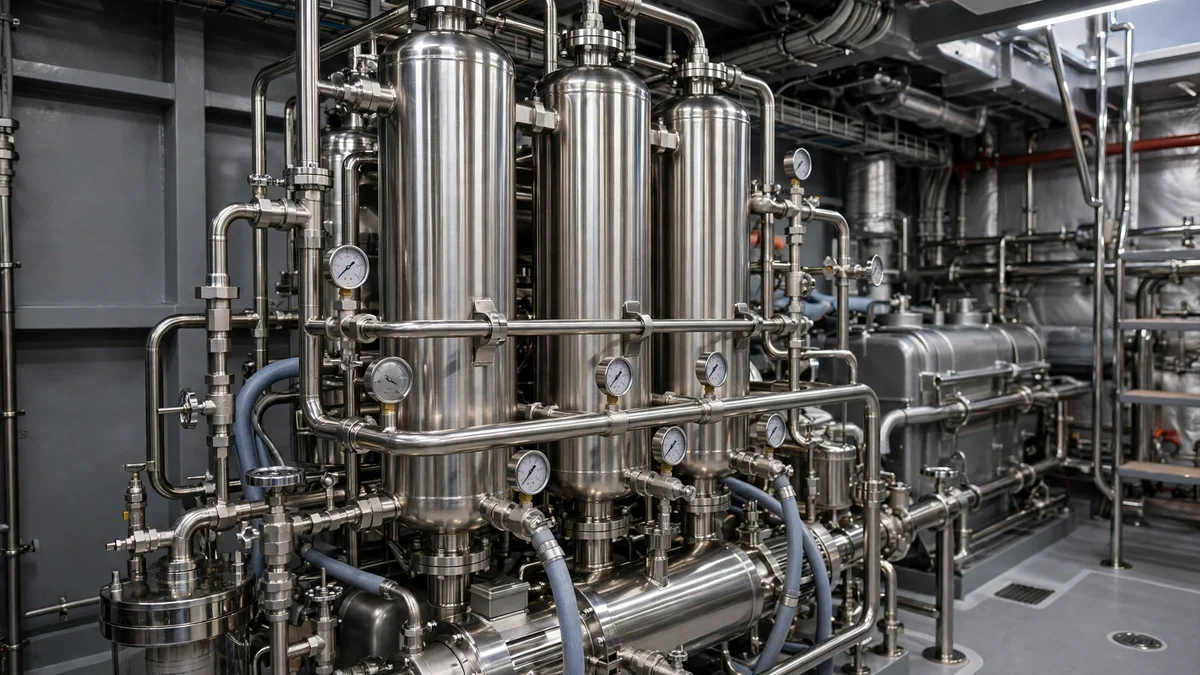
That machine is the watermaker, and it is one of the most important pieces of equipment on a large yacht. Without it, a superyacht’s range would be set by its tank capacity, a few thousand litres that a full crew and guests can empty in days. With it, the yacht is effectively free of the shore, able to stay at anchor in a remote bay for weeks, making its own water from the sea around it. The technology is reverse osmosis, the same process used in desalination plants, shrunk into a unit the size of a large fridge.
How It Works
Step 1: Drawing in seawater
The process starts outside the hull, where a dedicated intake draws seawater from below the waterline. The intake sits well away from the engine cooling outlets and the waste outlets, for obvious reasons, and it is fitted with a strainer to keep out weed, jellyfish and anything else large enough to damage a pump. A low-pressure feed pump pulls the water in and pushes it through the first filters, which remove sand and sediment.
Step 2: Filtering out the solids
Before the water reaches the membranes, it passes through a series of ever-finer filters. A coarse strainer catches the big particles, then a five-micron filter catches the fine sand and silt, and some systems add a carbon filter to remove chlorine and organic chemicals. The water is also dosed with a small amount of chemical to stop scale forming on the membranes, the same kind of limescale that furs up a kettle, only here it would coat a membrane worth thousands of dollars.
Step 3: Pressurising the water
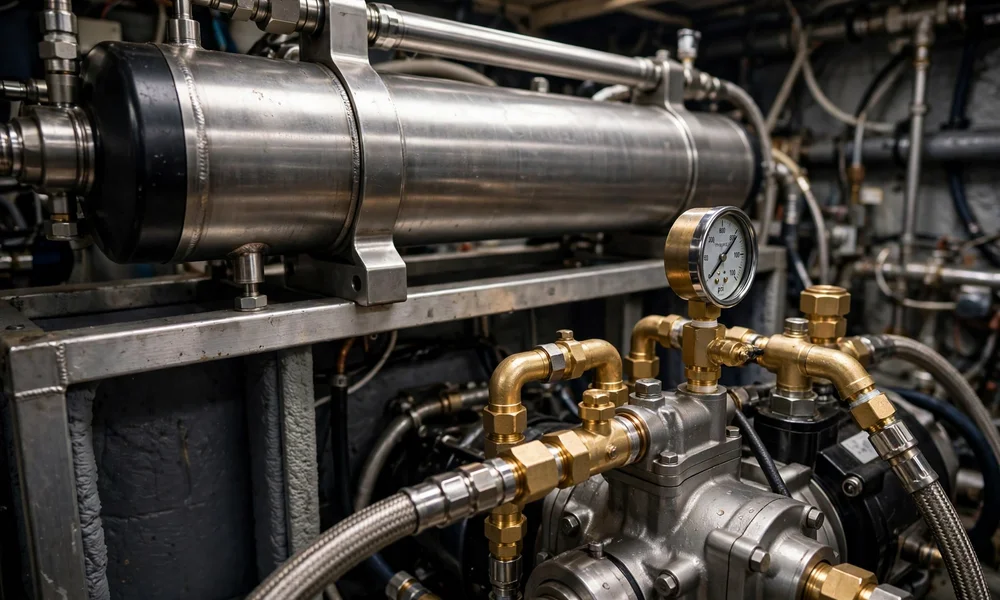
The heart of the system is a high-pressure pump that forces the seawater against the membranes at around 55 to 70 bar, roughly sixty times normal atmospheric pressure. This is where the energy goes: pushing water through a membrane that blocks salt requires real force, and the pump is usually the single largest power consumer in the watermaker. Modern systems recover some of that energy, using the pressure of the rejected brine to help drive the incoming water. The hull that carries all of this is itself a feat of engineering, as superyacht hull construction shows.
Step 4: Pushing water through the membrane
The membrane is a marvel of materials science: a thin film composite sheet wound into a spiral, with pores so small that water molecules can pass through but dissolved salt ions cannot. Under pressure, pure water is forced through the membrane and collected as product water, while the salt stays behind in a concentrated brine stream that is pumped back overboard. A single membrane vessel on a large yacht can produce hundreds of litres an hour.
Step 5: Polishing and mineralising
Water that has passed through a reverse osmosis membrane is almost too pure. It tastes flat, and it is slightly acidic and corrosive to pipes and tanks. So the product water is passed through a remineralising filter, usually crushed limestone, which adds back a little calcium and magnesium and brings the pH up to a pleasant, neutral level. A final ultraviolet steriliser kills any remaining bacteria, and an inline sensor checks the salt level continuously.
Step 6: Running it day after day
A watermaker is not a fit-and-forget machine. The crew runs it in blocks, typically a few hours a day, and after every run the system flushes itself with fresh water to stop salt crystallising on the membranes. If the yacht is laid up for more than a few days, the membranes are pickled in a preservative solution to stop bacteria growing on them. Keeping the yacht steady while all of this runs matters too, which is where yacht gyroscopic stabilizers earn their keep.
The Specs, Explained
The specification sheet for a watermaker is dominated by one number: output in litres per hour. Everything else, power draw, recovery rate, membrane count and weight, describes what that output costs. The table below shows typical figures for three sizes of yacht system.
| Property | Small yacht system | Mid-size superyacht | Large superyacht |
|---|---|---|---|
| Output | 60–120 L/h | 200–400 L/h | 500–1,000 L/h |
| Operating pressure | 55–60 bar | 60–65 bar | 60–70 bar |
| Power draw | 1.0–1.5 kW | 2.5–4.5 kW | 6–12 kW |
| Energy per litre | 10–15 Wh/L | 8–12 Wh/L | 6–10 Wh/L |
| Recovery rate | 20–30% | 30–40% | 35–45% |
| Membranes | 1–2 | 2–4 | 4–8 |
| Product water quality | Below 500 ppm TDS | Below 500 ppm TDS | Below 500 ppm TDS |
| System weight | 60–120 kg | 150–300 kg | 400–800 kg |
Output is the headline, and a large superyacht system making 1,000 litres an hour can refill a 10,000-litre tank in a single working day, which is what makes long stays at anchor possible. The recovery rate is the more subtle number: it is the percentage of the seawater taken in that becomes drinking water, and the rest goes back to the sea as brine. At forty percent recovery, the system draws in two and a half litres of seawater for every litre it makes. When the yacht finally drops anchor, the systems that keep it in place, like how a yacht anchor system works, matter just as much as the ones that keep it supplied.
What It Costs
Watermakers are expensive, but they are cheap compared with the alternative of cutting a voyage short to find a port. A small system for a cruising yacht typically costs $5,000–$12,000 installed, a mid-size superyacht system $25,000–$60,000, and a large superyacht installation with energy recovery and full automation $80,000–$200,000. The membranes are the running cost: a set for a large system costs $3,000–$8,000 and lasts three to five years with good care.
Running costs are modest, and these are estimates. Electricity is the main expense, and at typical generator costs the water works out at roughly $0.02–$0.05 per litre, against $0.10–$0.30 per litre for water bought in a marina in a remote location. For a yacht that spends weeks away from port, the system usually pays for itself in convenience alone.

A Rare Fact
Reverse osmosis was not invented for yachts, or even for drinking water. It was developed in the 1950s by researchers trying to desalinate seawater for arid regions, and the first practical membranes were so fragile and so slow that a square metre of membrane produced barely a cup of water a day. The breakthrough came when scientists learned to make the membrane as a microscopically thin skin on a stronger support, a structure so fine that the active layer is about a thousand times thinner than a human hair.
That is the quiet magic of the watermaker. It asks for nothing but seawater, pressure and a little electricity, and it returns the one thing a yacht cannot sail without. Tanks can be emptied and ports can be days away, and the crew can use water as if it were unlimited, because for practical purposes it is. The ocean is the largest reservoir on the planet, and somewhere below deck, a pump, a membrane and a little limestone are turning it into a glass of cold water on the aft deck.


