A superyacht at sea carries its own water supply in its tanks, but those tanks only last so long. With guests showering, a galley cooking, and a crew of a dozen or more, a big yacht can drink through thousands of litres a day. The answer is a machine that makes fresh water from the sea itself: a watermaker, quietly turning salt water into drinking water while the yacht is under way.
Inside the workshop that builds one, the watermaker looks less like a yacht fitting and more like a piece of industrial plant. It is a frame of stainless steel pipes, pressure vessels, pumps, and filters, built to survive salt, vibration, and years of running in a hot engine room. Every joint must hold against high pressure, and every filter must be clean enough to drink from.
Inside the Production
Step 1: Building the frame and vessels
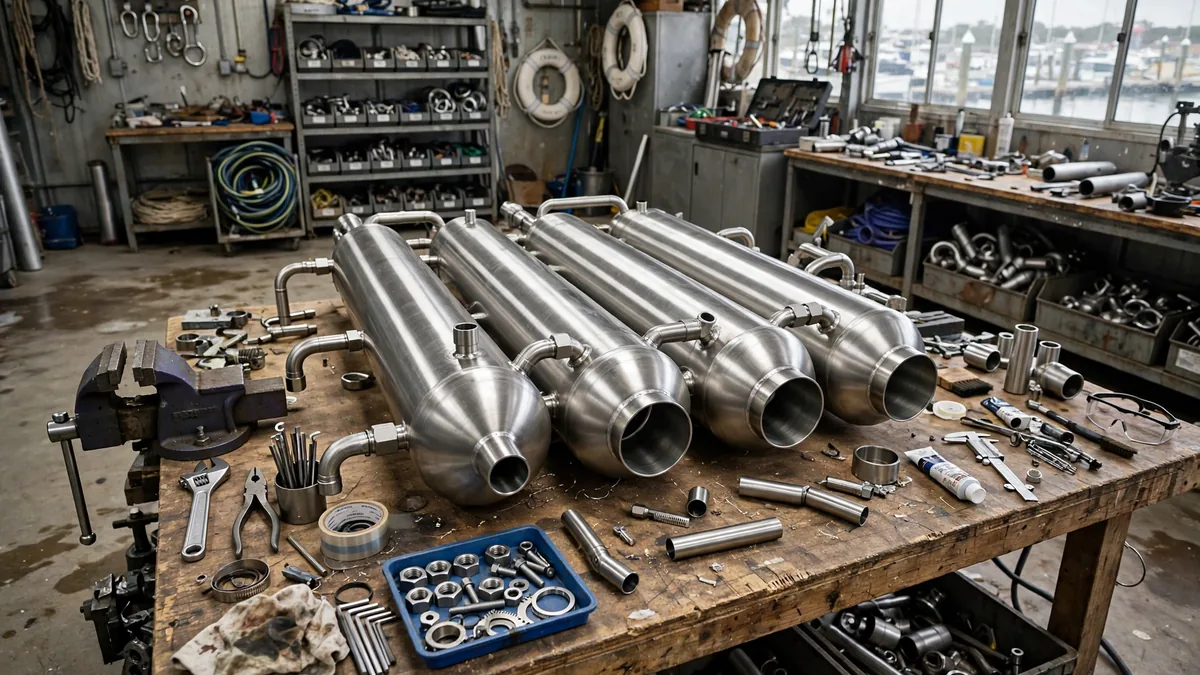
Production begins with the pressure vessels, the long stainless steel tubes that hold the membranes. The tubes are cut to length, their ends are machined smooth, and end caps are fitted with seals that must hold against pressures far higher than a household tap. The frame is welded from stainless steel box section, built to the size of the yacht’s engine room, and every weld is checked for pinholes that salt water would find. The vessels are mounted on the frame with clamps that hold them firm but let them expand slightly as they warm up under pressure.
Step 2: Fitting the membranes
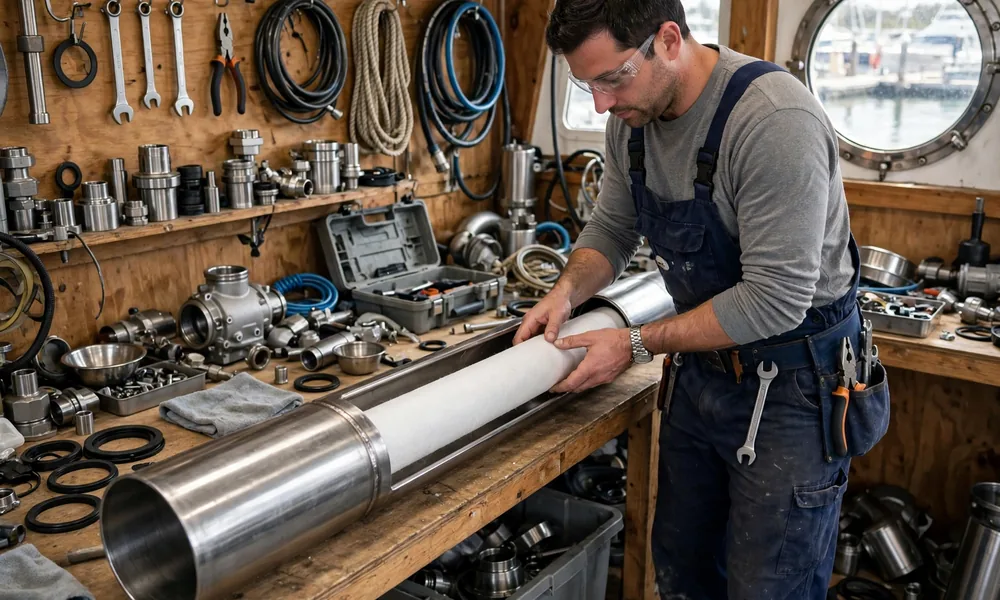
The heart of the watermaker is the membrane, a long roll of special material that lets water molecules through but blocks salt. Each membrane is a cylinder about a metre long, and it slides into a pressure vessel like a cartridge into a holder. The fit must be exact: a membrane that is loose would let salt water slip past, and one forced in roughly could tear. Workers wear clean gloves for this job, because grease or dirt on a membrane would block its pores and cut its output. The way the membranes are fitted is part of what how a superyacht watermaker is made describes, and a finished vessel is sealed and marked before it moves to the next bench.
Step 3: Pumps, filters, and pipework
While the vessels are prepared, the rest of the system is built. A low-pressure feed pump draws sea water in through a strainer that catches weed and sand, then a set of pre-filters removes finer particles that would damage the membranes. The high-pressure pump — the hardest-working part of the machine — then pushes the water through the membranes at around sixty times normal tap pressure. The pipework is stainless steel or high-grade plastic, joined with fittings that are tightened to a set torque, and every run of pipe is clipped to the frame so vibration cannot work it loose at sea.
Step 4: Controls and sensors
A modern watermaker runs itself, and the controls are fitted next. Sensors measure the pressure before and after the membranes, the flow of fresh water, and the salt content of the product water. A small control panel, often with a touchscreen, lets the crew start and stop the machine, flush the membranes, and read its output. The wiring is run through sealed conduits, because an engine room is a damp place, and every sensor is tested against a known reading before the machine is powered up for the first time.
Step 5: Pressure testing
Before the watermaker makes a single litre of drinking water, it is tested with plain water at full pressure. The system is filled, the high-pressure pump is run up, and every joint, seal, and fitting is checked for drips. The pressure is held for a set time, and any drop on the gauge means a leak somewhere that must be found and fixed. The membranes are flushed through with clean water to wash out the preserving fluid they are shipped in, and the first product water is tested for salt content: it must be well below drinking-water limits before the machine passes.
Step 6: Final run and packing
The finished watermaker is run for hours on a test bench, making water the way it will at sea, while its output, pressure, and power draw are logged. The crew’s manual is written for that exact unit, listing its membrane type, filter sizes, and service intervals, and the spare filters and seals are packed with it. The machine is then drained, capped, and crated for the journey to the yacht, where it will be bolted into the engine room and connected to the yacht’s sea intake and fresh water tanks. Only a unit with a clean test log is cleared to leave the workshop.

Specs
| Specification | Typical figure |
|---|---|
| Output | 100 to 500 litres per hour, yacht size depending |
| Membrane type | Reverse osmosis, seawater grade |
| Working pressure | Around 55 to 65 bar |
| Frame material | Stainless steel, marine grade |
| Pre-filters | Strainer plus 20 and 5 micron filters |
| Power | Electric motor, 1 to 4 kW |
| Product quality | Below 500 parts per million of salt |
| Controls | Automatic start, flush, and salinity check |
| Testing | Full-pressure run and water quality test |
Price
A superyacht watermaker is a serious piece of equipment, and its price reflects that. As an estimate, a small unit making around 100 litres an hour costs roughly $8,000 to $15,000, while a large unit for a big yacht, making 300 litres an hour or more, costs roughly $25,000 to $60,000 installed. The membranes themselves are a running cost, lasting a few years before they need replacing at roughly $500 to $1,500 each. These are estimates, and the real figure varies with output, brand, and installation — but the machine pays for itself in freedom: a yacht with a good watermaker need never cut a trip short to find a marina tap.
A Rare Fact
A watermaker makes fresh water by squeezing sea water so hard that only the water gets through. The membrane inside is a filter with pores so fine that salt molecules cannot pass, yet water molecules can — but only when the water is pushed at about sixty times the pressure of a household tap. The pressure is so high that a leak from a loose fitting can cut like a knife, which is why the testing stage is taken so seriously. Even stranger, the machine throws most of the sea water away: for every litre of fresh water it makes, roughly two to three litres of extra-salty water go back over the side. It is a wasteful-sounding way to make drinking water, and yet it is how a yacht stays at sea for weeks without ever visiting a port.
The watermaker is the yacht’s private water supply, but it only makes sense alongside the vessel it serves. The numbers behind its output and pressure are laid out in the superyacht watermaker specs explained guide, and the steel hull it sits inside is covered in how a superyacht steel hull is made. The next time a yacht anchors in a quiet bay for days on end, remember the stainless vessels, the membranes, and the machine that turned the sea into drinking water.