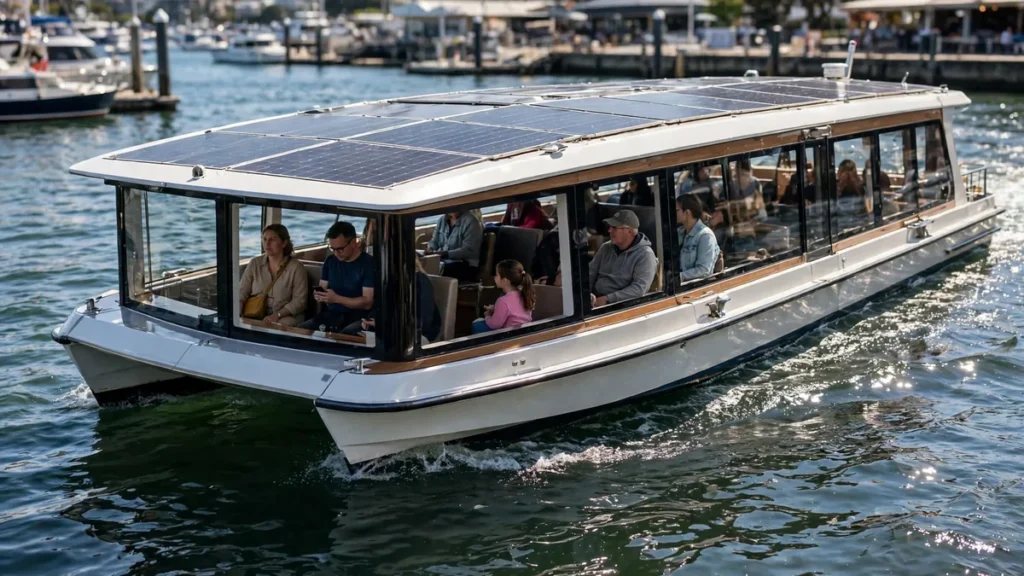
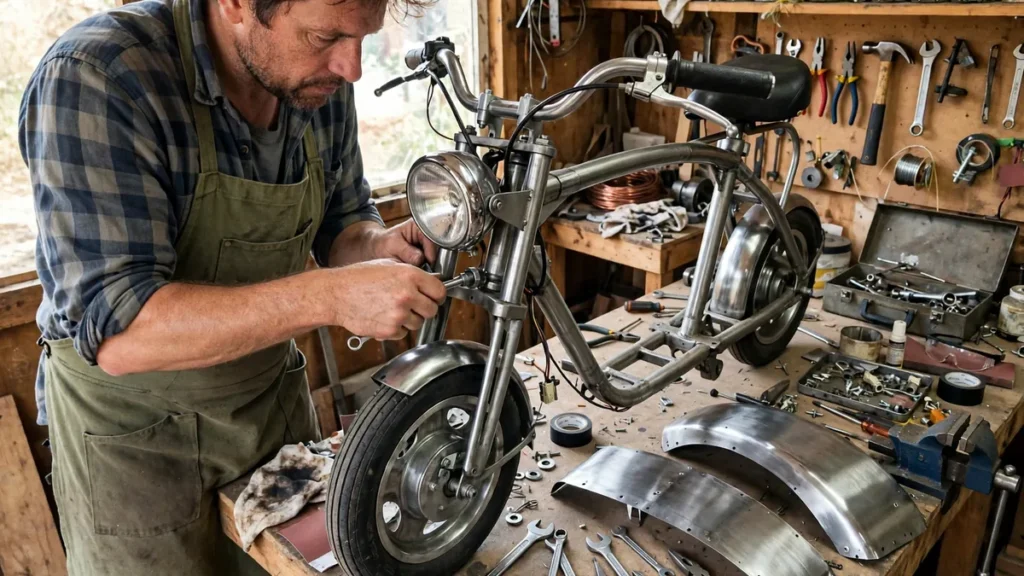
In the old cities of South Asia, the rickshaw is the sound of the street: a small three-wheeled taxi, weaving through traffic, carrying shoppers, schoolchildren and market goods. It is cheap, practical and everywhere. A luxury electric rickshaw is the same shape with a different soul: hand-finished, whisper-quiet, and built to order for owners who want the most charming way to move through a city, a resort or a private estate.
This is how a luxury electric rickshaw works, from the battery under the seat to the hub motor in the wheel, and why three wheels and a quiet motor make such a pleasant way to travel.
Step 1: The battery stores the journey under the seat
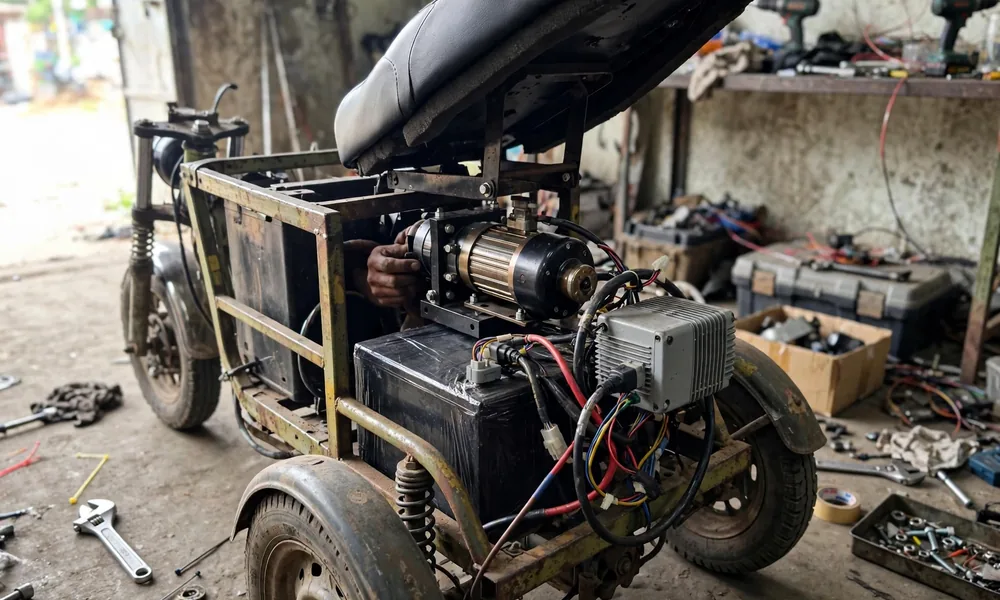
The work starts with the battery, which sits low in the rickshaw, usually under the driver’s seat or beneath the passenger bench, where it keeps the centre of gravity down and the weight between the three wheels. It is a lithium pack, modest in size beside a car’s battery, but generous for a machine this light, and it is managed by a small system that watches the charge, the temperature and the health of every cell. The driver can see the state of charge on a simple display at the handlebars, and the number becomes as familiar as a fuel gauge. The guide to how a luxury electric rickshaw is made follows the build from the frame to the teak body, and the battery fitted there is what the whole working day depends on. A full charge is usually enough for a day of short journeys around a resort or a city, and the rickshaw plugs into an ordinary socket overnight.
Step 2: The controller turns battery power into smooth motion
Between the battery and the motor sits the controller, a small box of electronics that decides how much power the motor gets at every moment. When the driver twists the throttle gently, the controller feeds the motor a little power, and the rickshaw pulls away smoothly, with no jerk and no noise. When the driver asks for more, the controller gives more, up to the limit the motor and the battery can safely give, and it eases the power back if the battery gets hot or the charge runs low.
Step 3: The hub motor drives the wheel directly
The motor itself is usually a hub motor, built into the rear wheel, and it drives the wheel directly, with no chain, no belt and no gearbox to lose energy or make noise. The motor is a ring of magnets and coils inside the hub, and when the controller feeds it power, the magnetic field turns the wheel. Because there is no transmission, the power goes straight to the road, and the rickshaw pulls away from a standstill with a strength that surprises people who expect a small machine to struggle. The motor also works in reverse when the driver needs it, and on some builds it recovers a little energy when the rickshaw slows down, feeding power back into the battery as the motor becomes a generator. The guide to the luxury electric rickshaw specs, explained sets out what the motor, the battery and the range numbers mean, and the hub motor is the number that matters most on the road.
Step 4: Three wheels keep it steady and easy to drive
The rickshaw has three wheels, one at the front and two at the back, and that layout is what makes it so easy to drive. The two rear wheels carry the passengers and the battery, and the single front wheel steers, turned by handlebars like a motorcycle, so the driver steers with their hands and brakes with their fingers, and there is no clutch, no gears and nothing to learn beyond the throttle.
Step 5: The brakes, suspension and steering keep the ride gentle
A luxury electric rickshaw is built to be ridden slowly, and the brakes, the suspension and the steering are set up for that. The brakes are usually disc brakes on the rear wheels, with a hand lever on the handlebars, and they are strong enough to stop the machine quickly even with two passengers aboard.
Step 6: The body carries the passengers in comfort
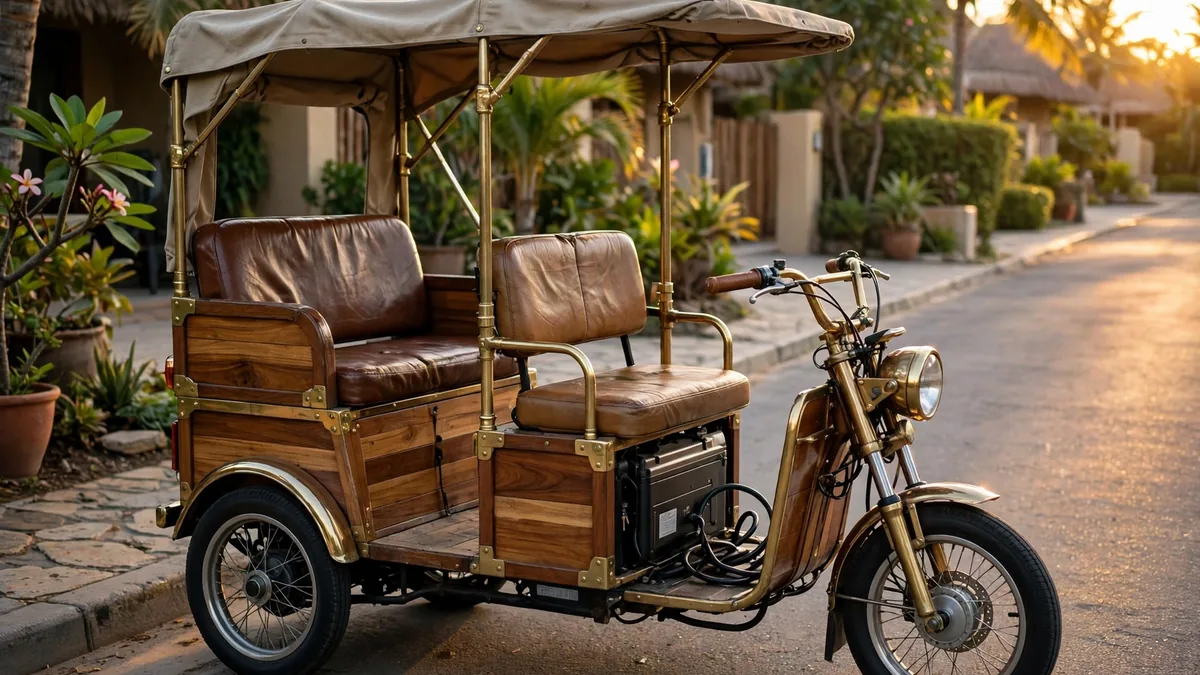
While the engineering works below, the passengers notice only the body. The panels are often teak or another fine hardwood, sealed against rain and sun, and the seats are leather, stitched by hand, with brass or polished steel fittings. The canopy is a heavy woven fabric rather than plastic sheet, and the floor is wood or stone composite rather than bare metal. The guide to why a luxury electric rickshaw is so expensive follows the money from the teak to the leather, and the body is where most of it is spent, because wood moves with heat and moisture, leather has to be cut and matched, and brass has to be polished and lacquered, all by hand. The passengers sit high, with a view over the street, and the canopy keeps the sun off without shutting out the breeze.
Step 7: Charging, range and a day of quiet journeys
At the end of the day, the rickshaw plugs into an ordinary socket, and the battery fills overnight, ready for the next morning. The range on a full charge is usually enough for a day of short journeys, and the driver learns the machine’s habits quickly: a gentle throttle goes further than a hard one, and a slow cruise through the resort uses far less power than hurrying between stops.
The spec sheet at a glance
| Specification | Typical luxury figure | What it tells you |
|---|---|---|
| Motor | Hub motor in the rear wheel, roughly 1 to 3 kilowatts | How strongly it pulls away, and how quietly it runs |
| Battery | Lithium pack, roughly 2 to 5 kilowatt-hours | How far it goes on a charge, and how long it takes to fill |
| Range | Roughly 60 to 120 kilometres | How far it travels on a full charge |
| Top speed | Roughly 25 to 45 kilometres per hour | How fast it travels, and how gentle the journeys are |
| Wheels | Three, one front and two rear | How steady it stands, and how tightly it turns |
| Passengers | Driver plus 2, sometimes 3 | How many people it carries in comfort |
| Body | Teak panels, leather seats, brass fittings | How the machine looks, feels and ages |
| Charging | Ordinary socket, overnight | How simply it is ready for the next day |
| Weight | Roughly 250 to 400 kilograms | How light it is, and how far the battery takes it |

What it costs
A luxury electric rickshaw typically costs an estimated $15,000 to $50,000, depending on its bodywork, its materials and how much of it was built by hand. The estimate covers the machine alone, not the registration, the insurance or the running costs.
A rare fact
One detail few passengers ever learn is that a luxury electric rickshaw can be driven by someone who has never ridden a motorcycle, and that is deliberate. The three wheels mean it cannot fall over at a standstill, there is no clutch and no gears to learn, and the throttle is the only control that matters, so a hotel driver, a resort host or an estate keeper can learn it in an afternoon.