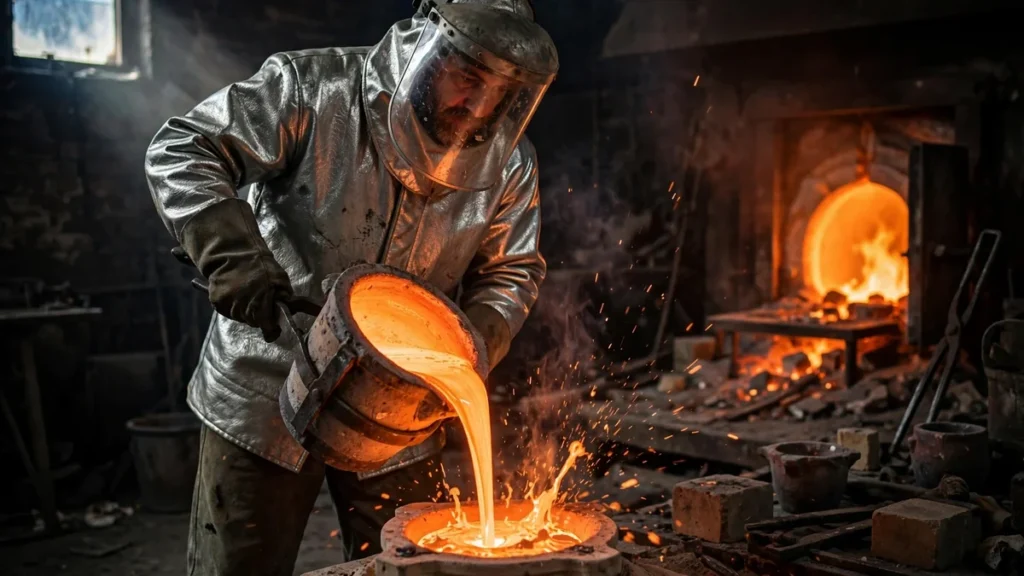
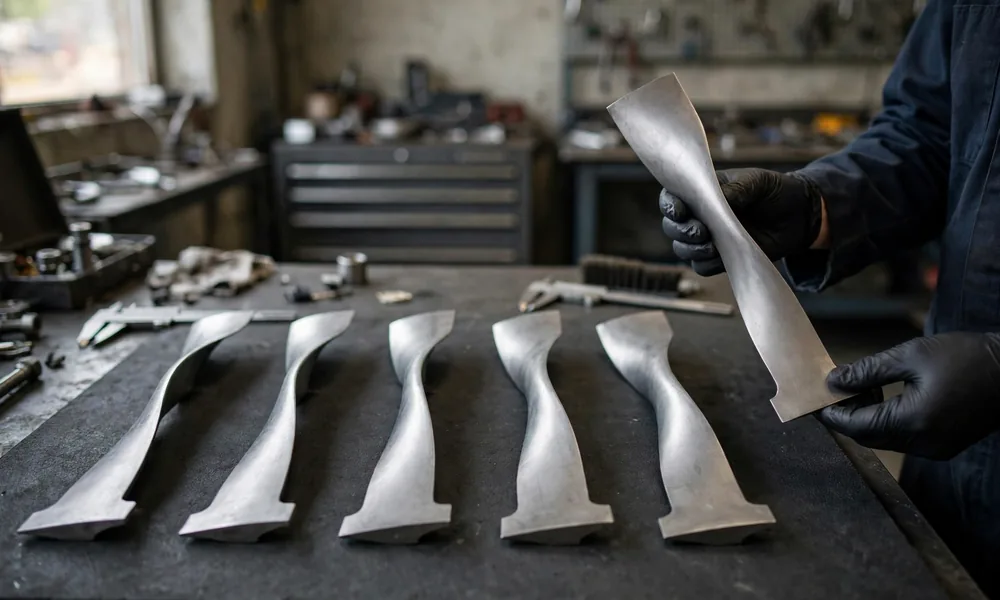
Hold a jet engine turbine blade in your hand. It is about the size of a butter knife, it weighs less than a paperback book, and it lives in a place hotter than molten lava, spinning at ten thousand revolutions a minute, pulled outward with a force of tonnes. Any ordinary metal would tear itself apart in minutes. This one runs for thousands of hours. It was poured as liquid metal into a ceramic mould and cooled so slowly that the whole blade grew as a single crystal.
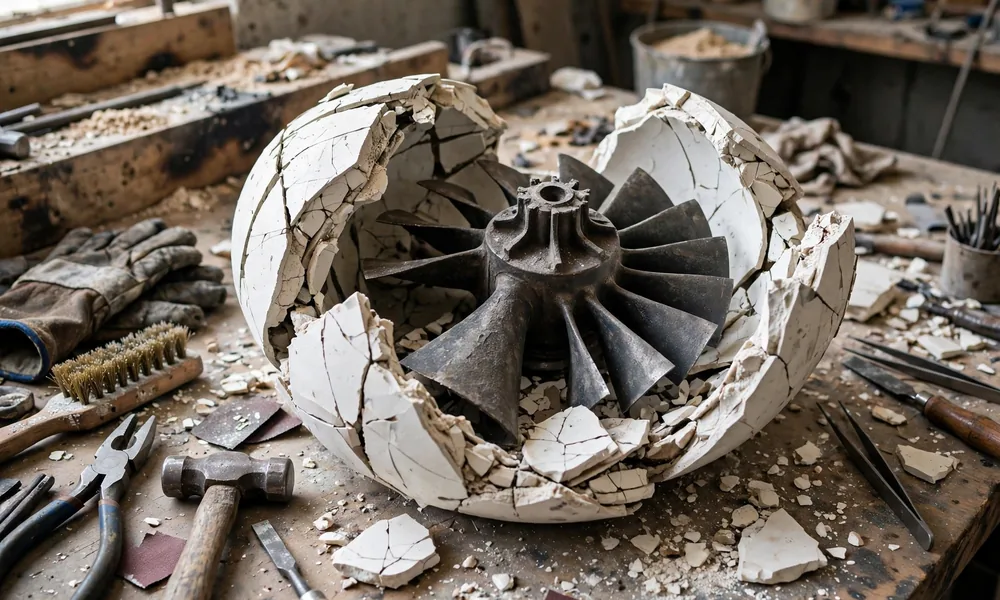
That is superalloy casting, the most demanding kind of casting on Earth. The alloys are mostly nickel, with chromium, cobalt, aluminium, titanium and small amounts of rare metals such as rhenium and tantalum. The moulds are ceramic, built around a wax pattern that is melted away. The metal is poured at around 1,500 degrees Celsius, then withdrawn from a furnace so slowly that the crystal grows upward in one unbroken structure, with no grain boundaries at all — the place where metals usually fail at high temperature.
Superalloy casting is what makes modern flight possible: without it, jet engines would run cooler and less efficiently, and flights would burn far more fuel. The closest relatives of this story are the superalloy casting production line where these blades are made, and the Inconel alloy family, the nickel superalloys that refuse to melt in the hottest parts of an engine. Here is what the specifications mean.

Pouring Temperature: Hotter Than Lava
The first number is the temperature of the liquid metal. Nickel superalloys melt at roughly 1,260 to 1,400 degrees Celsius, and they are poured with extra heat at about 1,350 to 1,550 degrees, so the metal stays fluid long enough to fill the thin passages of a turbine blade mould. Lava erupting from a volcano is typically 700 to 1,200 degrees; the metal in a superalloy crucible is hotter. The moulds are preheated to 900 to 1,050 degrees, and the pour often happens in a vacuum, because the liquid metal would react with oxygen in ordinary air.
Single Crystal Growth: One Crystal, No Seams
The most extraordinary specification is not a temperature but a structure. In the finest turbine blades, the metal is a single crystal: the entire blade is one continuous crystal lattice with no grain boundaries anywhere inside it. It is made by directional solidification: the mould sits on a water-cooled plate, and after pouring it is withdrawn slowly from the furnace’s hot zone, at about 3 to 10 millimetres per minute. The metal freezes from the bottom up, and a helical passage — the grain selector — lets only one crystal survive into the blade. Single-crystal blades last three to five times longer than ordinary cast blades, which is why every modern jet engine depends on them.
Creep Life: How Long Before It Stretches
Inside a jet engine, metal creeps: the slow, permanent stretching of a metal under a steady load at high temperature, and the main reason turbine blades eventually retire. Creep life is measured in hours at a given temperature and stress. A modern single-crystal superalloy can survive about 1,000 hours at 982 degrees Celsius under a stress of about 248 megapascals — roughly 25 tonnes pulling on a bar the width of your thumb, at a temperature where aluminium would be a puddle. The gas rushing through the engine is hotter still, up to 1,500 degrees or more, and the blade survives only because it is hollow, with cooling air blown through internal passages.
Wall Thickness and Cooling Holes: Thinner Than a Coin
A turbine blade is mostly empty space, its walls typically 0.5 to 2 millimetres thick, with a maze of cooling passages inside. Cooling air enters through the root, snakes through channels, and escapes through tiny holes about 0.3 to 0.5 millimetres across. Those passages are what make the blade so hard to cast: the ceramic core that forms them must survive the pour, leave walls less than a millimetre thick, and dissolve away afterwards. A cracked core means a blocked passage, and a blocked passage means a blade that will burn out in service — so every casting is X-rayed.
Reject Rates and Density: The Cost of Perfection
In superalloy casting, failure is normal. The reject rate for single-crystal turbine blades is typically 20 to 40 per cent: one in three or four castings is scrapped for a stray grain, a crack, a blocked passage or a surface defect. The alloys are heavy and expensive. Nickel superalloys have a density of about 8.4 to 9.0 grams per cubic centimetre, close to that of copper, and they contain costly elements: chromium at 10 to 20 per cent, cobalt at 5 to 10 per cent, aluminium and titanium together at 6 to 10 per cent, and small additions of tungsten, molybdenum, tantalum and rhenium, one of the rarest stable elements on Earth. The economics are inseparable from the physics, as any story of ship propeller casting shows — a giant bronze propeller can be repaired, but a turbine blade cannot.
Superalloy Casting Specs
| Specification | Typical range |
|---|---|
| Pouring temperature | 1,350 to 1,550 °C |
| Melting range of the alloy | 1,260 to 1,400 °C |
| Mould preheat temperature | 900 to 1,050 °C |
| Directional solidification rate | 3 to 10 mm per minute |
| Creep life, single crystal | 1,000 hours at 982 °C and 248 MPa |
| Maximum metal temperature in service | 1,000 to 1,100 °C, with gas above 1,500 °C |
| Blade wall thickness | 0.5 to 2 mm |
| Cooling hole diameter | 0.3 to 0.5 mm |
| Typical reject rate | 20 to 40 per cent of castings |
| Alloy density | 8.4 to 9.0 g per cubic centimetre |
What Does Superalloy Casting Cost?
It is one of the most expensive manufacturing processes in the world, and the price is dominated by the material and the scrap rate. A single finished turbine blade is estimated at roughly $5,000 to $15,000, and a full set for one large jet engine at $500,000 to $1 million or more — all estimates. The cost comes from everywhere: the nickel and rhenium, the ceramic moulds and cores destroyed with every casting, the vacuum furnaces, the X-ray inspection of every blade, and the one in three castings thrown away. Airlines pay it because the alternative costs more: a cooler engine burns more fuel for twenty years, and a failed blade costs far more than a scrapped one.
A Rare Fact
A single blade weighs only about 100 grams — less than a bar of chocolate — but at full speed it spins at more than 10,000 revolutions per minute, and the centrifugal force pulling it outward is equivalent to hanging a double-decker bus from it. The root of the blade, the fir-tree-shaped dovetail that locks it into the spinning disc, carries that entire load through an area the size of a postage stamp. And the blade is a single crystal, grown from a pool of liquid hotter than lava, with cooling passages thinner than a coin running through its middle.
Superalloy casting is where metallurgy becomes a high-wire act: metal hotter than lava, poured into a mould that will be smashed to get it out, cooled so slowly that a single crystal grows through the whole part, then trusted to hold together while a bus-worth of force tries to tear it off its disc. And every time a jet climbs away from a runway, a few dozen of these small, perfect crystals are doing the hottest, hardest job in the whole machine.