Watch a modern hypercar at full speed and you will see something strange: the car changes shape as it drives. A wing rises out of the bodywork under braking. Flaps open in the front bumper as it turns into a corner. The tail stretches backwards on a straight, then folds itself away again. Nothing is broken. The car is doing exactly what it was designed to do, reshaping itself several times a minute to manage the air flowing over, under and around it.
This is active aerodynamics, and it has become the defining technology of the current hypercar generation. A fixed wing is always a compromise: the angle that gives grip in a corner creates drag on a straight, and the shape that slips through the air at top speed cannot hold the car down through a fast bend. Active systems end the compromise by moving. Sensors read speed, steering, braking and acceleration, a computer decides what the air should do, and actuators move wings, flaps and ride height to match, in fractions of a second.
The results are startling. The McLaren W1 makes up to 1,000 kilograms of downforce in its Race mode, five times what it makes on the road. The Ferrari F80 reaches about 1,050 kilograms at 250 kilometres per hour. The Koenigsegg Jesko Attack claims up to 1,400 kilograms. These are not styling exercises. They are the reason a road car can corner at forces that would have been unthinkable a generation ago.

How It Works
Step 1: Downforce versus drag
Every aerodynamic decision starts with a trade-off between two forces. Downforce pushes the car into the road, giving the tyres grip to corner, accelerate and brake. Drag pushes back against the car, limiting top speed and wasting energy. A big wing makes downforce but also makes drag. A slippery shape cuts drag but gives up grip. Fixed aerodynamics forces engineers to pick one compromise and live with it everywhere. Active aerodynamics lets the car pick a different answer for every corner, straight and braking zone. On a straight it goes slippery. In a corner it goes sticky. Under braking it becomes a parachute.
Step 2: Sensors, software, actuators
The system works as a loop. Sensors measure speed, steering angle, throttle and brake pressure, acceleration in every direction, and sometimes ride height and suspension load. A control unit compares those readings with a map of the car’s aerodynamic behaviour and decides the best configuration: wing angle, flap position, ride height, cooling openings. Then actuators, usually electric motors or hydraulic rams, move the parts to match. The whole loop runs many times a second, so the car can react to a braking event before the driver has fully pressed the pedal. It is the same sense-decide-act loop that runs the rest of the car, and the way the chassis responds is part of what makes the rear of the car so active, as explained in how hypercar rear-wheel steering works, where the rear wheels turn as well as the wings move.
Step 3: The moving rear wing
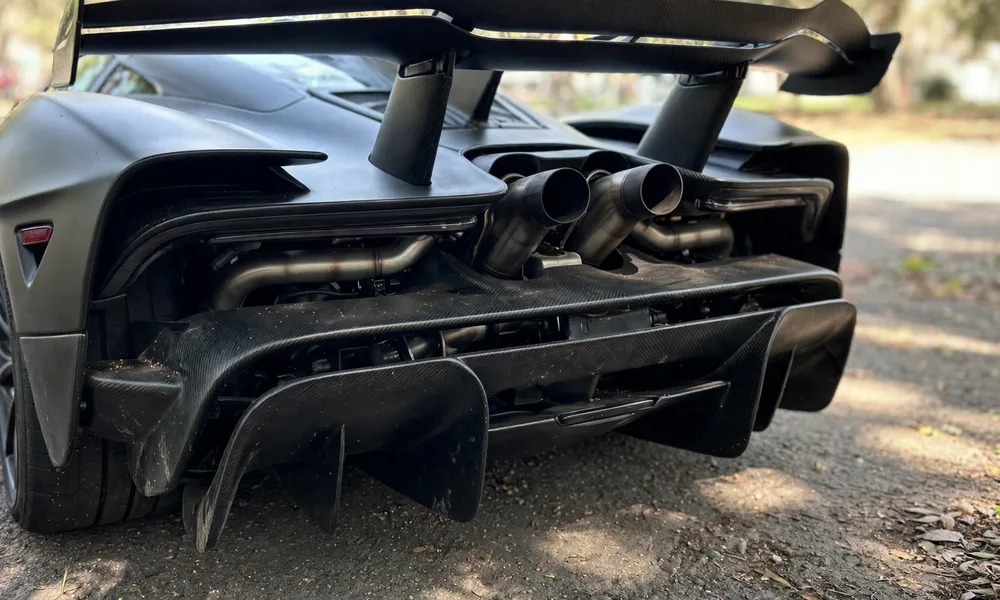
The most visible element is the rear wing, and on a modern hypercar it is a machine in its own right. At low speed it hides away, flush with the bodywork, keeping drag low and the car looking clean. As speed rises it deploys, tilting to an angle that balances downforce against drag. Under hard braking it snaps to its steepest angle and acts as an air brake, using the air itself to slow the car and pressing the rear tyres into the road at the same time. The Bugatti Tourbillon uses its wing exactly this way, keeping it retracted for top-speed running and deploying it for downforce and aerodynamic braking. The numbers behind wing design are covered in the hypercar spoiler specs, where chord, angle and profile decide how much air a wing can bend.
Step 4: The front end joins in
A rear wing alone would unbalance the car, pushing the back down while the front goes light, so the front end moves too. Active flaps in the front bumper open and close to feed air under the car or spill it away. A movable front wing, like the one on the McLaren W1, swings in an arc on two electric motors, sending air through an F1-style T-tray and keel beneath the car. The W1’s front wing is so effective that McLaren says its performance gain is comparable to the rear wing on most supercars.

Step 5: Ground effect and the long tail
The most powerful downforce on a modern hypercar does not come from wings at all. It comes from the floor. By shaping the underbody into venturi tunnels and a rising diffuser, engineers accelerate the air beneath the car, creating low pressure that sucks the car towards the road. The McLaren W1 takes this further than any road car before it, with a raised floor, no front subframe and an extreme diffuser that curves upward from just behind the cabin. Its signature trick is the Active Long Tail: in Race mode the rear bodywork extends 300 millimetres rearward and sweeps through an arc to become an extension of the underbody. Combined with the ground effect floor, it is what lifts the W1 to 1,000 kilograms of downforce, five times its road-mode figure.
Step 6: Four flaps and a tilting wing
The Koenigsegg Jesko Attack pairs a dynamic twin-profile rear wing with independently controlled front underbody flaps, chasing the highest downforce figure of any car here. The Ferrari F80 splits the job between an adaptive rear wing that changes height and angle and an active flap at the front.
Specs
| Specification | Typical value |
|---|---|
| McLaren W1 downforce (Race) | Up to about 1,000 kg |
| Ferrari F80 downforce | About 1,050 kg at 250 km/h |
| Koenigsegg Jesko Attack downforce | Up to about 1,400 kg |
| W1 Active Long Tail extension | About 300 mm |
| Control loop | Sensors, software, actuators |
| Key moving parts | Rear wing, front flaps, ride height |
| Air brake | Wing at steepest angle |
| Main downforce source | Ground-effect floor |
What Does It Cost?
Active aerodynamics is one of the most expensive systems on a hypercar, and its cost is measured in engineering hours as much as in parts. McLaren spent at least 350 hours in the wind tunnel testing 5,000 points on the W1 and ran more than 3,000 computational fluid dynamics simulations. The hardware itself, the actuators, sensors, hydraulic lines and carbon fibre moving panels, adds weight and complexity. The braking systems that work alongside it are covered in the best hypercar braking systems, where carbon-ceramic discs and air brakes share the job of stopping a car from speeds a family hatchback never reaches.
A Rare Fact
Here is the detail most people miss: the wing on a hypercar can push the car down harder than the car weighs. A Koenigsegg Jesko Attack making 1,400 kilograms of downforce is being pressed into the road with more force than gravity alone provides, which means that, in theory, it could drive upside down on the ceiling of a tunnel at speed and not fall off. No one has tried it, and no one will. But the number is real, and it explains why modern hypercars corner the way they do. The air is no longer something the car pushes through. It is something the car uses, reshaped moment by moment, to hold itself to the road.


