The test driver came back from the straight with his gloves still on and a grin he could not hide. The car had been quick all morning, but on the last run something had changed: through the fast right-hander at the end of the straight, the rear of the car felt planted, as if an invisible hand were pressing it into the tarmac. He had not driven any harder. The only difference was a wing.
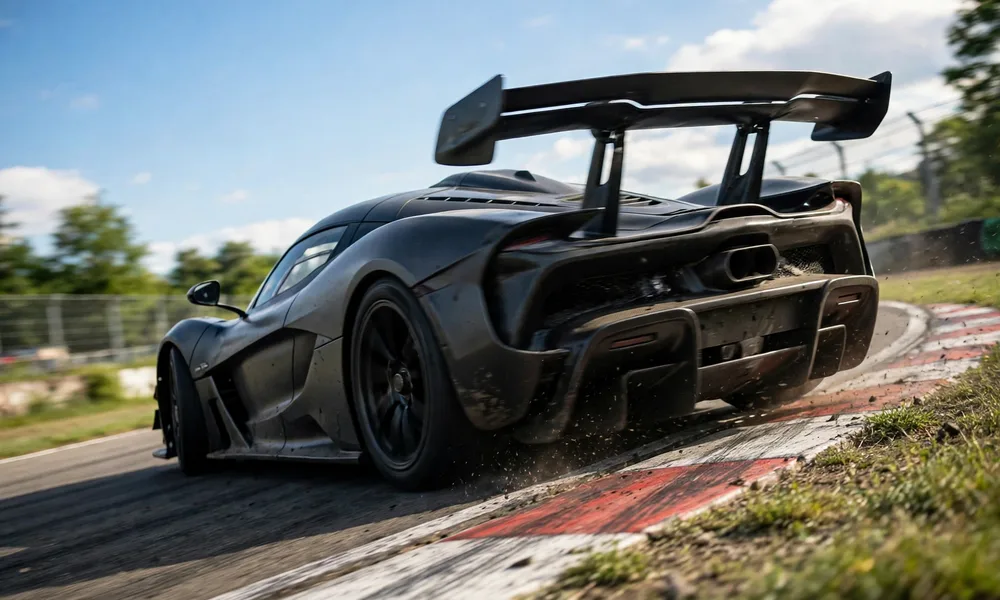
That wing was a hypercar spoiler, and it is one of the most misunderstood parts on any fast car. To most people it looks like decoration, a piece of theatre bolted to the tail. In reality it is a carefully shaped piece of aerodynamics, and the numbers on its spec sheet decide whether a car that can reach 350 kilometres an hour stays glued to the road or starts to feel light and nervous exactly when the driver needs confidence most.
This guide reads a hypercar spoiler spec sheet in plain English: what each number means, how the wing actually works, and how to tell a genuine piece of engineering from a styling exercise.
How It Works
Step 1: Air meets the wing
Everything starts with air. At 300 kilometres an hour, a hypercar is pushing through roughly 83 metres of air every second, and the spoiler’s job is to persuade some of that air to push the car down instead of just flowing past. The wing is shaped like an upside-down aeroplane wing: air travels faster over its lower surface than its upper surface, and the pressure difference pulls the car towards the ground. That downward push is called downforce, and it is the single most important number on the spec sheet. The engine that gets the car to those speeds in the first place is a masterpiece of its own, as the Bugatti W16 engine guide explains.
Step 2: The angle of attack
A wing only works if it meets the air at the right angle. Tilt it too flat and it makes almost no downforce; tilt it too steeply and the airflow separates from the surface, the wing stalls, and drag soars while downforce collapses. Hypercar spoilers typically run between about 5 and 20 degrees of angle of attack, and many can change that angle on the move.
Step 3: Active aero takes over
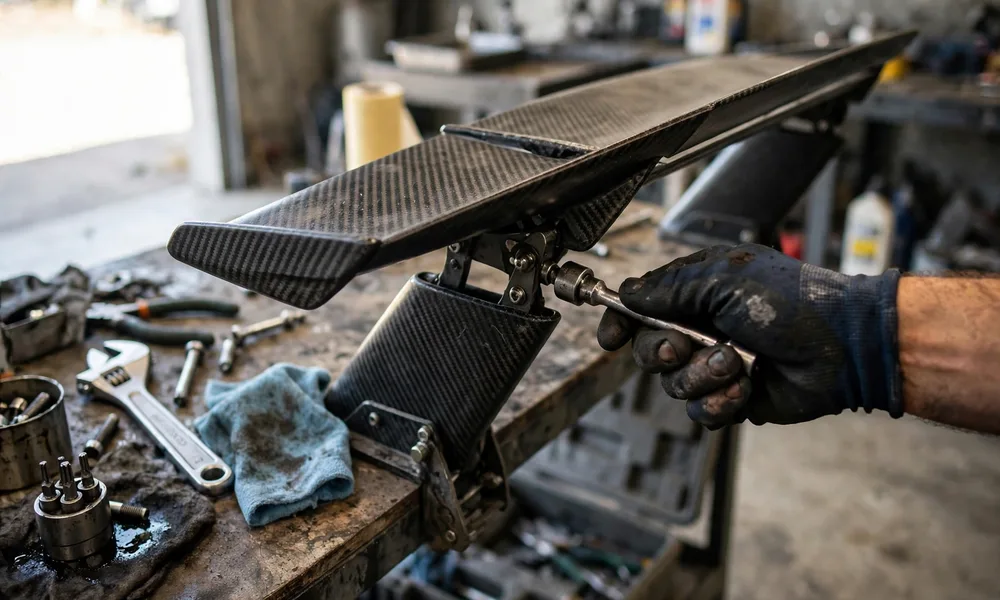
Most modern hypercars do not leave the wing fixed. Hydraulic actuators or electric motors adjust the wing several times a second, responding to speed, braking, steering angle and even the car’s pitch under acceleration. Under hard braking the wing can swing up steeply to act as an air brake, adding drag exactly when the driver wants to slow down. Through a fast corner it settles at an angle tuned for grip. The wing itself is usually built from the same material as the car’s structure, and the carbon fibre weave guide explains why that material is chosen.
Step 4: Endplates keep the air honest
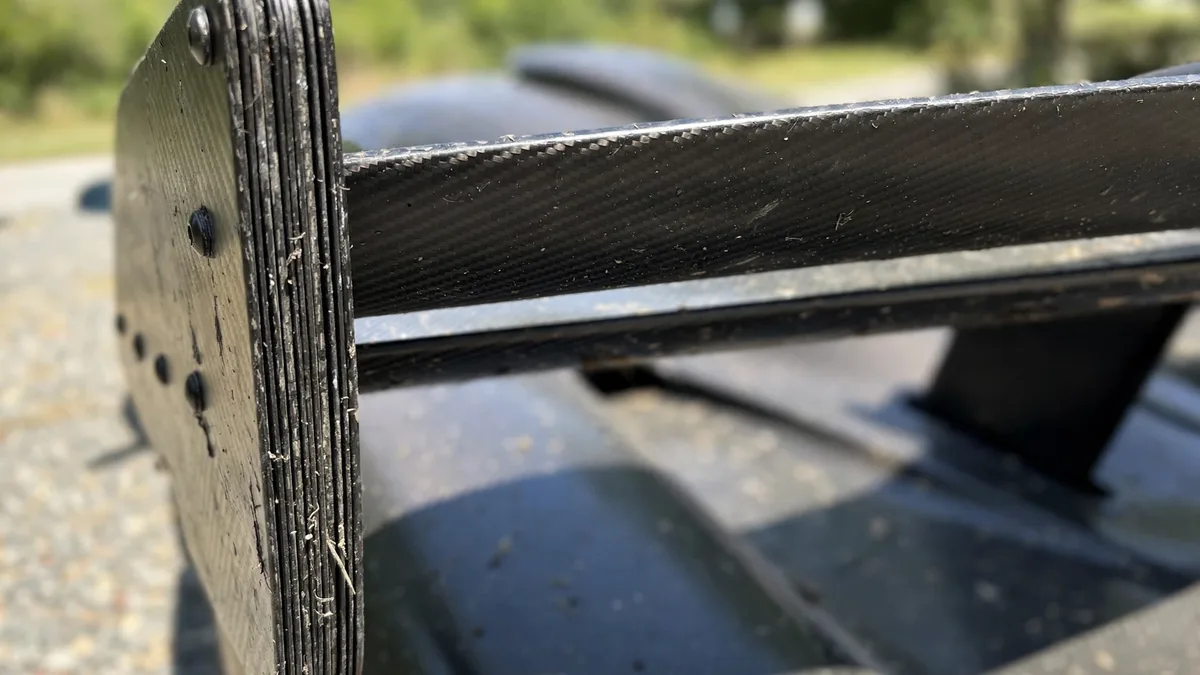
At the tips of the wing sit the endplates, flat vertical panels that look like fins. Their job is to stop high-pressure air from spilling around the ends of the wing and cancelling out the low pressure underneath. Without endplates, a wing loses a large share of its downforce to these tip vortices, the same swirling trails you see behind an aeroplane. On some cars the endplates also house the brake lights.
Step 5: The drag penalty
Downforce is never free. Every newton of downward push comes with drag, the resistance that holds the car back and burns fuel. A hypercar spoiler in its highest-downforce setting can add hundreds of kilograms of drag-equivalent resistance, which is why the wing flattens on straights. Engineers measure the trade-off with a ratio: downforce-to-drag. A well-designed wing might make three kilograms of downforce for every kilogram of drag; a badly designed one might manage barely one to one.
Step 6: The DRS moment
Many hypercars borrow a trick from Formula 1: a drag reduction system that flattens the wing at the touch of a button or automatically above a set speed. With the wing flattened, drag falls sharply. The moment the driver brakes, the wing snaps back to its high-downforce angle. The whole point of a hypercar is that it is a road car shaped by racing ideas, and the wing is where that heritage is most visible — a philosophy the Aston Martin Valkyrie takes further than almost any other road car.
Hypercar Spoiler Specs
| Specification | Typical range |
|---|---|
| Maximum downforce | About 500 to 1,000 kilograms at top speed on a modern hypercar |
| Downforce at 200 km/h | About 150 to 400 kilograms, depending on wing size and angle |
| Angle of attack range | About 0 to 25 degrees, adjustable on active wings |
| Wingspan | About 1.4 to 1.9 metres, close to the width of the car |
| Chord (wing depth) | About 250 to 400 millimetres from leading edge to trailing edge |
| Material | Carbon fibre composite, usually with a foam or honeycomb core |
| Weight | About 5 to 15 kilograms for the wing itself; actuators add more |
| Drag coefficient contribution | About 0.05 to 0.15 added to the car’s overall drag coefficient |
| Adjustment speed | About 0.2 to 0.5 seconds from flat to full downforce on active systems |
| Operating temperature | About -20 to 80 degrees Celsius, with heat from the exhaust and brakes nearby |
What Does a Hypercar Spoiler Cost?
A hypercar spoiler is never sold as a cheap bolt-on part. A genuine carbon fibre rear wing for a hypercar is estimated at roughly $15,000 to $60,000 as a replacement part, depending on the car and whether the active aero actuators are included. The actuators and hydraulic system behind an active wing are estimated at roughly $5,000 to $20,000 on their own. Aftermarket wings for ordinary sports cars are far cheaper, estimated at roughly $2,000 to $8,000, but they are designed for looks as much as function and rarely come with the wind-tunnel testing that makes a real hypercar wing work. Fitting and calibration, including a session to set the angle correctly, is estimated at roughly $500 to $2,000. All prices are estimates only and vary by brand, model, and supplier.
A Rare Fact
The first road-car spoilers were not wings at all. In the late 1960s, engineers discovered that a simple flat lip on the tail of a car could reduce lift, and the earliest spoilers were little more than a raised edge on the boot lid. The first true inverted wing on a road car appeared on the 1969 Dodge Charger Daytona, a car built for NASCAR, whose enormous wing stood above the roofline — and it worked so well that NASCAR changed the rules to ban it.
A hypercar spoiler is not decoration. It is a wing that flies upside down, pressing the car into the road at speeds where ordinary cars start to float. Learn to read the numbers — downforce, angle, and the downforce-to-drag ratio — and the spec sheet stops being a list of big claims and starts being a map of how the car will behave when it matters most.