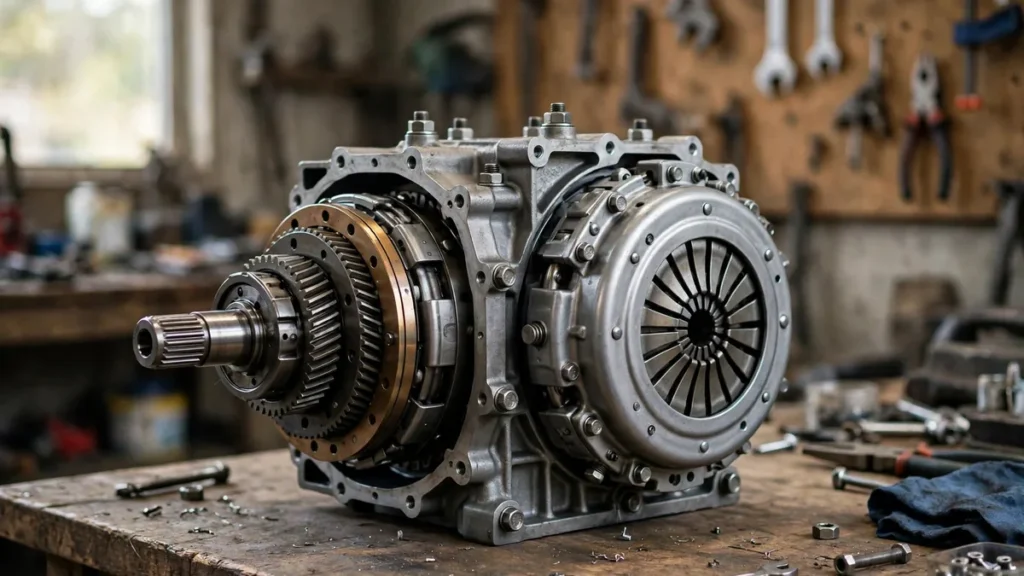
The pit lane is empty at first light. A hypercar sits with its rear bodywork raised, the engine still ticking as it cools. Behind the engine sits a gearbox no bigger than a suitcase, bolted directly to the crankshaft.
To a driver, a gearbox is just two paddles and a feeling. Pull the right paddle and the car lunges forward. Yet the numbers behind that feeling are extreme: gears cut from steel so hard it barely yields to a file, clutches bathed in oil, and a unit that weighs less than the driver.
Two hypercars can both claim a seven-speed dual-clutch gearbox, yet feel completely different on the road. Gear ratios decide how hard the car pulls at every speed. Shift time decides whether a gear change interrupts the acceleration or disappears into it. Here is what each of those numbers really means.

Hypercar Gearbox Specs Explained
1. Number of gears and gear ratios
Most modern hypercars use seven or eight forward gears, and the count alone tells you very little. What matters is the ratio of each gear: the relationship between engine speed and wheel speed. A short first gear, near 3.5 to 1, multiplies torque hard so the car launches violently from a standstill. A tall top gear, near 0.6 to 1, lets the engine loaf at high road speed. Engineers space the ratios so the engine stays in its strongest rev range after every shift. The spread between first and top gear, often around five or six to one, is the real measure of how versatile the box is.
2. Shift time
Shift time is the headline number every manufacturer quotes, and it is measured in milliseconds. A modern dual-clutch hypercar gearbox changes gear in roughly 50 to 100 milliseconds, which is faster than a human can blink. The trick is that the next gear is already engaged before the shift begins. One clutch handles the odd gears and the other handles the even gears, so the gearbox simply swaps which clutch carries the power. The full story is told in how a hypercar gearbox works, where the two clutches and their hydraulic brains take centre stage.
3. Torque capacity
Torque capacity is the maximum twisting force the gearbox can handle without breaking, and in a hypercar it is enormous: commonly 1,000 to 1,500 newton metres. Torque, not power, is what breaks gearboxes. Every gear tooth, shaft, and clutch plate must survive that force, repeated thousands of times. Engineers build in a safety margin, rating the box above the engine’s peak output. If the engine is ever tuned for more power, torque capacity is the first limit the tuner hits.
4. Weight and packaging
A hypercar gearbox typically weighs between 70 and 110 kilograms, which sounds heavy until you remember what it does. Saving weight here is doubly valuable, because the gearbox sits low and near the middle of the car, so every kilogram removed improves balance as well as acceleration. The casing is usually cast from aluminium or magnesium alloy, thin-walled and ribbed for stiffness rather than thick and heavy. Inside, hollow shafts and compact gear clusters pack seven or eight ratios into a case barely longer than a forearm. The gearbox must also carry the differential and the reverse gear, while leaving room for exhaust pipes and cooling ducts.

5. Clutch type and cooling
Almost every modern hypercar uses a wet dual-clutch system, where two multi-plate clutch packs run submerged in oil. The oil does two jobs at once: it cools the clutches and it lets them slip smoothly, so a launch from standstill is violent but controlled. A launch control start is the hardest thing a clutch ever does, because the plates slip against each other at full engine torque while the car is barely moving. The gearbox oil cooler, often fed by its own duct in the bodywork, carries that heat away, and the oil itself must stay stable above 120 degrees Celsius. The twin-clutch layout is the same idea behind the road-car system in how a dual-clutch gearbox works.
6. Final drive ratio and top speed
The final drive is the last reduction gear before the wheels, usually a single ratio between about 2.5 and 4.0 to 1, and it sets the character of the whole car. A short final drive makes every gear feel urgent, with savage acceleration and a lower top speed. A tall final drive stretches each gear out, favouring top speed over punch. The differential sits inside the final drive housing, splitting torque between the rear wheels and letting them turn at different speeds through corners. Many hypercars use an electronically controlled limited-slip differential, which can send more torque to the wheel with grip, and that single device does more for lap times than a small power increase ever could.
7. Control software and shift modes
The final specification is not made of metal at all. It is software. A hypercar gearbox is managed by a dedicated control unit that decides when to shift, how fast to shift, and how much torque to cut during the change, hundreds of times a second. In automatic mode it reads throttle position, road speed, and steering angle. In manual mode it obeys the paddles, but still protects itself: it will refuse a downshift that would over-rev the engine, and it will shift up automatically at the red line. The numbers on the sheet tell you what the gearbox can do, but the software decides what it actually does.
Hypercar Gearbox Specs
| Specification | Typical range |
|---|---|
| Number of forward gears | Seven or eight |
| Shift time at full throttle | About 50 to 100 milliseconds |
| Maximum torque capacity | About 1,000 to 1,500 newton metres |
| Gearbox weight | About 70 to 110 kilograms |
| First gear ratio | About 3.0 to 3.8 to 1 |
| Top gear ratio | About 0.55 to 0.70 to 1 |
| Final drive ratio | About 2.5 to 4.0 to 1 |
| Gearbox oil temperature in hard use | About 100 to 130 degrees Celsius |
What Does a Hypercar Gearbox Cost?
A replacement dual-clutch gearbox for a modern hypercar is estimated to cost roughly $25,000 to $60,000 for the unit alone, depending on the manufacturer and the torque rating. A full replacement with labour, oil, and recalibration is estimated at roughly $35,000 to $80,000. Prices are estimates only and vary widely by model and specification. That figure is part of why a hypercar gearbox is so expensive, from the exotic materials to the tiny production runs.
A Rare Fact
The fastest-shifting gearboxes in hypercars owe a debt to a 1980s racing ban. Porsche developed the first dual-clutch gearbox for its 956 and 962 Group C race cars, and it worked so well that the system was effectively outlawed in Formula 1 before it ever raced there.

A hypercar gearbox is easy to overlook, because it never makes a sound of its own and never appears in a photograph of the car. But it is the part that decides whether a thousand horsepower becomes speed or smoke. Read the ratios, the shift time, and the torque rating together, and the specification sheet stops being a list of numbers and starts being a description of how the car will feel.