Twelve cylinders, nearly a thousand horsepower, and an engine note that sounds less like machinery than like something alive. A hypercar V12 is the last of a breed — an engine built not because it is sensible, but because nothing else feels like it.
That is why the materials in a V12 are unlike those in any ordinary car engine. The pistons, the valves, the crankshaft and the block are each made from alloys chosen for one brutal job: to be light enough to move at impossible speed, strong enough not to tear apart, and cool enough not to melt in the fire they contain. This is the story of those materials, and of the engineering that keeps a V12 alive at full throttle.
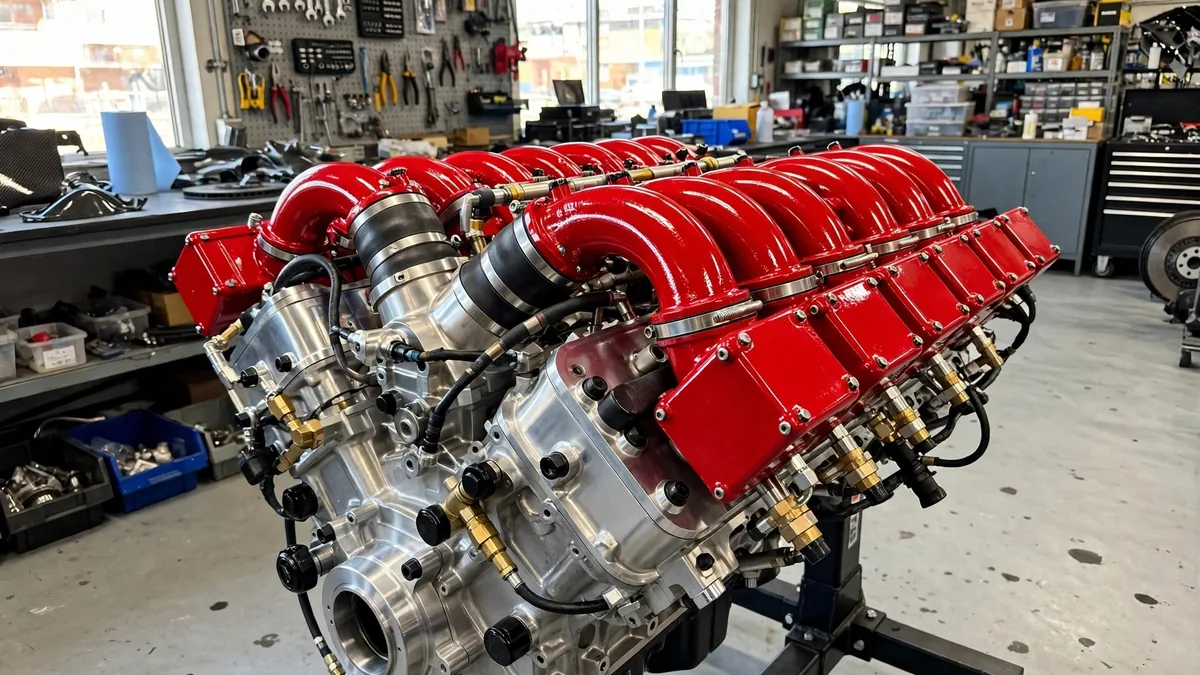
The Materials Behind the Hypercar V12 Engine
The headline materials are forged aluminium for the pistons and block, titanium for the connecting rods and valves, Inconel for the exhaust, and a forged steel crankshaft at the centre of it all. Around them sit the bearings, coated in layers thinner than a hair, the cylinder liners of plasma-sprayed steel, and the carbon fibre that shrouds the engine bay.
Step 1: Forging the pistons
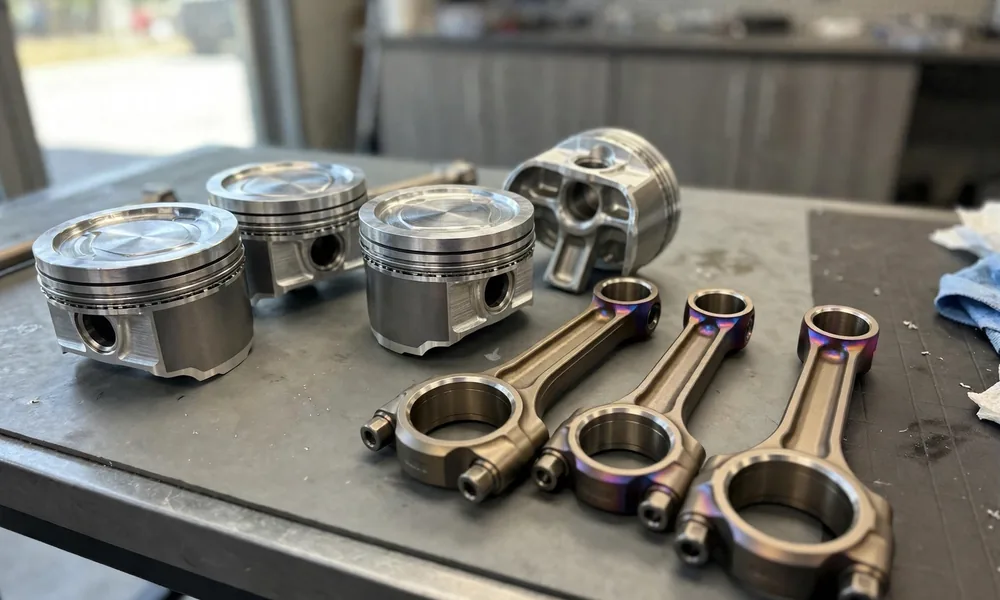
A V12 piston is a small masterpiece of aluminium. It starts as a billet of high-silicon aluminium alloy, forged under thousands of tonnes of pressure so its grain flows around the crown instead of being cut across it. The silicon in the alloy — around 12 percent — stops the piston expanding too much when it gets hot, so the gap between piston and cylinder stays tight. The crown is coated with a ceramic thermal barrier, a thin layer that reflects heat back into the combustion chamber instead of letting it soak into the metal. The hypercar V12 engine build begins with these pistons, weighed and matched so all twelve are within a gram of each other.
Step 2: Titanium rods and valves
The connecting rods link each piston to the crankshaft, and at 9,000 rpm they are the most stressed parts in the engine. A steel rod would be strong enough, but its weight would tear the bearings apart at that speed, so the rods are machined from titanium — specifically Ti-6Al-4V, an alloy of titanium, aluminium and vanadium that is nearly as strong as steel at half the weight. The valves are titanium too, with a stem thinner than a pencil, because a lighter valve can be opened and closed faster by the springs without floating.
Step 3: The crankshaft at the centre
The crankshaft is the spine of the engine, and it is forged from a single piece of high-strength steel, usually a nickel-chromium-molybdenum alloy. The crank spins in main bearings lined with a tri-metal sandwich: steel backing, a copper-lead layer, and a whisper of babbitt metal on top, soft enough to embed a speck of dirt rather than let it score the crank.
Step 4: The block and its liners
The engine block is cast from aluminium-silicon alloy, chosen because it is light and sheds heat quickly, then machined on five-axis mills that take hours per block. Inside each bore sits a liner — in many hypercars a plasma-sprayed coating of iron, sprayed molten onto the aluminium and honed to a mirror finish, rather than a separate sleeve. The coating is only a tenth of a millimetre thick, yet it must survive the piston rings sliding over it millions of times. Some makers use a hypereutectic alloy instead, where silicon crystals embedded in the aluminium form the wear surface, and the aluminium between them is etched away to leave the crystals standing proud.
Step 5: Inconel and the exhaust
The exhaust is where the V12’s materials get truly extreme. The gases leaving the cylinders are hotter than 900 degrees Celsius, and the exhaust manifold sits inches from the engine, glowing dull red at full throttle. Ordinary steel would soften and crack, so the manifold is made from Inconel, a nickel-chromium superalloy invented for jet engines that keeps its strength at temperatures where steel turns to putty. The same alloy thinking runs through the hypercar gearbox materials, where gears face similar punishment at a different speed.
Step 6: Cooling, lubrication and the oil itself
An engine making nearly a thousand horsepower throws off heat like a furnace, and the materials that manage it are as important as the ones that make the power. The cooling passages in the block are cast with cores of sand that are washed out after casting, leaving channels no drill could make. The oil is a synthetic ester-based fluid, engineered to stay slippery at temperatures where mineral oil would char, and it carries additives — zinc, phosphorus and molybdenum compounds — that lay down a protective film on metal surfaces. The head gasket is a sandwich of stainless steel layers with a polymer coating, sealing combustion pressure that would lift the head clean off if it escaped.
Step 7: Balancing and the final test
A V12 is naturally smooth — its twelve pistons cancel each other’s vibrations almost perfectly — but only if every part is balanced. The crankshaft is spun on a balancing machine and drilled in tiny increments until it runs true, and the whole rotating assembly is balanced as a unit. Then the engine is run on a dynamometer, first gently, then at full throttle, while engineers listen for knock, watch oil pressure, and measure power. The test is the last gate, and it is why the Bugatti W16 engine specifications read like a promise rather than a boast — every figure was proven on a dyno before the car ever moved.

Hypercar V12 Engine at a Glance
| Specification | Detail |
|---|---|
| Pistons | Forged high-silicon aluminium, ceramic-coated crown |
| Connecting rods | Titanium Ti-6Al-4V, diamond-like carbon coating |
| Valves | Titanium, lightweight for high revs |
| Crankshaft | Forged nickel-chromium-molybdenum steel, nitrided |
| Block | Cast aluminium-silicon alloy, sprayed iron liners |
| Exhaust | Inconel nickel superalloy, thin-wall tubing |
| Redline | Over 9,000 rpm |
What Does It Cost?
A hypercar V12 engine on its own typically costs around $100,000 to $250,000 to build (estimate), and a replacement engine for a flagship hypercar can exceed $300,000 (estimate). The car around it sells for $2 million to $4 million (estimate), and the engine is a large share of that — the titanium, the Inconel and the hundreds of hours of hand assembly are not cheap. The V12 is a luxury, and its materials are priced like one.
A Rare Fact
A V12 at full throttle fires a spark plug roughly 900 times every second — twelve cylinders, each firing once per two revolutions, at 9,000 revolutions a minute — and each spark must land within a fraction of a millisecond or the engine loses power. The ignition system is therefore a precision instrument in its own right, and the spark plugs are made with platinum or iridium tips, metals chosen because they survive the heat and erosion of thousands of sparks a minute.