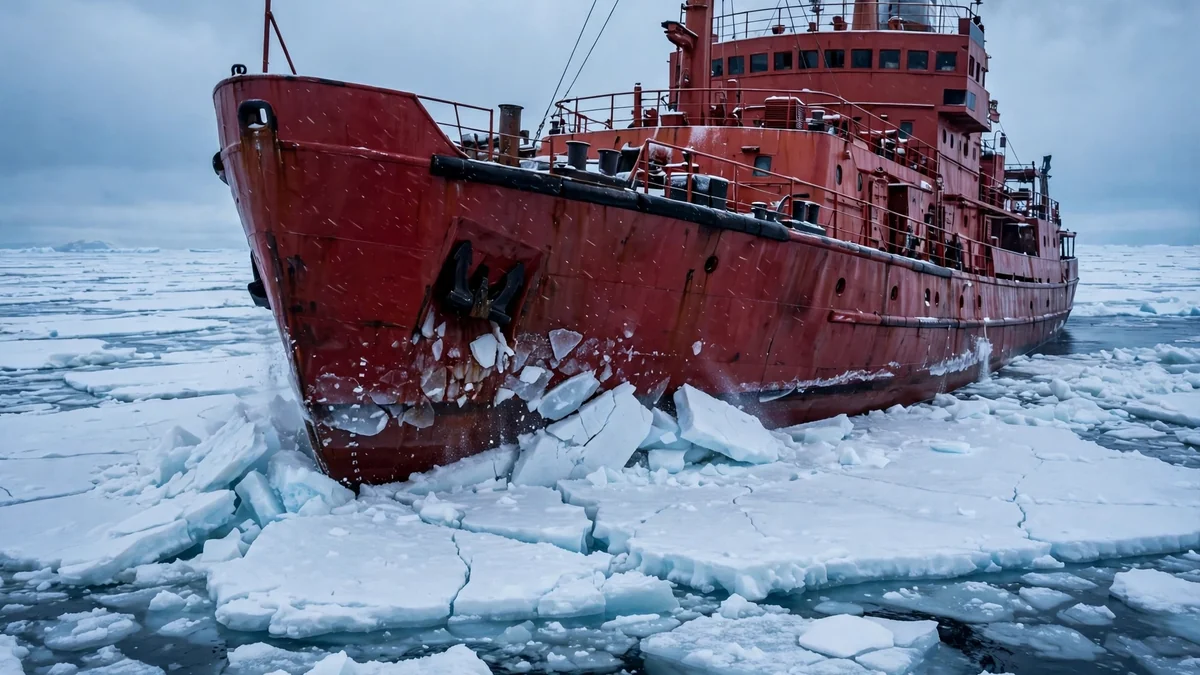
There is a sound no other ship makes: a hull riding up onto sea ice, the ice cracking beneath it, and the ship’s own weight breaking the sheet apart as it slides forward. An icebreaker does not cut ice like a knife. It climbs onto it and breaks it with gravity, again and again, for thousands of kilometres, in temperatures that turn steel brittle.
That is a brutal job for a hull. Every metre is an impact, a scrape and a grind against ice that is harder than it looks and often carries rocks frozen into it. The steel must be tough at minus 40 degrees, the bow must be shaped to ride up rather than smash, and the coating must survive being sanded by ice for months. A normal cargo ship sent into the same ice would be holed within days.
Here is what an icebreaker hull is made of, and why each material earned its place.
The Materials Behind It
1. High-strength low-temperature steel, the ice belt
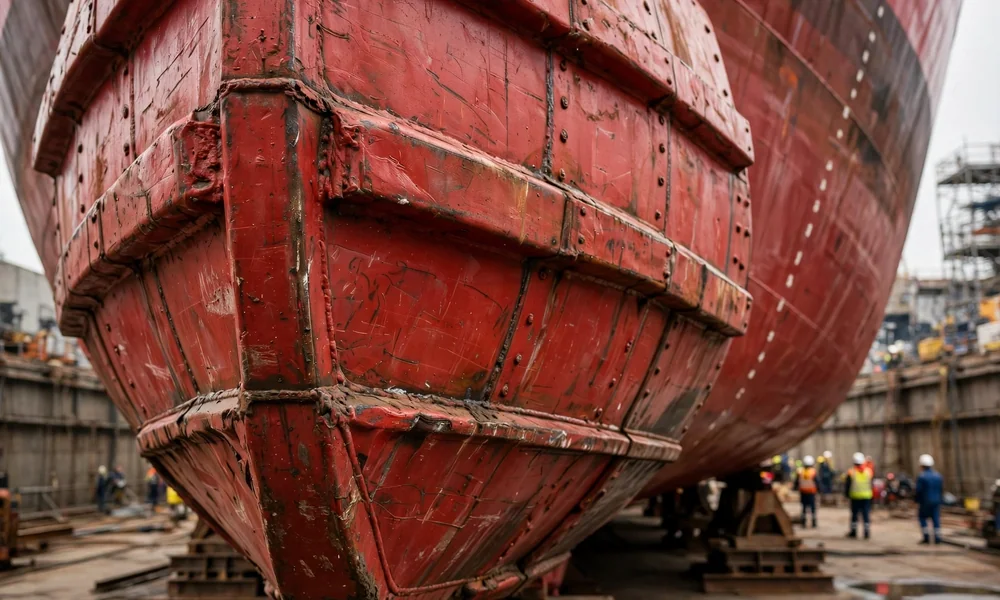
The most important steel on an icebreaker is the ice belt, the band of plating around the waterline where the hull meets the ice. It is high-strength steel, usually grades such as EH36 or EH40, certified for low temperatures. Ordinary ship steel becomes brittle in the cold, and a brittle plate hit by ice will crack rather than dent. Ice-class steel is Charpy-tested at minus 40 degrees Celsius, proving it can still absorb a blow without shattering. The ice belt plating is also thicker than on a normal ship, often 30 to 40 millimetres.
2. The spoon bow, the shape that breaks the ice
An icebreaker’s bow is not a knife edge. It is a rounded, spoon-shaped curve, angled so the ship rides up onto the ice instead of ramming it. The steel of the bow is the thickest on the ship, and behind it sits a dense forest of frames and stringers that carries the ice loads into the rest of the hull. The frames in the ice belt are spaced much closer together than on a normal ship, sometimes half the usual distance, because the ice pushes on a small area at a time. Ordinary hulls are built to a different logic entirely, as the guide to the ferry hull shows, where the loads are waves and cargo, not ice.
3. Stainless steel cladding and ice horns, the wear surfaces
Where the ice scrapes hardest, along the waterline and around the bow, some icebreakers carry stainless steel cladding or replaceable wear plates over the hull steel. Stainless resists the corrosion that comes from ice scraping the paint away and leaving bare steel in salt water, and it is slicker than painted steel. The rudder and the propeller are protected by ice horns, heavy steel structures that shield them from ice blocks churned up by the bow. Without them, a single block could bend a rudder stock or smash a propeller blade.
4. Inerta and epoxy coatings, the paint that ice cannot strip
The coating on an icebreaker hull is a specialist product, usually a hard epoxy or a glass-flake epoxy, applied far thicker than normal marine paint, sometimes over a millimetre in the ice belt. The coating has two jobs: keep salt water off the steel, and reduce friction so the hull slides over the ice instead of gripping it. Ice strips ordinary paint in weeks, so the ship is repainted in dry dock every few years. Some modern icebreakers use a low-friction coating that also saves fuel in open water.
5. Bronze and stainless propellers, the parts the ice hits last
The propeller is the most vulnerable part of an icebreaker, spinning in water full of broken ice. Icebreaker propellers are usually nickel-aluminium bronze, a tough alloy that resists corrosion and can absorb an ice strike without cracking. Many icebreakers also use ducted propellers, with a steel nozzle around the blades that shields them from ice and improves thrust at low speed. The propeller shaft is stainless steel.
6. Heeling tanks and the double hull, the systems around the steel
An icebreaker is more than its outer plate. Many carry heeling tanks, tanks of water pumped from side to side to rock the ship and break the ice gripping its sides. Modern icebreakers are double-hulled, with an inner skin behind the outer plate. The engine that drives all of this works in the same brutal cold, and the cruise ship engine guide shows how marine engines are built for a different, warmer kind of hard life.
How an Icebreaker Hull Is Built
- Steel selection. Low-temperature high-strength steel is ordered for the ice belt, with Charpy impact tests at minus 40 degrees proving its toughness.
- Plate cutting and forming. The thick plates are cut and rolled to the spoon-bow shape.
- Close framing. Frames and stringers are welded in at half the normal spacing in the ice belt.
- Block assembly. The hull is built in blocks, the bow section first, then welded together in dry dock.
- Coating. The ice belt is blasted and coated with thick epoxy, layer by layer.
- Ice trials. The finished ship sails to real ice, where it is driven onto measured ice sheets to prove it can break its design thickness.
Icebreaker Hull Materials
| Material | Where it is used | Why it is chosen |
|---|---|---|
| EH36 / EH40 steel | Ice belt plating | Strong and tough at minus 40 degrees |
| High-strength steel frames | Bow structure | Carries ice loads into the hull |
| Stainless cladding | Waterline wear areas | Resists corrosion, slides over ice |
| Glass-flake epoxy | Hull coating | Thick, hard, low friction, keeps water out |
| Nickel-aluminium bronze | Propellers | Tough, corrosion-resistant, survives ice strikes |
| Stainless steel shaft | Propeller shaft | Strong, resists salt water and ice damage |
What Does an Icebreaker Hull Cost?
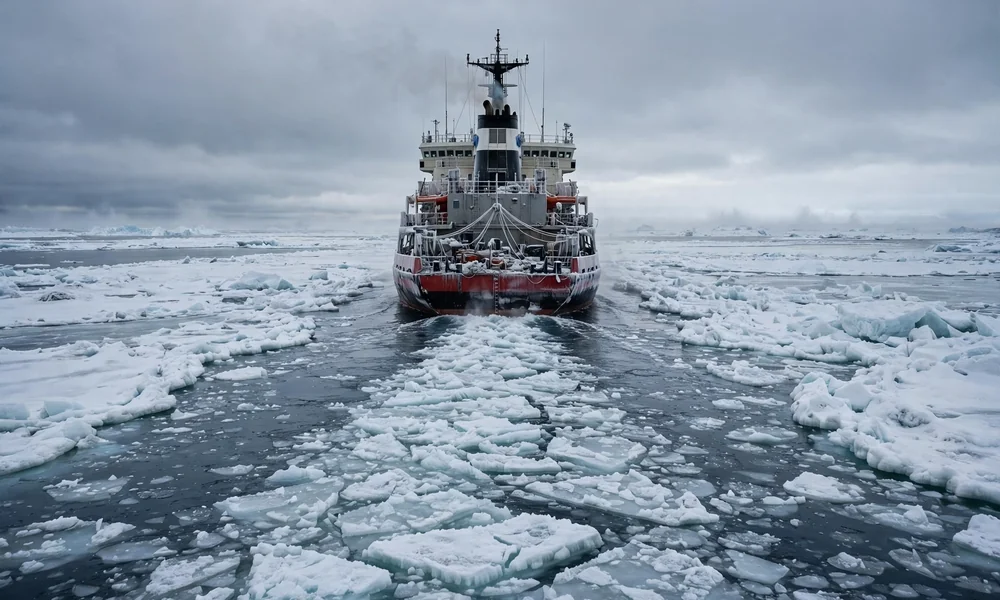
An icebreaker is one of the most expensive ships to build per tonne, and the hull is the reason. A medium polar icebreaker is estimated at roughly $300 million to $500 million to build, with the ice-strengthened steel, the close framing and the specialist coating making up a large share of the hull cost. The steel alone is estimated at roughly $20 million to $40 million of that, because the ice belt uses far more steel, and far thicker steel, than a normal ship of the same size. A dry-dock recoating is estimated at roughly $1 million to $3 million. The aircraft carrier flight deck is one of the few structures built to a comparable standard of punishment.
A Rare Fact
The most powerful icebreakers in the world are nuclear-powered, and they can break ice more than two metres thick without refuelling for years. The largest of them, Russia’s Arktika class, is about 173 metres long and displaces over 33,000 tonnes, and it is designed to keep the Northern Sea Route open through the winter. Its hull follows the same principles as any icebreaker, just bigger: thicker steel, closer framing, and a bow that rides up onto the ice.
An icebreaker hull is a study in what happens when a ship is asked to fight its environment instead of floating in it. The steel is tougher, the frames are closer, the coating is thicker, and the propeller is built to be hit. The elegance is in the result: a ship that can go where no other ship can, through ice that would stop anything else, because every plate and every frame was chosen for a single purpose, to break the ice and come home.