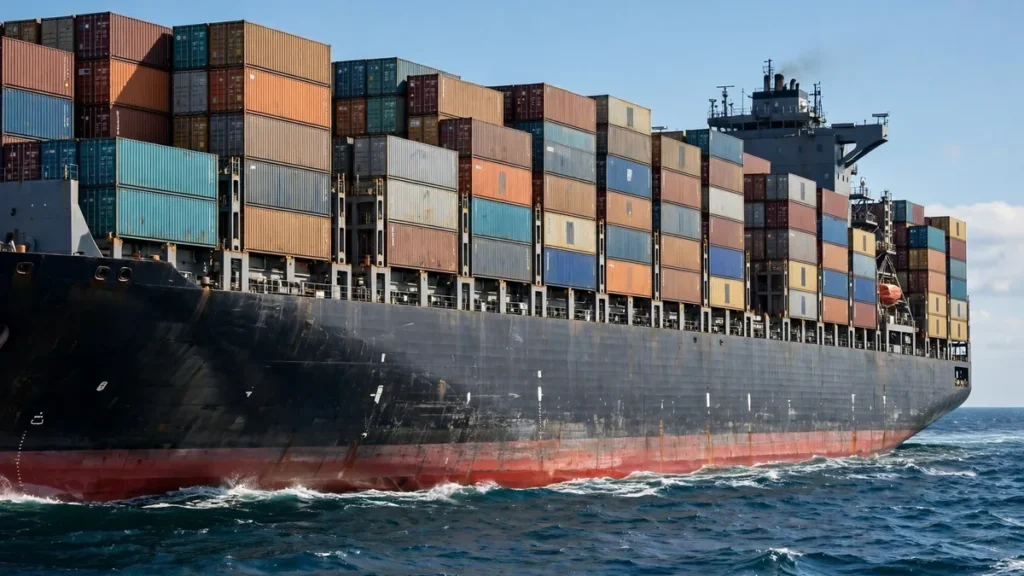
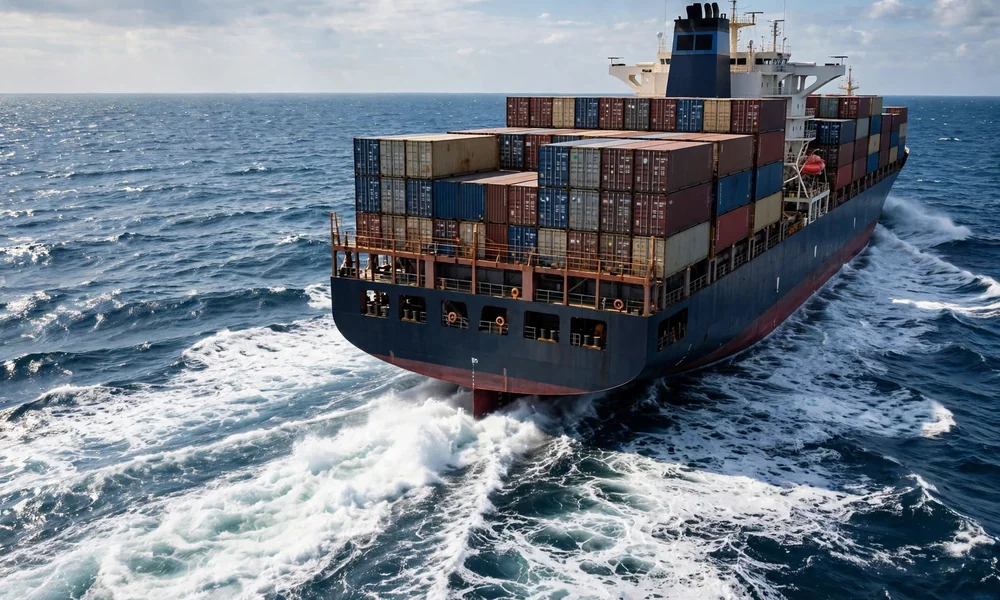
The container ship is 400 metres long, carries 24,000 boxes, and weighs more than 200,000 tonnes fully loaded. The pilot gives a small order — five degrees to starboard — and below the waterline, at the very stern, a steel plate the size of a house turns a few degrees. The whole ship follows it.
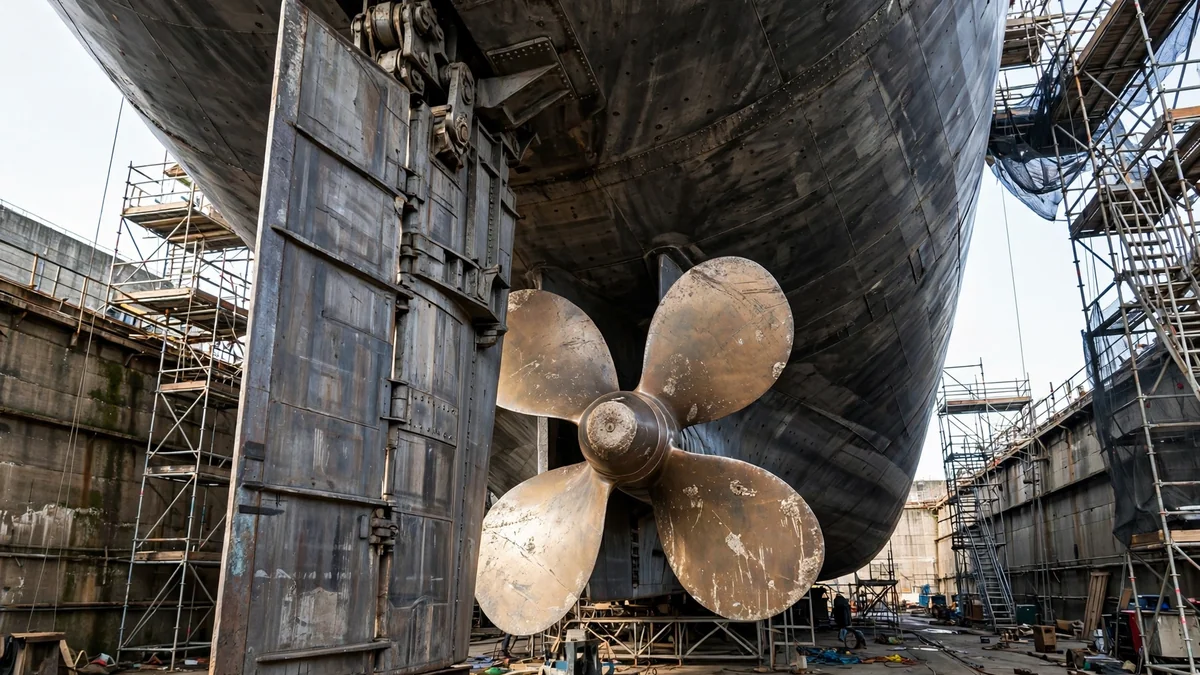
That plate is the rudder, the oldest steering device on any ship. It has no engine and no glamour, but without it a ship is a floating building with no way to choose where it goes. The rudder turns the water flowing past the hull into a sideways force, and its spec sheet is where that force is measured.
This guide explains the numbers on a ship rudder spec sheet in plain English: what rudder area means, why shape matters as much as size, how the steering gear moves tonnes of steel with fingertip control, and which figures decide whether a ship can turn in a tight harbour or hold a straight line in a storm.
The Numbers That Matter on a Ship Rudder
1. Rudder area: the size of the turning force
Rudder area is measured in square metres — the surface of the blade that meets the water, typically 20 to 100 square metres on a large merchant ship, more than 150 on the biggest. The area is usually 1.5 to 2 percent of the ship’s lateral underwater area, a ratio naval architects have used for a century. A bigger rudder gives a stronger turning force but also adds drag, so size is a compromise between manoeuvrability and fuel consumption.
2. Rudder type: spade, semi-balanced, or flap
Rudder type describes how the blade is hung and shaped: spade, semi-balanced, or flap. A spade rudder hangs only from its stock, with no skeg beneath it — efficient, but hard on its bearings. A semi-balanced rudder has part of its area ahead of the stock, so water pressure partly balances the turning effort. A flap rudder adds a hinged trailing edge that swings further than the main blade, giving a much stronger turning force at low speed — the reason harbour tugs and ferries can spin almost in place.
3. Steering gear torque: the muscle behind the blade
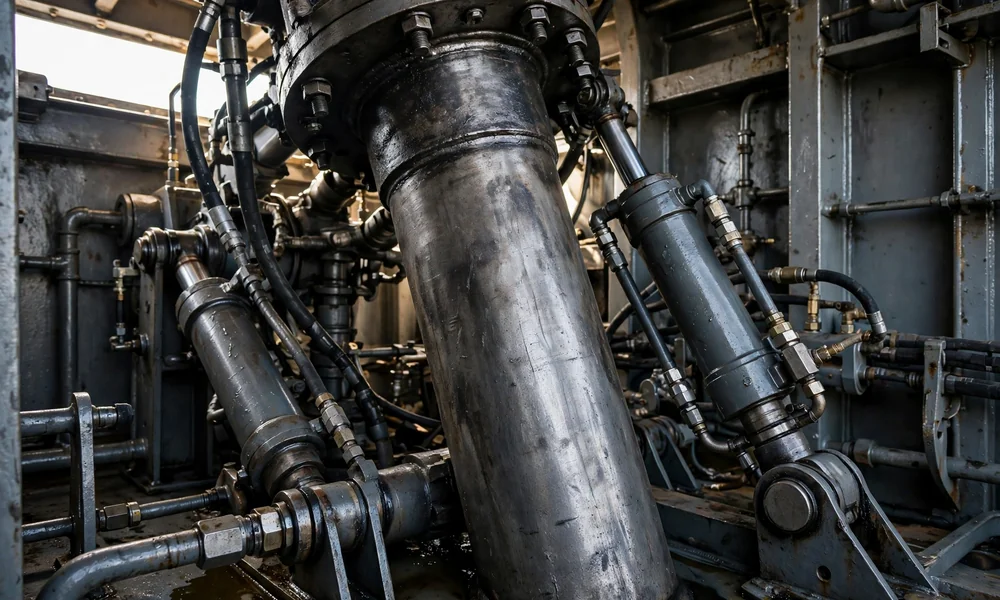
Steering gear torque is measured in kilonewton-metres: the twisting force the steering gear must deliver to the rudder stock to hold the blade against the water. On a large ship it runs to several thousand kNm, largest at speed with the rudder hard over. The steering gear is usually hydraulic, with two or four rams pushing on a tiller arm, and it is built with redundancy — one failed pump must not leave the ship without steering. The torque figure sizes the rams, the pumps, and the emergency system.
4. Turning speed: hard over in seconds
Turning speed is the time to swing the rudder from 35 degrees on one side to 30 degrees on the other, and international rules require no more than 28 seconds. A large ship manages 20 to 28 seconds; smaller ships are faster. The time matters because a ship that cannot answer the helm quickly cannot dodge, and in a narrow channel a few seconds can decide between a safe passage and a grounding. The sheet quotes the time alongside the number of steering pumps, because more pumps means a faster answer.
5. Rudder stock and bearings: the axle that carries everything
The rudder stock is the vertical steel shaft that carries the blade and transmits the steering torque, and on a large ship it can be more than a metre in diameter. It runs through bearings in the hull; the sheet quotes its diameter, bearing loads, and material — usually forged steel. The stock is the weak point in a grounding: if the ship touches bottom stern-first, it takes the blow, and it is designed to bend rather than snap. The propeller ahead of it has its own story in the ship propeller specs guide, the steadying fins in the ship stabilizer specs guide, and the hull in the ferry hull specs guide.
Ship Rudder Specs
| Specification | Typical range |
|---|---|
| Rudder area | 20 to 100 m², 150+ m² on the largest ships |
| Maximum rudder angle | 35° each side, up to 45° on some ships |
| Hard-over to hard-over time | 20 to 28 seconds |
| Steering gear torque | Several hundred to several thousand kNm |
| Rudder stock diameter | 0.5 to 1+ m on large ships |
| Rudder type | Spade, semi-balanced, or flap |
How a Ship Rudder Works
Turning a ship looks effortless from the bridge, but it is a chain of events from the pilot’s hand to the water at the stern.
Step 1: The order is given on the bridge. The pilot or captain moves the helm, and a signal travels to the steering gear room at the stern, a journey of hundreds of metres.
Step 2: Hydraulic pumps drive the rams. Electric motors drive hydraulic pumps, which push oil into cylinders. The rams pull on a tiller arm attached to the rudder stock, and the stock turns.
Step 3: The blade turns into the flow. The blade swings to its ordered angle, typically up to 35 degrees, and meets the water flowing past the hull — a flow made stronger by the propeller directly ahead of it.
Step 4: The water pushes back. The angled blade deflects the water to one side, and the water pushes the blade, and therefore the stern, to the other. That sideways push is the turning force.
Step 5: The ship pivots around her centre. The force at the stern rotates the ship around a point near her middle, and the bow swings into the turn. The faster the ship, the stronger the force and the tighter the turn.
Step 6: The rudder returns to centre. As the ship reaches her new course, the helm is brought back, the blade returns to the centreline, and the ship holds course with small corrections of a degree or two.
What Does a Ship Rudder Cost?
A ship rudder is estimated at roughly $100,000 to $500,000 for a large merchant ship, and $500,000 to $2 million or more for a very large container ship or tanker, including the steering gear. The blade is the smaller share; the steering gear, stock, bearings, and dry-dock installation cost far more. An emergency replacement costs several times more, because the ship is out of service. All prices are estimates only.
A Rare Fact
The rudder was not always at the stern. For thousands of years, ships were steered with an oar hung over one side near the stern — the reason the right-hand side is still called starboard, from the Old Norse for steerboard side. The hinged rudder on the centreline only appeared in northern Europe around the 12th century, and it was so much better that it spread across world shipping within a few hundred years. The biggest sailing ships of the 19th century had rudders so heavy they needed a steam engine to move them. The modern rudder is a medieval carpenter’s hinge, scaled up to the size of a house.
The spec sheet is the honest version of the ship’s handling. Rudder area tells you how hard she can turn, the type tells you how she behaves at low speed, and the steering gear figures tell you how fast she answers. A ship’s rudder is the simplest machine on board, and its numbers decide whether 200,000 tonnes go where the pilot wants.