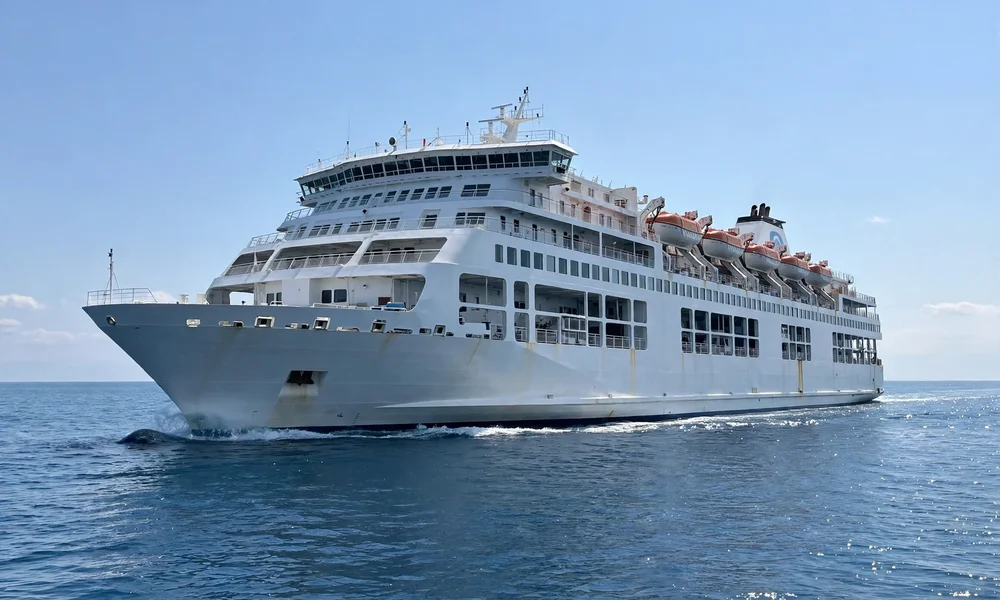
At six in the morning, a ferry leaves the harbour with a thousand passengers and two hundred cars, and nobody aboard thinks about the steel box keeping them afloat. Yet that box — the hull — is one of the largest moving structures most people will ever stand inside, a welded steel shell the length of two football pitches, carrying its load through storms, debris and forty years of salt water.
A ferry hull is not a yacht hull scaled up. It has vehicle decks with no pillars, doors at both ends big enough for a lorry, and a flat bottom for shallow island ports. Building one is heavy industry at its most dramatic: plate the size of a house, welding arcs that burn for months, and a launch that slides a hundred thousand tonnes into the sea. Here is how it is made.

How It’s Made
Step 1: Designing the hull and its decks
The design starts with the route the ferry will serve: the distance, the sea conditions, the vehicles it must carry, and the depth of its ports. Naval architects draw a hull with a wide, flat bottom for stability and shallow draught, a blunt bow with a visor door that opens like a garage door, and a stern door to match, so vehicles drive straight through. Inside, the vehicle decks are laid out with lanes for lorries and turning circles for cars, while the passenger decks sit above. The designers run the hull shape through simulations and towing-tank models, balancing speed against fuel consumption, because a hull one percent more efficient can save millions of litres of fuel over the ship’s life.
Step 2: Cutting and forming the steel plate
A modern ferry hull is built from thousands of steel plates, most 10 to 25 millimetres thick, cut by computer-controlled plasma or laser machines from sheets the size of a small room. Curved plates — for the bow, the stern and the bilge — are pressed or rolled into shape on giant machines that bend steel like cardboard. Each plate is marked with a code telling the yard where it belongs, and primed before it is moved to the building dock, because bare steel starts rusting within hours in a salty shipyard. The hull of a container ship is cut the same way, but a ferry’s plates must also leave room for its vast open vehicle decks, which change the whole structure.
Step 3: Assembling the blocks
Ferries are not built plate by plate in one place. They are built as blocks — huge sections, some weighing 500 tonnes — assembled under cover in a fabrication hall. Welders join the plates into panels, then into blocks complete with frames, stiffeners, pipes and cable trays already fitted. Working on a block in a hall is far easier than inside a finished hull: the welders can stand, the lighting is good, and the welding can be checked properly. Each block is inspected with ultrasound and X-ray, because a hull weld that fails at sea is a disaster nobody wants to imagine. The blocks are then painted inside and moved to the dry dock by giant transporters.
Step 4: Joining the blocks in the dry dock
In the dry dock, cranes lift the blocks into place one by one, like a giant jigsaw. The yard’s fitters align them with lasers to within a few millimetres across a hundred metres of hull, then weld the joints that tie the ship together. This is the slowest phase of the build: the hull must be perfectly fair, or the ferry will waste fuel pushing water aside for its whole life. Once the hull is joined, the superstructure is lifted on in a few enormous blocks, and the visor and stern doors are fitted and tested. The dry dock itself is part of the production line, a concrete basin that will be flooded at the end to float the finished ship out.
Step 5: Fitting out the vehicle and passenger decks
With the steel shell complete, the ferry becomes a building site. Vehicle decks are coated with hard-wearing epoxy and fitted with lane markings, lashing points and fire detection; they must be strong enough for a loaded lorry and smooth enough for cars at walking pace. Above, the passenger spaces are fitted out like a small hotel: lounges, restaurants, cabins and a bridge with a full view over the bow. The machinery goes in too — engines, generators, bow thrusters, stabilisers and steering gear — lowered through openings in the deck by crane. Miles of cable and pipe are pulled through the hull, and every system is tested as installed, because finding a fault after the decks are sealed is a job nobody wants.
Step 6: Coating, launching and sea trials
Before launch, the hull is coated below the waterline with antifouling paint, applied by spray teams working from scaffolding. The paint is the ferry’s first defence against the sea, and its thickness is measured coat by coat. Then the dry dock is flooded and the ferry floats for the first time, tugs guiding it to a fitting-out quay. Sea trials follow: the ferry is run at full speed, its engines tested, its turning circle measured, its stabilisers checked, and its bow and stern doors opened and closed in a seaway. The propeller that drives the ferry is inspected by divers after the trials, and only when every system has passed does the ferry sail to its home port and take its first paying passengers.

Ferry Hull Specifications
| Specification | Typical Value |
|---|---|
| Hull length | 150–220 m |
| Beam (width) | 25–32 m |
| Steel weight | 8,000–15,000 tonnes |
| Plate thickness | 10–25 mm |
| Vehicle capacity | 200–350 cars, or 120 lorries |
| Passenger capacity | 800–2,000 |
| Service speed | 20–24 knots |
| Design life | 35–40 years |
| Build time | 18–30 months |
What a Ferry Hull Costs
Prices are estimates and vary with size, speed and the route it serves. A mid-size roll-on/roll-off ferry typically costs an estimated $80–$150 million to build, of which the steel hull accounts for an estimated $25–$45 million. A large 220-metre ferry with 2,000-passenger capacity can cost an estimated $180–$300 million complete, with hull, outfitting and machinery each taking roughly a third. Steel alone runs an estimated $800–$1,200 per tonne fabricated and erected, and the coating system an estimated $2–$4 million per ship. It is a huge investment, but a ferry earns it back one crossing at a time: a busy route can carry a million passengers a year, and the hull is expected to work every day for four decades.
A Rare Fact
Some modern ferries have a bulbous bow — a torpedo-shaped bulb sticking out below the waterline. It looks like a mistake, but it is clever: the bulb creates its own wave that cancels the bow wave, cutting resistance by as much as 10%. On a ferry burning tens of tonnes of fuel a day, that bulb can save thousands of tonnes.
The ferry hull is easy to ignore and impossible to replace. It is the platform for everything the ship does — the cars, the passengers, the restaurants, the whole floating town — and it is built to survive a lifetime of salt, storms and steel meeting steel in the dark.