Step aboard a superyacht in the Caribbean at noon and the first thing you notice is not the marble or the teak — it is the air. Cool, dry, silent, and exactly the same in every cabin, from the owner’s suite to the crew mess. Outside, the sun is hammering the decks at 38 degrees. Inside, nobody is sweating, nothing is condensing, and no vent is rattling. That invisible comfort is the work of a marine air conditioning system, a machine that is closer to a small power station than to the unit humming on the side of a house.
A superyacht’s climate system must cool dozens of rooms, fight the heat pouring through acres of glass, and do it all without a sound reaching a sleeping guest — while the yacht rolls and the seawater cooling it is warm. Building that system is a factory discipline of its own. Here is how it is made.
How It’s Made
Step 1: Calculating the cooling load
Every superyacht air conditioning system begins as a spreadsheet. Engineers calculate the heat gain of every room: sunlight through the windows, heat from guests and crew, warmth from ovens and electronics, and the soak of a steel hull in tropical water. A 60-metre yacht can need 150 tonnes of cooling or more, and the load changes by the hour as the sun moves around the boat. The engineers divide the yacht into climate zones, each with its own target temperature and humidity, and size the chillers, pumps and air handlers. Get this step wrong and the yacht will be cold in one cabin and clammy in the next for its entire life.
Step 2: Building the chillers
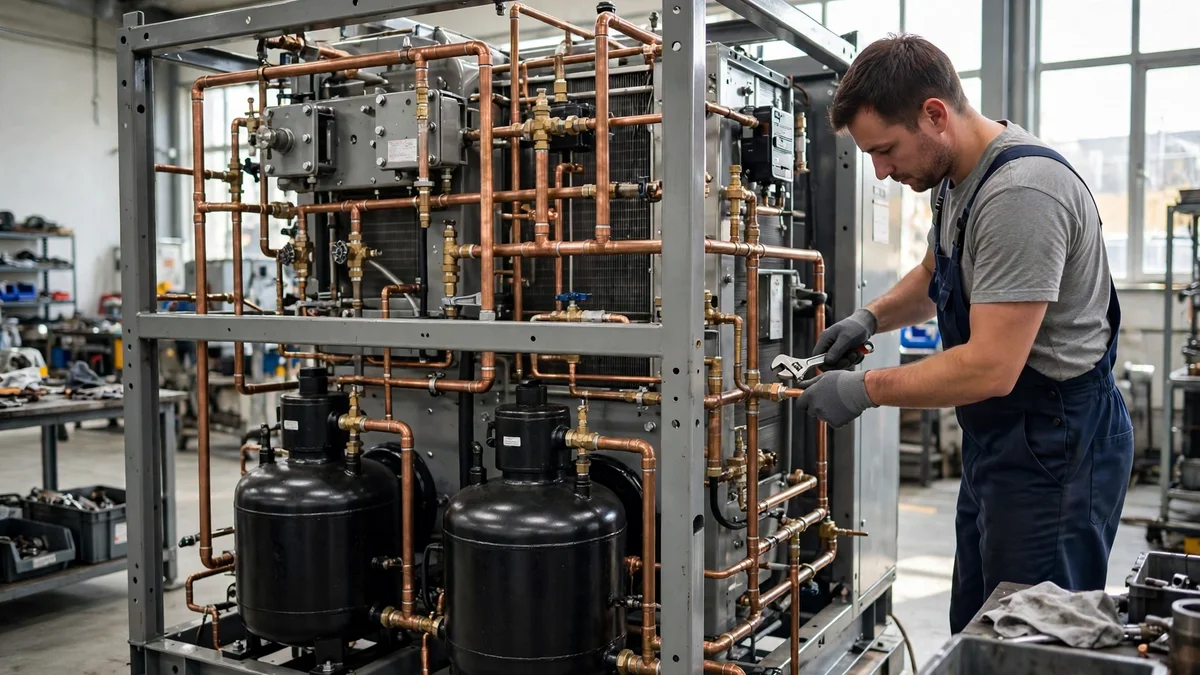
At the heart of the system sit the chillers, which make cold water. A chiller is built around one or more compressors — usually scroll or screw types chosen for quiet running — mounted on a steel frame with vibration isolators. Around them go the heat exchangers: a titanium condenser cooled by seawater, since ordinary copper would corrode in months, and an evaporator that chills fresh water to around 7 degrees. The refrigerant circuit is brazed from copper pipe, pressure-tested with nitrogen, evacuated to remove moisture, and charged with refrigerant. The assembly is wired to a control panel that stages compressors up and down as demand rises and falls.
Step 3: Making the air handlers and fan coils
While the chillers make cold water, air handlers and fan coil units turn it into cool air. An air handler is a long insulated box containing a chilled-water coil, a fan, filters and, on many yachts, a heater coil. The factory builds them in many sizes, because no two cabins have the same space to hide one in. Each unit is balanced on a test rig so its fan delivers the designed airflow at a whisper, and its condensate drain is checked so no water can escape into the joinery. The engine room below decks gets its own heavy-duty ventilation, since no air conditioning system can cool a space full of running diesel engines.
Step 4: Pipework, ducting and insulation
The chiller and the air handlers are connected by kilometres of pipe and duct, and this is where marine air conditioning differs most from a building. Chilled-water pipes are insulated so thickly they cannot sweat — a single drip can ruin a hand-finished panel worth thousands — and every joint is lagged and sealed by hand. Ducts are made from insulated board or galvanised steel, cut to follow the yacht’s curves and lined so the rush of air is inaudible. The factory supplies pipework as pre-assembled modules where possible, so the yard can lift whole sections into the hull. Seawater pipework is made from copper-nickel alloy, the only common metal that survives decades of warm salt water.
Step 5: Controls, sensors and zoning
A superyacht’s climate is run by a control system like a smart building’s. Temperature and humidity sensors sit in every cabin, feeding a central controller that adjusts water flow, fan speed and fresh-air intake zone by zone. Guests set their own temperature from a touchscreen, and the crew can monitor the whole yacht from one panel. The factory programs the system before it leaves the floor, then simulates the yacht’s zones on a test bench. Modern systems also manage fresh air and dehumidification together, because on a yacht the enemy is not just heat — it is damp, which breeds mould in hidden spaces.
Step 6: Factory testing and commissioning
Before anything ships, each chiller is run on a factory test rig at full load, often for 24 hours without a break. Air handlers are run too, their airflow and noise checked — a unit that is too loud fails, no matter how cold it blows. The steel hull of a superyacht is a giant heat sink in warm water, and the climate design must account for it. Once aboard, the system is commissioned in stages: pipes flushed and filled, air bled out, controls tuned room by room, and the yacht tested to prove it holds temperature and humidity at full occupancy. Only when every cabin holds its set point in silence does the yard sign the system off — and the anchor system at the bow gets the same sign-off discipline, since a superyacht is a chain of systems that must all work at once.

Superyacht Air Conditioning Specifications
| Specification | Typical Value |
|---|---|
| System type | Chilled-water central plant with fan coil units |
| Cooling capacity | 80–300 tonnes of refrigeration (60 m yacht) |
| Chilled water temperature | 7°C supply, 12°C return |
| Compressor type | Scroll or screw, staged for part load |
| Condenser material | Titanium, seawater-cooled |
| Seawater pipework | Copper-nickel alloy |
| Cabin noise target | Below 35 dB(A) |
| Humidity control | 45–55% relative humidity |
| Fresh air | Filtered, dehumidified, per-zone control |
What Superyacht Air Conditioning Costs
Prices are estimates and vary with yacht size, zone count and the yard. A complete chilled-water climate system for a 40-metre yacht typically costs an estimated $350,000–$700,000 installed, while a 60-metre yacht’s system runs an estimated $800,000–$1.5 million. A single large marine chiller alone costs an estimated $60,000–$150,000, and a custom air handler unit an estimated $4,000–$12,000 each. Annual maintenance, including refrigerant checks, seawater strainer cleaning and coil servicing, runs an estimated $15,000–$40,000. It is a lot of money for air you cannot see, but on a superyacht the air is the product: a guest kept awake by a humming vent will remember nothing else about the trip.
A Rare Fact
Superyacht air conditioning systems are sized for the tropics, but they have a secret second job: in cold climates they run in reverse, and the same seawater that cools the yacht in the Caribbean can warm it in Norway. Because seawater rarely drops below freezing, a marine heat pump can pull warmth from the sea even when the air above it is well below zero — a trick a land-based heat pump, stuck breathing freezing air, cannot match.
Step into a superyacht saloon and feel nothing at all — no draught, no hum, no clamminess — and remember that the nothing is engineered. It is the product of tonnes of copper, titanium and quiet machinery, built and tested in a factory long before the yacht ever touched the sea.


