Eleven kilometres down, at the bottom of the Mariana Trench, the pressure is a thousand times what it is at the surface — enough to crush a car flat. The only way to get there and come back is inside a sphere of titanium a few centimetres thick, with a pilot squeezed into a space smaller than a phone box. A deep-sea submersible is a spacecraft that goes down instead of up, built to survive a place no human was meant to reach.
The factory that builds one is quiet, clean and slow. There are no production lines and no rush: a single submersible can take years to build, and every part is made and tested again and again. The sphere is machined to perfection, the thrusters are sealed against pressure that would force water through a pinhole, and the whole craft is squeezed in a pressure chamber harder than the ocean ever will. This is how a deep-sea submersible is assembled.
How a Deep-Sea Submersible Is Made
Step 1: Designing for pressure
Every submersible starts with a number: the depth it must reach. That depth decides the pressure, and the pressure decides everything else — the thickness of the sphere, the strength of the seals and the weight of the whole craft. Designers work in software that simulates crushing loads, then choose the shape: almost always a sphere, because a sphere spreads pressure evenly and has no weak corners. Inside, every control, screen and oxygen bottle is fitted into a space barely bigger than a bathtub. The science of how the finished craft survives down there is covered in how a deep-sea submersible works.
Step 2: Forging the sphere
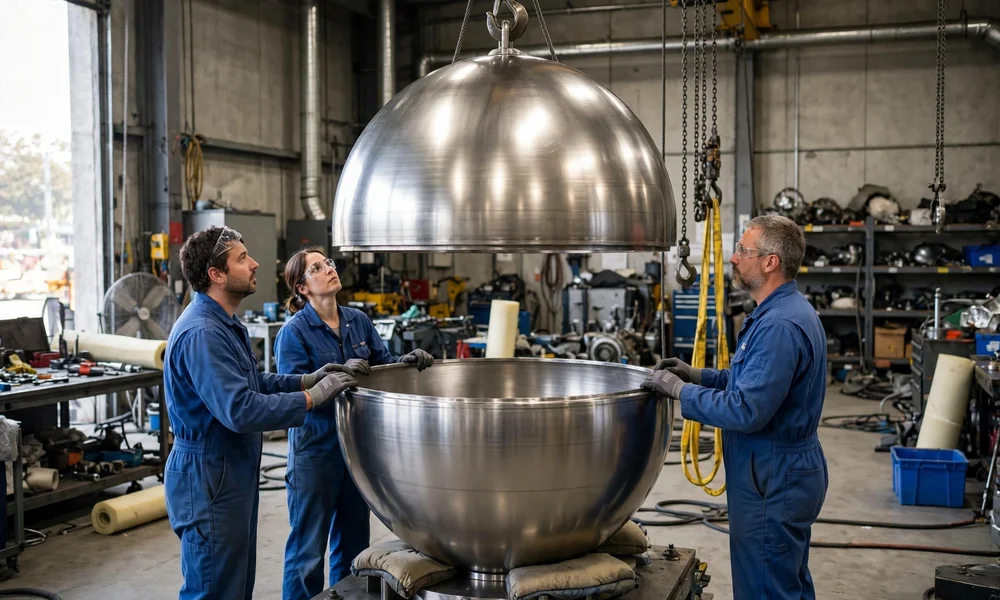
The pressure sphere is the heart of the submersible, and it starts as titanium. Two hemispheres are forged from titanium alloy, then machined on a giant lathe until the wall thickness is even to within a fraction of a millimetre — a thin spot would be the place the ocean crushes first. The hemispheres are welded together and the joint is ground smooth and inspected with ultrasound and X-rays. A viewport of thick acrylic is fitted into a conical seat, and a hatch is machined to seal against the sphere with an O-ring. The sphere is the only thing between the pilot and the pressure outside.
Step 3: Building the frame and buoyancy
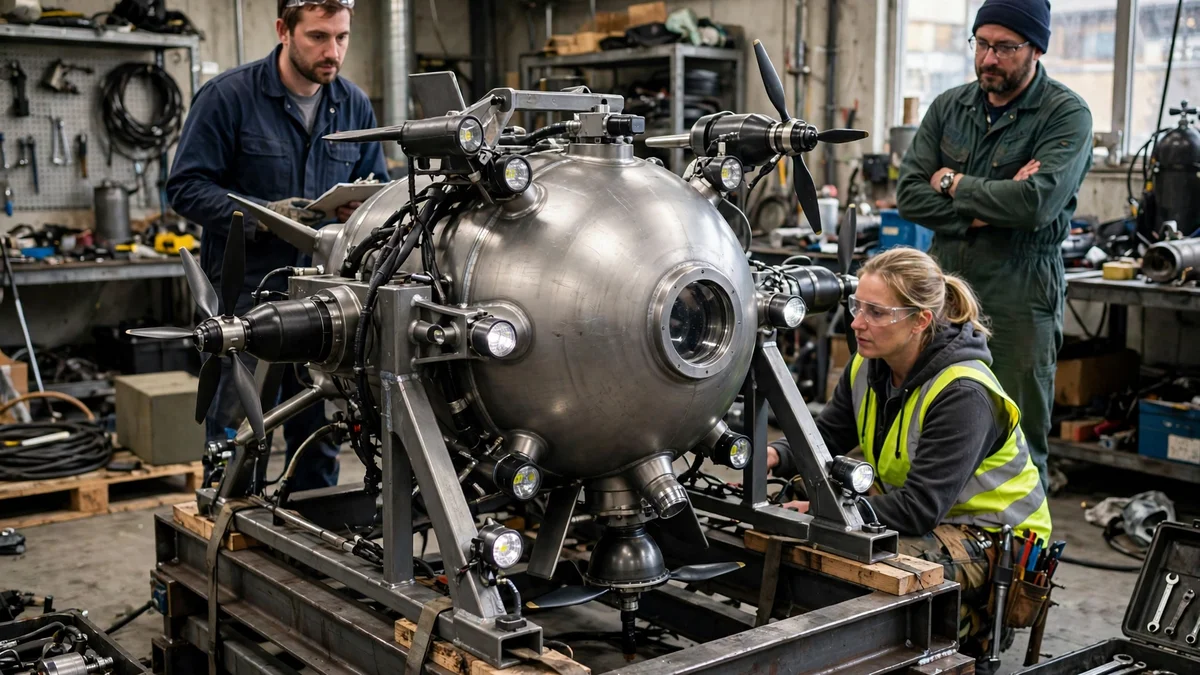
Around the sphere, the yard builds a frame that carries everything else: thrusters, lights, cameras, manipulator arms and the syntactic foam that gives the submersible its buoyancy. The foam is made of tiny glass spheres set in resin, and it is strong enough to resist the pressure while being lighter than water — it is what brings the craft back up. The frame is usually titanium or composite, built to be strong but light, and every component is bolted on so it can be removed and serviced. The craft must be slightly lighter than the water it displaces, or it will never come home.
Step 4: Fitting thrusters and systems
The submersible moves with electric thrusters, each one sealed in a pressure-proof housing with its own motor and propeller. The thrusters are fitted to the frame and wired to batteries inside the sphere, with cables passing through pressure-proof penetrators — sealed holes that let wires through the titanium without letting water in. Inside the sphere, the pilot gets life support: oxygen, carbon dioxide scrubbers, temperature control and a communication system that talks to the surface ship by sound waves, since radio does not travel through water. Every system has a backup, because at full depth there is no rescue.
Step 5: Sealing and pressure testing
Before the submersible ever touches the sea, it is tested in a pressure chamber. The sphere, with its hatch and viewport, is lowered into a steel chamber and the pressure is raised beyond the maximum the craft will ever face — often to 110 percent of its rated depth. Engineers listen for creaks, watch gauges for leaks and measure how much the sphere shrinks under load: a titanium sphere compresses measurably under pressure, and the designers need to know by exactly how much. If the sphere passes, the whole assembled craft is tested the same way, with its thrusters, lights and seals all under pressure at once.
Step 6: Fitting cameras and tools
With the pressure tests passed, the science payload goes on: cameras in pressure housings, lights bright enough to cut through total darkness, a manipulator arm for picking up samples, and sample boxes for rocks and creatures. The cameras must work in water colder than a freezer. The full list of what the craft carries, from its cameras to its batteries, is set out in the deep-sea submersible specifications. Each item is tested on the bench and again on the assembled craft, because a tool that fails at depth cannot be fixed until the submersible is back on deck.
Step 7: Harbour trials and the first dive
Finally, the submersible goes into the water. Harbour trials check that it floats, dives and surfaces on command, that the thrusters answer the controls and that the pilot can see, breathe and communicate. Then comes a shallow test dive, then a deeper one, each time going further down. Only after a series of successful dives is the craft cleared for its full rated depth. The pressure hull that makes all of this possible is built on the same principles as a military submarine’s hull — see how a submarine pressure hull is made — but a submersible’s sphere is built for depths no submarine can reach.
Deep-Sea Submersible at a Glance
| Specification | Typical Value |
|---|---|
| Pressure hull | Titanium sphere, machined to fractions of a millimetre |
| Maximum depth | Up to about 11,000 m for full-ocean-depth craft |
| Pressure at depth | About 1,100 times surface pressure |
| Crew | Usually 1–3 people inside the sphere |
| Propulsion | Electric thrusters, battery powered |
| Buoyancy | Syntactic foam of glass spheres in resin |
| Key advantage | Carries people to the deepest places on Earth and back |
What Does It Cost?
A deep-sea submersible is built to order, and the price is set by its depth rating. A small two-person craft rated to 1,000 metres can cost $2–$5 million (estimate), while a full-ocean-depth submersible able to reach the bottom of the Mariana Trench costs $30–$50 million (estimate) or more. The titanium sphere is the single most expensive part, followed by the pressure testing, the life support and the years of engineering. The support ship and expeditions cost as much again. It is one of the most expensive vehicles per passenger ever built — and one of the very few that can take a human somewhere no one has ever been.

A Rare Fact
The deepest place on Earth, the Challenger Deep, has been visited by fewer people than have walked on the Moon. The first dive, in 1960, took nearly five hours to descend and the crew could barely see out of a tiny window; the second crewed dive did not happen for another fifty-two years. The early divers found life down there: tiny shrimp-like creatures living in the mud at the bottom, in total darkness, under crushing pressure. The submersibles that found them were built by hand, one at a time, in workshops like the one in this article — and every one of them came back up because the sphere held.


