An e-bike battery is a compromise. Make it big and the bike goes further, but it also gets heavier, uglier, and harder to pedal when the power runs out. Make it small and the bike stays light and nimble, but the rider starts watching the battery gauge after twenty miles. The range extender is the answer: a small extra battery, about the size of a water bottle, that clips onto the frame and adds miles without turning the bike into a moped.
A range extender is a complete power system in miniature. It needs its own cells, its own management electronics, its own cooling, and a connector that can survive rain, mud, and thousands of plug-in cycles. It must work with the bike’s main battery and motor, and it must be safe enough to carry in a backpack if the rider takes it off. This is how an e-bike range extender is produced.

Inside the Factory
Step 1: Choosing and testing the cells
Production begins with the battery cells, and a range extender uses the same cylindrical lithium-ion cells found in power tools and laptop packs, usually the 21700 size, about 21 millimetres wide and 70 millimetres long. Every batch of cells is tested before it is accepted, and cells that fall outside the limits are sent back. The cells are then sorted into groups of closely matched capacity, because a pack built from mismatched cells will age unevenly. Only cells from the same production batch go into the same pack.
Step 2: Building the cell pack
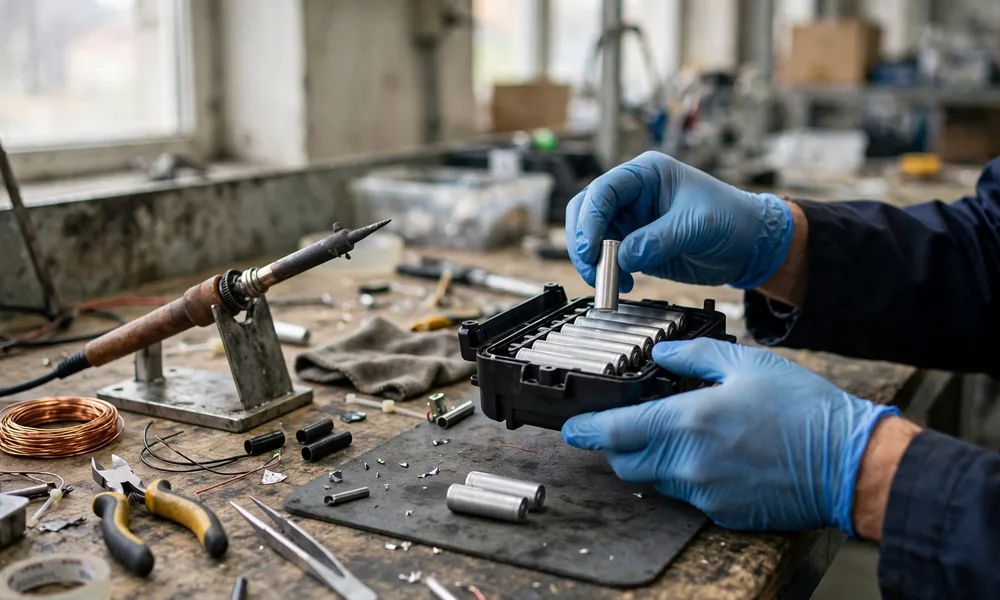
The matched cells are arranged in a tight bundle that fits inside the bottle-shaped case, held apart by plastic spacers so they cannot short out. Thin nickel strips are welded across the tops and bottoms of the cells to connect them in series and parallel, using a spot welder that fuses the strip to the cell without heating the cell itself. A temperature sensor is glued to the centre of the pack, where the cells get hottest, and the whole bundle is wrapped in insulating film and fish paper. The pack is then given its first electrical test, a charge and discharge cycle, and any pack that fails is opened up or broken down for its cells.
Step 3: Fitting the battery management system
Every range extender carries its own battery management system, a small circuit board that watches over the cells for the whole life of the pack. The board is fitted with a microcontroller, balancing circuits, and a current sensor, and it is soldered and tested on a separate line before it meets the cells. Once fitted, the board monitors the voltage of every group of cells, cuts the power if any group goes too high or too low, and balances the groups during charging. It also talks to the bike over a data connection, telling the motor controller how much energy is left, so the extender and the main battery share the load. The full story of how the unit is built from cells to finished bottle is told in how an e-bike range extender is made, and the management board is the part that turns a bundle of cells into a safe, usable product.
Step 4: Housing, sealing, and the connector
The finished pack and board are slid into the housing, a tube of aluminium or toughened plastic shaped to fit a standard bottle cage, with a mounting bracket that locks it to the frame. The housing is sealed with gaskets and screws, and the seam is tested for water resistance, because the extender will spend its life in rain and road spray. The connector is the most abused part of the whole unit: it must plug in and out thousands of times, survive grit and water, and carry both power and data, so it is made from gold-plated contacts in a sealed, keyed plug that can only fit one way. A cable runs from the extender to the bike, strain-relieved at both ends so a tug pulls on the housing rather than on the solder joints inside. The case is then labelled with its capacity and voltage, and each unit is given a serial number.
Step 5: Charging, discharging, and safety testing
Before any range extender leaves the factory, it is put through a full test cycle on a computer-controlled rig. The unit is charged from empty to full while the tester watches the voltage of every cell group, then discharged at the maximum rated current while the temperature is logged, to make sure no cell gets hotter than its limit. The tester then simulates faults, shorting the output briefly to check that the protection trips. Units are also tested in a humidity chamber, to prove the seals keep water out, and a sample from each batch is torn down and inspected. Only a unit that passes every test is cleared for sale.

Step 6: Finishing and pairing with the bike
The last stage is finishing, and it starts with a final visual inspection, checking the case for scratches, the label for the right markings, and the connector for any bent pins. The unit is then charged to about half capacity for storage and shipping, because lithium-ion cells last longest when they are stored neither full nor empty. A quick-start guide and a charging cable go into the box, and the unit is paired at the factory with a test bike to confirm it adds range as its label promises. The boxed extender is weighed, sealed, and packed for shipping.
Specs
| Specification | Typical figure |
|---|---|
| Cell type | 21700 lithium-ion, matched by capacity |
| Capacity | Roughly 160 to 250 watt-hours |
| Voltage | Roughly 36 to 48 volts |
| Weight | Roughly 1 to 1.6 kilograms |
| Shape | Bottle size, fits a standard cage |
| Range added | Roughly 30 to 60 kilometres |
| Connector | Sealed, keyed, gold-plated contacts |
| Testing | Full charge and discharge cycle on every unit |
Price
A range extender is sold as an accessory, and its price is estimated at roughly $400 to $800, depending on its capacity and on whether it is made for one bike brand or for many. The cells are the biggest single cost, estimated at roughly a third of the total, followed by the management board, the housing, and the connector, with the rest going to testing and certification.
A Rare Fact
Some range extenders are smart enough to hold their own charge in reserve until the main battery is nearly empty, and a few can even be set to feed the motor only on climbs, so the rider gets the extra power exactly when their legs need it most. The little bottle is not just a spare tank: it is a second brain for the bike’s power system.
A range extender is the smallest power system on an e-bike, and the numbers behind it are set out in the e-bike range extender specifications, while how an e-bike battery is made explains the main pack it is designed to work alongside. The next time a rider passes you on a long climb with a bottle that is not a bottle, remember the matched cells, the balancing board, and the sealed connector that made the extra miles possible.


