Every e-bike rider knows the feeling. You are forty kilometres from home, the trail is beautiful, the battery gauge has dropped to a single bar, and the mental maths begins: can I make it back, or will the last ten kilometres be pure leg power? For years, the only answer was a bigger, heavier battery. Then engineers offered a different answer — a small extra power source you can carry in a bottle cage, clip on when you need it, and leave at home when you do not. It is the range extender, and it is quietly changing how far an e-bike can go.
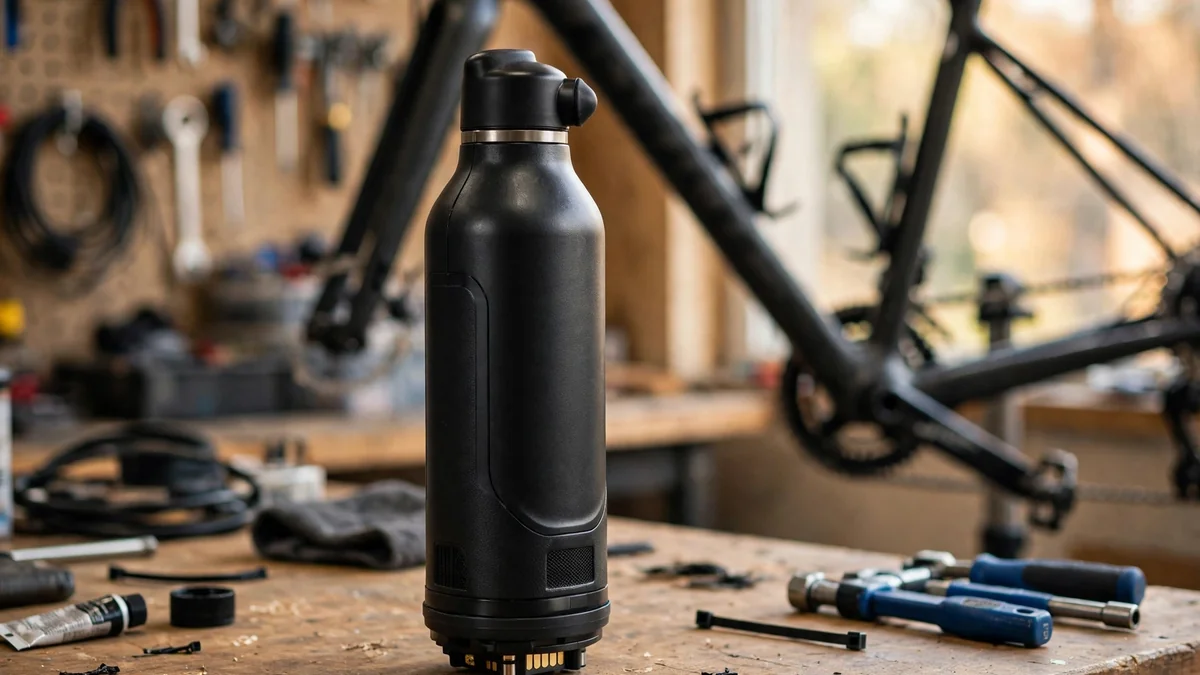
A range extender is a compact auxiliary battery, usually shaped like a water bottle, that plugs into the e-bike’s main system and tops up the main battery as you ride — or powers the motor directly. It does not replace the main battery; it extends it, adding roughly a third to a half more range. The idea is simple, but making one is not. It must be light, safe, waterproof, and smart enough to talk to the bike’s motor controller without confusing it.
Inside that bottle-shaped case is a pack of lithium cells, a management system watching every cell, and connectors built to survive rain, vibration, and thousands of plug-in cycles. This is how a range extender is made.
How It’s Made
Step 1: Choosing the cells and designing the pack
The range extender starts with its cells — usually the same cylindrical lithium-ion cells used in power tools and electric cars, chosen for their energy density and reliability. Engineers decide how many cells the pack needs: enough to add meaningful range, but few enough to keep the weight near a kilogram and the shape inside a standard bottle cage. They model the pack’s voltage and capacity, and design the layout so heat can escape and no single cell works harder than its neighbours. The pack must also match the bike’s main battery voltage, so the two can work together without fighting each other. The main battery it partners with follows the same science, as e-bike battery specs explain.
Step 2: Welding the cells into a pack
Individual cells are sorted by capacity and internal resistance, so that only closely matched cells go into the same pack — a weak cell would drag the whole pack down. The cells are arranged in a holder, then joined with nickel strips welded by precise pulses of electric current. Spot welding is used instead of soldering, because soldering would heat the cells and damage them. Temperature sensors are placed between the cells, and the finished block is wrapped in insulation and a protective sleeve. Every weld is inspected, because a single bad joint can create a hot spot or a dead pack.
Step 3: Building the battery management system
Next comes the brain: the battery management system, a small circuit board that watches every cell’s voltage and temperature, balances the charge between cells, and cuts the power if anything goes wrong. It also talks to the bike, telling the motor controller how much energy is available and how fast it can be delivered. Technicians fit the board to the cell block, connect the sensor wires, and load the firmware that defines the pack’s behaviour — how fast it charges, when it stops, and how it hands over to the main battery. This electronics work is as delicate as anything in EV battery cell production, just at a smaller scale.

Step 4: Moulding the bottle-shaped case
The pack needs a home that fits a bicycle. The case is usually moulded from tough polycarbonate or aluminium, shaped like an oversized water bottle so it slides into a standard bottle cage. Moulding must be precise: the case has to hold the pack snugly, leave room for the wiring and connectors, and seal against rain and dust. Rubber gaskets seal the lid, and the mounting points are reinforced so the unit cannot rattle loose on rough trails. Some cases include a small display or LED gauge showing the remaining charge at a glance. The case is then tested for water resistance, often to standards that mean surviving a downpour or a river splash.
Step 5: Fitting connectors and the mounting system
The range extender connects to the bike through a rugged cable and connector, designed to be plugged in with gloves on and to survive thousands of insertions. Inside the case, the wiring is secured against vibration, and a fuse protects the whole unit from short circuits.
The mounting system — the cage, the latch, or the magnetic dock, depending on the brand — is tested by shaking the unit on a rig that simulates years of rough riding, because a range extender that falls off on a descent is worse than useless.
Step 6: Testing, charging, and final checks
Before shipping, every range extender is charged and discharged on a test rig, and its management system is checked against its specifications: does it deliver its rated capacity, does it cut out at the right voltage, does it stay cool under load? Sample units go through drop tests, vibration tests, and water tests, and a few are ridden for thousands of kilometres to prove the design in the real world. Only then is the unit charged to a safe storage level, boxed with its cable and mount, and sent to shops. Riders then pair it with a bike whose own components are just as tested — including the brakes, as e-bike disc brakes show.
| Cell type | Cylindrical lithium-ion cells, matched by capacity |
| Typical capacity | About 150 to 250 watt-hours |
| Typical weight | About 1 to 1.5 kilograms |
| Range added | Roughly 30 to 50 percent more than the main battery alone |
| Shape | Bottle-shaped, fitting a standard bottle cage |
| Management | Battery management system with balancing and cut-off protection |
| Water resistance | Sealed against rain and splashes |
| Charging | Charges from a standard charger, often alongside the main battery |
What Does an E-Bike Range Extender Cost?
A range extender is a premium accessory, and its price reflects the cells and electronics inside. A branded range extender is estimated at roughly $300 to $600, depending on capacity and brand, with the mounting hardware and cable usually included. These are estimates only, and some brands sell the extender only with a matching bike. For riders, the value is in the freedom: a day-long ride without range anxiety, and a bike that stays light on short trips because the extender stays at home.
A Rare Fact
The range extender idea did not start with bicycles. Early electric cars in the 1990s and 2000s experimented with small petrol generators that extended their range — the most famous being the BMW i3, which offered a tiny two-cylinder engine as an optional range extender. E-bikes took the same concept and made it electric, light, and removable. The bottle-shaped battery on a modern e-bike is the descendant of a car idea, shrunk to the size of a water bottle and freed from petrol entirely.

The range extender is a small answer to a big question: how far can an e-bike go without becoming heavy? By splitting the battery into a main pack and a removable extra, engineers gave riders a choice — travel light, or travel far. It is a bottle that holds not water but distance — and for riders who have watched their battery gauge fall, that distance is worth every gram.


