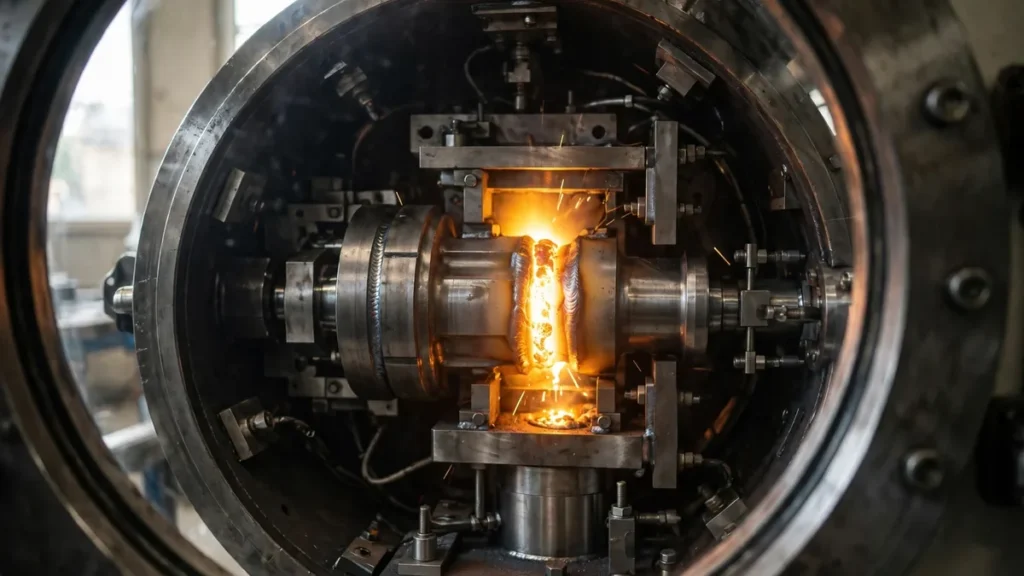
Most welding is a violent, noisy business: sparks, smoke, and a blinding arc. Electron beam welding is the opposite. It happens in silence, inside a sealed steel chamber, in a vacuum, with no flame and no filler metal at all. A beam of electrons thinner than a pencil melts the joint from the inside out, and when the beam switches off, the metal freezes into a weld so deep and narrow that it looks as if the two pieces were always one.
The process is used where a weld must be perfect: in jet engines, nuclear reactors, spacecraft, and pressure vessels. It can join thick plates in a single pass, weld metals that ordinary welding cannot touch, and leave almost no distortion behind, because the heat is so concentrated. This is how electron beam welding is produced.
Inside the Factory
Step 1: Building the vacuum chamber
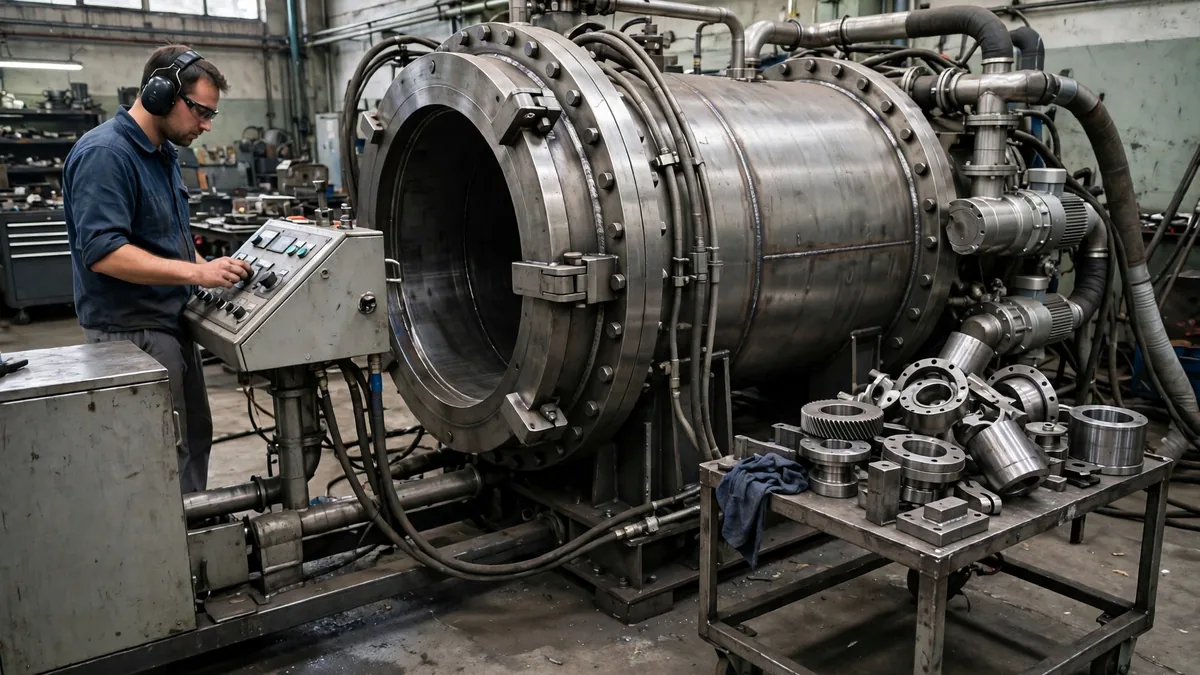
Production begins with the chamber, a thick-walled steel vessel big enough to hold the parts being welded, with a door that seals against a rubber gasket. The chamber is machined from rolled steel plate, then bored and faced so the door seats perfectly, because it must hold a vacuum of less than a millionth of normal air pressure while the beam is running. Pumps are bolted to the chamber: a roughing pump that pulls the first air out, and a diffusion or turbo pump that takes the pressure down to the working vacuum, and the vessel is leak-tested with helium. Inside the chamber, a work table moves on computer-controlled axes, carrying the parts under the beam with a precision of a fraction of a millimetre.
Step 2: Making the electron gun
The heart of the machine is the electron gun, which works like the tube in an old television, scaled up to industrial power. A tungsten filament is heated until it gives off electrons, and a high voltage, typically 60,000 to 150,000 volts, accelerates them down a column, while magnetic lenses focus them into a beam less than a millimetre across. The gun is built in a clean room, because a speck of dust will distort the beam, and the filament, cathode, and anode are assembled by hand and aligned with gauges. The gun is mounted on top of the chamber, looking down through a sealed port, with interlocks that cut the voltage the instant the door is opened.

Step 3: Preparing the parts and the joint
The parts to be welded are prepared to a higher standard of cleanliness than any other process demands. The joint faces are machined flat and square and degreased, because any oil or oxide on the joint will be trapped in the weld and weaken it. The parts are clamped into a fixture on the work table, aligned so the joint runs exactly under the beam, because the beam cannot follow a joint that moves. There is no filler metal: the beam melts the edges of the two parts, and the molten metal flows together and freezes, so the joint must fit tightly, with a gap of less than a fraction of a millimetre. The full story of how a weld is made from beam to finished joint is told in how electron beam welding is made, and the preparation of the joint is the stage where most bad welds are decided.
Step 4: Pumping down and aligning the beam
With the parts loaded and the door sealed, the pumps pull the chamber down to vacuum, a process that takes minutes for a small chamber and much longer for a large one. The operator then runs the beam at low power onto a test piece, watching the glow through a viewing window, and steers it with the magnetic lenses until it sits on the joint line. The beam is focused by changing the current in the lenses until the spot is at its smallest and brightest, and the focus is checked by making a short test weld. The welding program, which sets the beam power, the travel speed, and the path of the work table, is loaded from the computer, and a dry run is made with the beam off.
Step 5: Welding the joint
The weld itself is quick and almost silent. The beam switches on, the joint melts, and the work table moves the parts under the beam at a steady speed, while the molten pool freezes behind the beam into a narrow seam. Because the beam is so concentrated, it can weld plates tens of millimetres thick in a single pass, and the heat-affected zone around the weld is only a few millimetres wide. The operator watches the weld through the window, looking for the steady glow that means the beam is on the joint. When the beam reaches the end of the joint, it is ramped down slowly, and the chamber is left to cool before the door is opened.
Step 6: Testing and finishing the weld
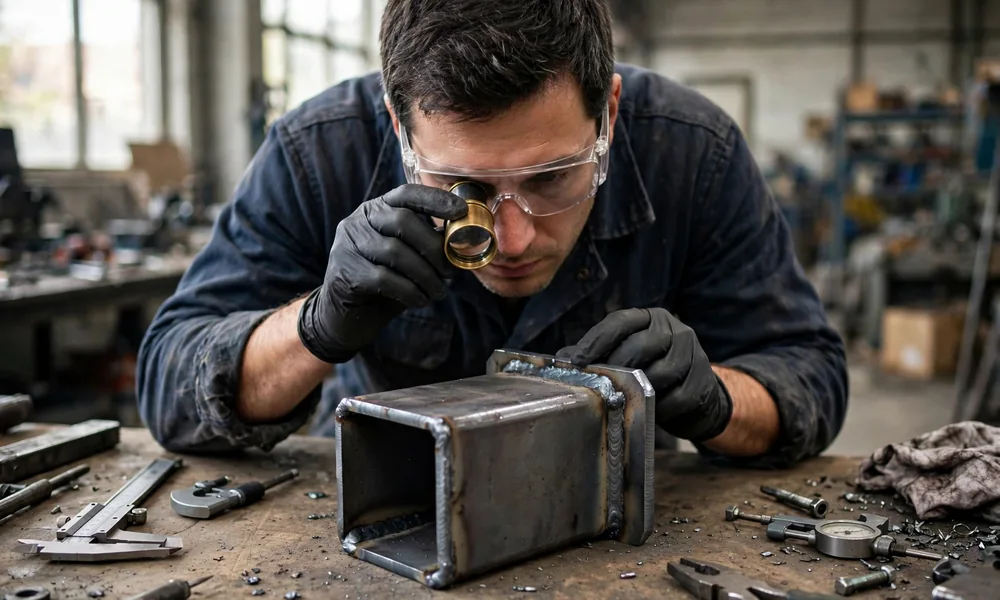
Once the chamber has cooled, the weld is inspected. The seam is checked visually, then tested with ultrasound or X-rays, which reveal pores and cracks hidden inside the metal, and any weld that fails is cut out and redone. A sample from the batch is cut through the weld and polished, so the engineers can see the shape of the fusion zone under a microscope. The parts are then cleaned, and the finished assembly is measured against its drawing, because electron beam welding leaves so little distortion that a part which comes out of tolerance has almost certainly been clamped wrong. Only a weld that passes every test is cleared for its next stage.
Specs
| Specification | Typical figure |
|---|---|
| Beam voltage | Roughly 60,000 to 150,000 volts |
| Beam diameter | Less than 1 millimetre at focus |
| Chamber vacuum | Less than a millionth of normal air pressure |
| Weld depth | Tens of millimetres in a single pass |
| Filler metal | None, the joint melts and fuses |
| Heat-affected zone | Only a few millimetres wide |
| Inspection | Ultrasound and X-ray on every weld |
| Joint gap tolerance | Less than a fraction of a millimetre |
Price
An electron beam welding machine is a major capital purchase, estimated at roughly $500,000 to $5 million, depending on the size of the chamber, the power of the gun, and the precision of the work table. A single weld is priced by the job, estimated at roughly $200 to $2,000 for a typical aerospace or pressure-vessel joint, with most of the cost going to the pumping time, the joint preparation, and the inspection that follows.
A Rare Fact
Electron beam welding can join metals that refuse to be welded any other way, including titanium to steel, and it can weld in places no human welder could reach, because the beam can be steered by magnets. The same beam can also drill holes and cut metal, so one machine can weld, drill, and machine a part without it ever leaving the vacuum chamber.
Electron beam welding is the quietest welding process in any factory, and the craft behind it is set out in the electron beam welding specifications, while how steel welding is made explains the older, louder process it is often compared with. The next time you see a jet engine or a spacecraft, remember the silent chamber, the vacuum, and the beam of electrons that fused its parts into one.