Three kilometres down, the ocean presses on every square centimetre with the weight of a small car. A research submersible that goes there carries its crew inside a sphere, because a sphere is the only shape that spreads that pressure evenly, with no corners for the water to crush. The sphere cannot.
The materials of that sphere decide how deep the submersible can go, and whether its crew comes home. This is the story of the titanium, glass and seals inside a research submersible sphere, and of what happens when each one fails.
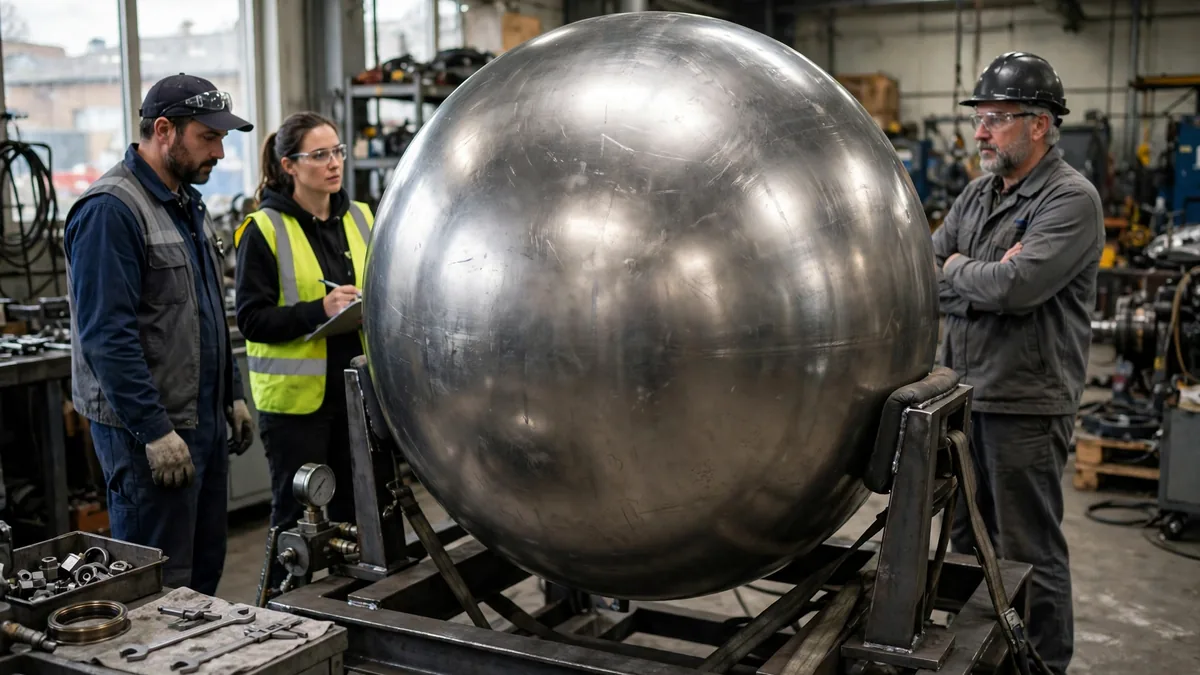
The Materials Behind the Research Submersible Sphere
A sphere under pressure is a study in balance. The metal must be strong enough to resist being crushed, ductile enough to bend a fraction of a millimetre instead of cracking, and light enough that the submersible can still float. Into that perfect shell go the weak points every sphere must have: a hatch for the crew, viewports to see through, and penetrators where the cables pass into the hull. The research submersible sphere construction starts with the choice of alloy, because everything else — the thickness, the welding, the testing — follows from it.
Step 1: The titanium shell
The shell is almost always titanium, usually the alloy Ti-6Al-4V — titanium with six percent aluminium and four percent vanadium — chosen because it is as strong as steel at little more than half the weight, and because it does not rust in salt water. The metal is heated in a furnace to relieve the stresses of forming, then inspected with ultrasound for flaws thinner than a hair. If the titanium fails, it fails suddenly: a buckle starts at a flaw or a thin spot, and in a fraction of a second the whole sphere collapses inward, driven by the pressure of the ocean.
Step 2: The weld at the equator
The two hemispheres meet at the equator, and the weld that joins them is the most inspected centimetre of metal on the submersible. It is usually made by electron beam welding or tungsten inert gas welding, in a clean room, with the joint machined to a perfect fit before the torch ever starts. A weld that looks perfect on the outside can hide a pore the size of a grain of sand, and under pressure that pore becomes the place where the collapse begins. If the weld fails, the sphere fails with it, so the weld is never trusted on appearance alone — it is tested, X-rayed, and tested again.

Step 3: The hatch and its seal
The crew climbs in through a hatch, a thick disc of the same titanium, held down by a ring of bolts and sealed with an O-ring. The seal is usually a rubber compound, sometimes with a metal backup ring, and it works because the pressure outside pushes the hatch harder against its seat the deeper the submersible goes — the ocean itself helps to seal the door. If the O-ring is nicked, or a grain of sand sits on the sealing face, the hatch weeps: a thin jet of water at enormous pressure, which can cut like a knife.
Step 4: The acrylic viewports
The crew needs to see out, and the viewports are made of acrylic — the same material as a fish tank, but far thicker. A viewport is a cone, thick at the outside and thinner at the inside, seated in a metal ring so that pressure pushes it tighter into its seat, just like the hatch. Acrylic is chosen because it is clear, it does not shatter like glass, and it can flex slightly under pressure without cracking. If acrylic fails, it crazes first — a network of tiny cracks that clouds the view and warns the crew — and that warning is the reason acrylic is used instead of glass. Glass would fail without warning; acrylic complains first. The deep-sea submersible materials use the same acrylic for the same reason, and the same rule applies: a cloudy viewport is a viewport that has already started to fail.
Step 5: The penetrators and the cables
Power and data must get into the sphere, and every cable that passes through the shell is a hole in the perfect pressure vessel. The holes are filled with penetrators: metal plugs with glass or ceramic seals, through which the wires pass, potted in epoxy so that water cannot follow the wire inside. If a penetrator leaks, water follows the cable into the sphere, first as a drip and then as a jet, and it can short out the electrical systems the crew depends on.
Step 6: The paint, the anode and the quiet corrosion
The outside of the sphere is painted, not for looks but to keep the salt water off the metal, and it carries a sacrificial anode — a lump of zinc bolted to the shell that corrodes first, protecting the titanium beneath it. The paint is a marine epoxy, applied in several coats and touched up after every dive, and the anode is checked and replaced when it has wasted away. If the paint fails and the anode is gone, the corrosion is slow and invisible, working for months before anyone notices. The submarine pressure hull materials face the same quiet enemy, and the defence is the same: paint, anodes, and inspection after every dive.

Materials at a Glance
| Material | Why it is chosen | How it is shaped | When it fails |
|---|---|---|---|
| Ti-6Al-4V titanium | Strong as steel at half the weight; does not rust | Pressed hemispheres, machined to exact thickness | Buckles suddenly at a flaw or thin spot |
| Equatorial weld | Joins the hemispheres into one shell | Electron beam or TIG weld, stress-relieved, X-rayed | A hidden pore becomes the start of a collapse |
| Titanium hatch | Crew entry; pressure helps seal it shut | Machined disc, bolted ring, O-ring seal | A nicked O-ring lets in a cutting jet of water |
| Acrylic viewport | Clear, flexible, crazes before it breaks | Thick cone, polished, seated in a metal ring | Crazing clouds the view; the warning comes first |
| Glass-sealed penetrator | Lets cables through without letting water in | Metal plug, glass melted around the wire | A leak follows the cable and shorts the electrics |
| Epoxy paint and zinc anode | Stops galvanic corrosion where metals meet | Several coats; anode bolted to the shell | Slow, invisible corrosion once the anode is gone |
Research Submersible Sphere at a Glance
| Specification | Detail |
|---|---|
| Shell alloy | Ti-6Al-4V titanium |
| Shape | Sphere, two welded hemispheres |
| Typical diameter | Around 2 metres for a two- or three-person crew |
| Viewport material | Acrylic, over 10 centimetres thick at depth |
| Hatch seal | O-ring, replaced on schedule |
| Testing | Pressure chamber to beyond rated depth |
| Main enemy | Buckling at a flaw; a leak at a seal |
A Rare Fact
An egg and a submersible sphere share the same secret: a curved shell spreads a crushing force so evenly that a thin wall can hold back an enormous load. Crack the curve, and both fail in the same instant. Every gram saved in the shell is a gram that can be spent on batteries, cameras or samples.


