A submarine is a steel tube built to keep the sea out, and every hatch in its hull is a place where the sea could get in. The escape hatch is different from the rest: it is the door the crew would use to leave the boat if it could not surface. It must seal perfectly against crushing water pressure for years, yet open smoothly, by hand, in an emergency, in the dark, underwater.
Inside the shipyard workshop that builds one, the escape hatch looks like a piece of heavy engineering from another age: a thick round steel door, a wheel handle, and a ring of bolts, made with the same care as a bank vault. The work is slow and exact, because a hatch that leaks is a failure of the whole boat.

Inside the Production
Step 1: Cutting and shaping the steel
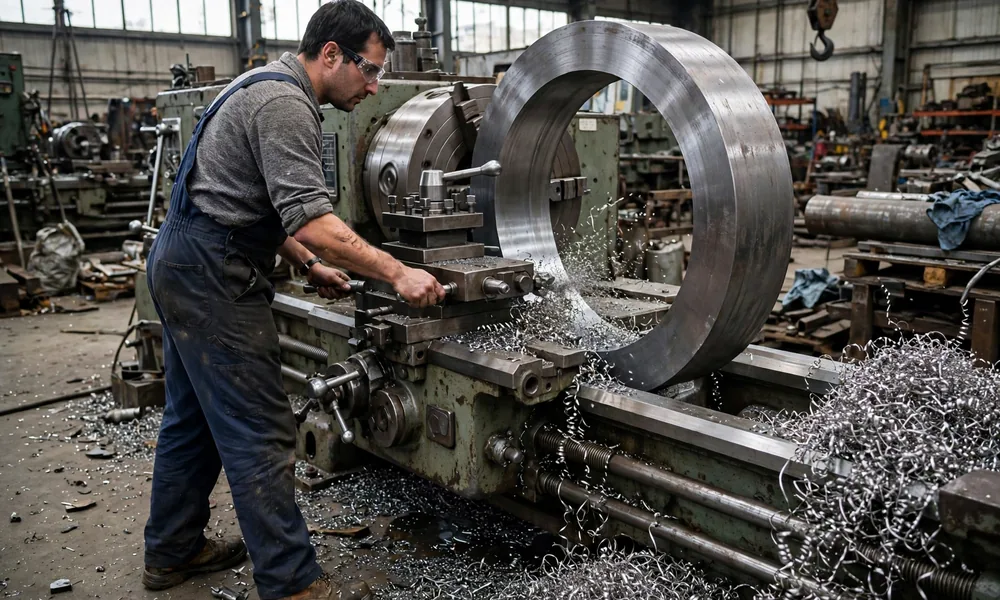
Production begins with the steel itself, a thick plate of high-strength marine steel chosen for its toughness under pressure. The plate is cut into a disc, then pressed into a shallow dome, which resists water pressure far better than a flat door. The edge of the disc is machined on a lathe until it is perfectly round and smooth, since the seal will sit against it and any roughness would let water past. The hatch ring — the frame the door closes into — is made the same way, from a thicker ring of steel, and the two are matched as a pair: a door is never swapped between rings.
Step 2: Machining the sealing faces
The sealing faces are the most exact surfaces on the whole hatch. The ring and the door are machined to a smooth finish, checked with fine gauges and polished by hand where needed. The groove that holds the rubber seal is cut to a precise depth: too shallow and the seal would be crushed, too deep and it would not press hard enough to hold back the sea. The hinge pins and the dogs — the clamps that pull the door tight against the ring — are machined from the same tough steel and fitted with clearances so small that they move smoothly without any rattle.
Step 3: Fitting the wheel and locking gear
The wheel handle is the part the crew will touch, and it must work even when the hatch has not been opened for months. The wheel is fitted to a spindle that runs through the centre of the door, and turning it drives the locking dogs in or out together, pulling the door evenly against its seal. The mechanism is greased with a compound that does not wash away in sea water, and the wheel is tested again and again: it must turn with one hand, in gloves, with no sticking. The gear is checked until it turns smoothly every time.
Step 4: Fitting the seal
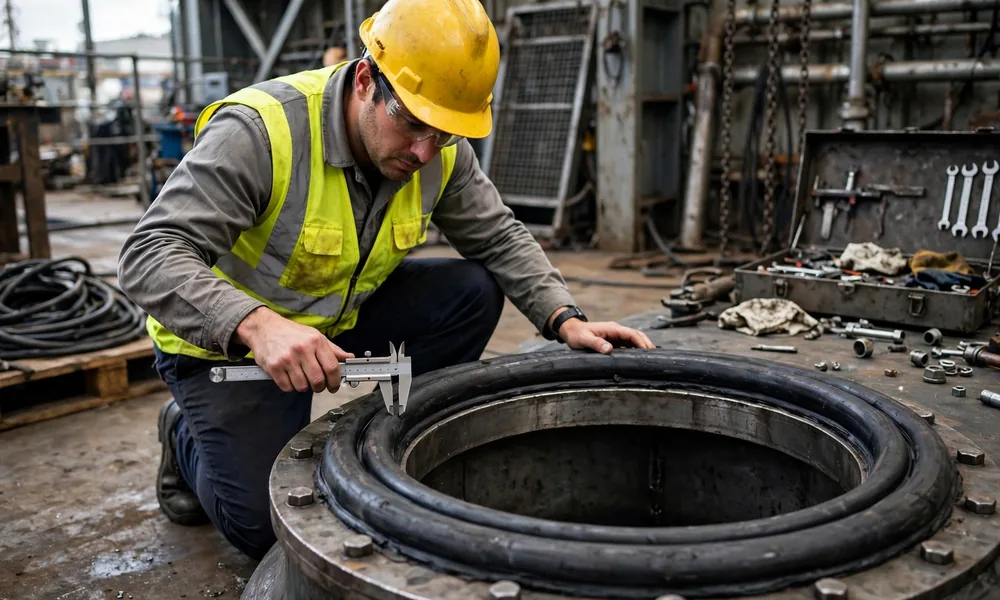
The rubber seal is a thick ring of special rubber, made to stay flexible in cold water and to resist salt, oil, and age. It is fitted into its groove in one piece, with no joint that could leak, and its surface is checked for nicks or flat spots. The door is then closed against the ring for the first time, and the gap around the edge is measured with thin feeler gauges: the gap must be even all the way round, or the seal would be squeezed harder on one side than the other. The numbers behind the finished hatch are laid out in the submarine escape hatch specs explained guide, and the sealing stage is where the hatch stops being a steel door and becomes a watertight barrier.
Step 5: Pressure testing
No hatch leaves the workshop untested. The finished door and ring are bolted into a test chamber, and water pressure is applied from the outside, slowly, up to a level far beyond what the hatch will meet in service. The chamber is watched for drips, and the pressure is held to prove the seal does not creep or relax over time. The wheel is also operated under pressure, to prove the door can still be opened when the sea is pushing on it. A hatch that leaks even a slow drip is taken apart and its seal replaced.
Step 6: Painting, marking, and delivery
Once the hatch passes its pressure test, it is cleaned, dried, and painted with marine coatings that protect the steel from rust. The moving parts are greased once more, the wheel is given a final turn, and the hatch is wrapped against damage for the journey to the submarine. A record is made for that exact hatch — its measurements, its test pressures, and its seal type — so the boat’s crew will know its history years later. Only a hatch with a clean test record and a complete history is cleared to be fitted into a hull, where it will sit, closed and waiting, for the life of the boat.
Specs
| Specification | Typical figure |
|---|---|
| Door shape | Round, shallow domed steel disc |
| Door material | High-strength marine steel |
| Seal type | Single-piece rubber ring in a machined groove |
| Locking | Hand wheel driving clamping dogs |
| Operation | By hand, one person, in gloves |
| Pressure rating | Tested well beyond service depth pressure |
| Corrosion protection | Marine paint and grease on moving parts |
| Fit | Door matched to its own ring as a pair |
| Testing | Full water pressure test before delivery |
Price
A submarine escape hatch is not bought off a shelf, and its price reflects the hand work in it. As an estimate, a large escape hatch costs roughly $50,000 to $150,000 to build, depending on its size, steel grade, and the depth it is rated for. The machining and testing alone take many hours of skilled labour, and the pressure test chamber is itself an expensive piece of equipment. These are estimates, and the real figure varies with the boat, the specification, and the yard — but against the cost of a whole submarine, the hatch is a small price for the safety it provides.
A Rare Fact
A submarine hatch is tested with more pressure than it will ever meet at sea, on purpose. The test pressure is set well above the pressure at the boat’s deepest working depth, so that the seal has a wide margin of safety even if the rubber ages or the steel flexes. The test is done in a chamber, not in the ocean, so that engineers can watch every part of the hatch while the pressure is on. The hatch is the one door the crew may never use, yet the factory must prove it works. That is why the hatch is treated like a lifeboat built into the hull — inspected, tested, and then left alone, ready, for years.
The escape hatch is the boat’s last way out, but it only makes sense alongside the hull it seals. The steel it closes into is covered in how a submarine pressure hull is made, and the power that moves the boat it protects is explained in how a submarine propeller works. The next time a submarine slips below the surface, remember the domed steel door, the rubber seal, and the hatch that was pressure-tested before it ever met the sea.


