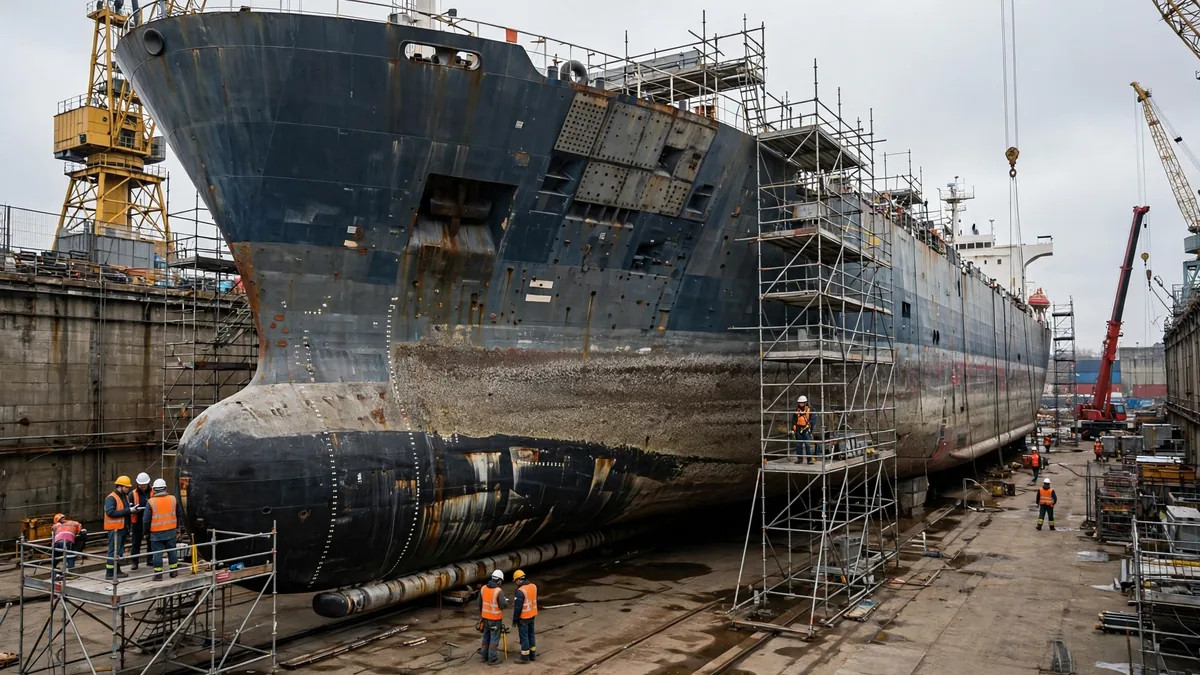
There is a moment in every ship’s life when the sea is taken away. The vessel that has spent months ploughing through waves is towed into a concrete basin, the gates close behind it, and the water is pumped out until the great hull stands in the open air, resting on wooden blocks. This is dry dock, and it is the only time a ship can be fully inspected, repaired and repainted below the waterline.
A dry dock is not just a hole in the ground. It is a massive piece of engineering in its own right: a basin longer than three football pitches, with gates that hold back the sea, pumps that can empty it in hours, and a floor strong enough to carry tens of thousands of tonnes. Building and running one takes the same care as building the ships that use it, and a mistake can strand a vessel worth hundreds of millions of dollars.
How a Ship Dry Dock Is Made
Step 1: Digging the basin
A dry dock begins with excavation. Engineers dig a basin into the shore, often below the level of the sea, and line it with reinforced concrete thick enough to resist the pressure of the water outside. The floor is built in sections, with joints that allow it to flex slightly without cracking, and drainage channels are set into it so the last of the water can be pumped away. The basin must be perfectly level: a ship that rests unevenly can bend its own hull under its own weight.
Step 2: Building the gates
The entrance to the dock is closed by a caisson, a huge hollow steel gate that floats into place and is then flooded until it sinks and seals against the dock walls. Some docks use hinged gates instead, like the doors of a canal lock. Either way, the seal must be watertight against the full weight of the sea. The gates are built in a shipyard, towed to the dock, and tested by flooding and emptying the basin again and again until the engineers are satisfied that not a drop gets through.
Step 3: Installing the pumps
Emptying a dry dock is a race against the tide. Powerful pumps, often several storeys tall, can move thousands of tonnes of water an hour, draining the basin in a few hours. The pumps sit in a chamber beside the dock, with their own power supply and backups, because a pump failure with a ship half-afloat would be a disaster. Valves and culverts carry the water back to the sea, and screens keep fish and debris out of the machinery.

Step 4: Laying the keel blocks
Before a ship enters, workers lay a line of keel blocks along the centre of the dock floor: stacks of hardwood and steel that will carry the ship’s weight. Side blocks are prepared to steady the hull once it settles. The positions are calculated from the ship’s own plans, because the blocks must sit under the strongest parts of the hull. A block placed under a weak plate can dent it, while a missing block can leave the ship sagging. The container ship hull above them is designed with these blocks in mind, its keel built to take the full load.
Step 5: Docking the ship
Docking is the most delicate part of the whole operation. The dock is flooded, the gates are opened, and tugs guide the ship in at walking pace. Divers and dockmasters watch from the sides as the ship is winched into position over the keel blocks, lined up by marks on the dock walls. Then the pumps start, and the water falls slowly, centimetre by centimetre, until the hull touches the blocks. Workers rush in to set the side blocks as the ship settles, and only when the water is gone and the ship stands firm is the docking declared complete.
Step 6: Repair, cleaning and painting
With the hull exposed, the real work begins. High-pressure jets strip away barnacles, algae and old paint, revealing the steel beneath. Inspectors check every plate for corrosion and cracks, welders cut out damaged steel and fit new plates, and the ship propeller is polished or repaired. The hull is then painted with antifouling paint, which slowly releases chemicals that stop marine growth, and the rudder and thrusters are serviced. A large ship can spend two to four weeks in dock, with hundreds of workers on board around the clock.
Step 7: Flooding and undocking
Leaving is the reverse of arriving, and just as careful. The dock is cleaned, the blocks are checked one last time, and the gates are closed. Water is let in slowly, and the ship lifts gently off the blocks as it floats again. Divers check that nothing is caught beneath the hull, the gates are opened, and tugs pull the ship back to sea. The dock is then pumped dry, inspected, and made ready for the next vessel, often within days. The icebreaker hull that leaves a dock like this is built for the hardest service of all, and its time in dry dock is what keeps it that way.
Specifications
| Feature | Typical value |
|---|---|
| Dock length | About 300 to 400 metres for large docks |
| Dock width | About 50 to 70 metres |
| Dock depth | About 10 to 14 metres below sea level |
| Pumping capacity | Thousands of tonnes of water per hour |
| Time to empty | About 3 to 6 hours |
| Ship capacity | Up to about 300,000 tonnes deadweight |
| Typical docking | Every 2 to 5 years, for 2 to 4 weeks |
| Keel blocks | Hardwood and steel, spaced along the keel |
What It Costs
Dry docking a large ship is one of the most expensive routine jobs in shipping. A typical docking for a container ship or tanker costs an estimated 1 to 5 million dollars, depending on the size of the vessel and the work needed, and a major refit can cost far more. The dock itself costs an estimated hundreds of millions of dollars to build. Shipowners accept the bill because the alternative is worse: a fouled hull can burn an estimated 10 to 20 percent more fuel, and a corroded plate discovered too late can sink a ship. A few weeks in dry dock buys years of safe, efficient sailing.
A Rare Fact
The world’s largest dry docks are so big that they have their own weather. When a dock is flooded and then pumped out, the temperature and humidity inside the concrete basin can change so fast that mist forms over the dock floor, and workers have reported rain falling inside the dock on hot days, condensed from the humid sea air against the cold concrete walls. It is a strange sight: a steel giant standing in a man-made canyon, with its own little cloud drifting along its hull.