The laptop boots in seconds. A video file that once took an hour to copy moves in a blink, and a game loads before the loading screen has finished drawing itself. Nobody thinks about the little rectangle of metal and silicon that makes it happen, because a solid-state drive has no moving parts and makes no sound. It is easy to forget that inside that silent box is one of the most demanding manufacturing feats in all of computing.
A solid-state drive stores your data in tiny traps that hold electric charge, millions of them stacked in towers so small that a speck of dust is a skyscraper by comparison. The drive in a flagship laptop can hold two terabytes in a package the size of a stick of gum, and it must keep every bit safe for years. The price is the price of that precision, and of the factories that make it possible.

Why It Costs So Much
A solid-state drive looks simple from the outside, but it is a stack of hard problems. The memory cells are built in three dimensions, layer upon layer, the controller must manage millions of cells that wear out a little with every write, and the whole device must survive for years without losing a single bit. The cost comes from the factory, the yield, and the relentless testing.
Reason 1: The memory is built upwards, layer by layer
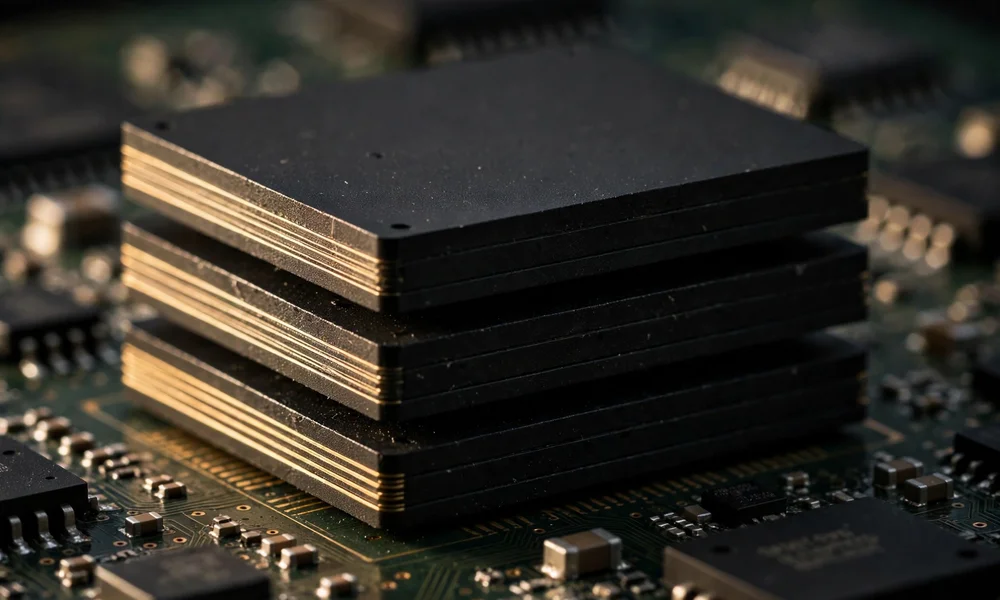
Modern flash memory is stacked in towers of more than two hundred layers, each one only a few atoms thick, with tiny vertical channels drilled through the whole stack. Building that structure means depositing layer after layer of material, etching holes through all of them without the walls collapsing, and filling the holes with precisely the right materials. A single mistake anywhere in the stack can ruin a whole column of cells, as inside solid-state drive production shows.
Reason 2: The cells wear out, so the drive must outsmart physics
Every time a flash memory cell is written, its insulating layer degrades a fraction. After thousands of writes the cell can no longer hold charge reliably, so the drive’s controller must spread writes evenly across every cell, retire dying cells, and keep spare capacity in reserve. That controller is a small computer in its own right, tracking the health of millions of cells in real time. Building a controller that never loses data, even when the power fails mid-write, is one of the hardest jobs in storage engineering.
Reason 3: Yield is a war against invisible defects
A memory chip contains billions of cells, and a defect in any one of them matters. Factories test every chip and map the bad cells, and the controller is programmed to avoid them, but chips with too many defects are discarded outright. The larger the capacity, the more cells there are to fail, and the harder it is to get a perfect chip. High-capacity drives carry the cost of all the silicon that did not make the grade, a yield battle familiar from EV battery cell specs.
Reason 4: The factory costs more than a small city
Flash memory is made in fabrication plants that cost tens of billions of dollars to build, filled with lithography machines that cost hundreds of millions of dollars each. The cleanrooms inside are cleaner than an operating theatre, and they run around the clock, because stopping a fab for even a day costs a fortune. Only a handful of companies in the world own such plants, and the cost of building the next generation of them is divided among the drives they produce, which is why storage prices fall slowly even as capacity climbs.
Reason 5: Speed demands exotic interfaces
A modern drive does not plug into a slow cable. It connects directly to the computer’s fastest lanes, moving data at several gigabytes per second, and the controller, the circuit board and the connector must all keep up without errors. The board is a multi-layer design with carefully controlled signal paths, and the drive is tested at full speed under heat, because a drive that is fast when cold and flaky when hot is useless. The precision behind that testing is like inside metal 3D printing production, where tolerances are measured in microns.
Reason 6: Every drive is tested for years of life in days
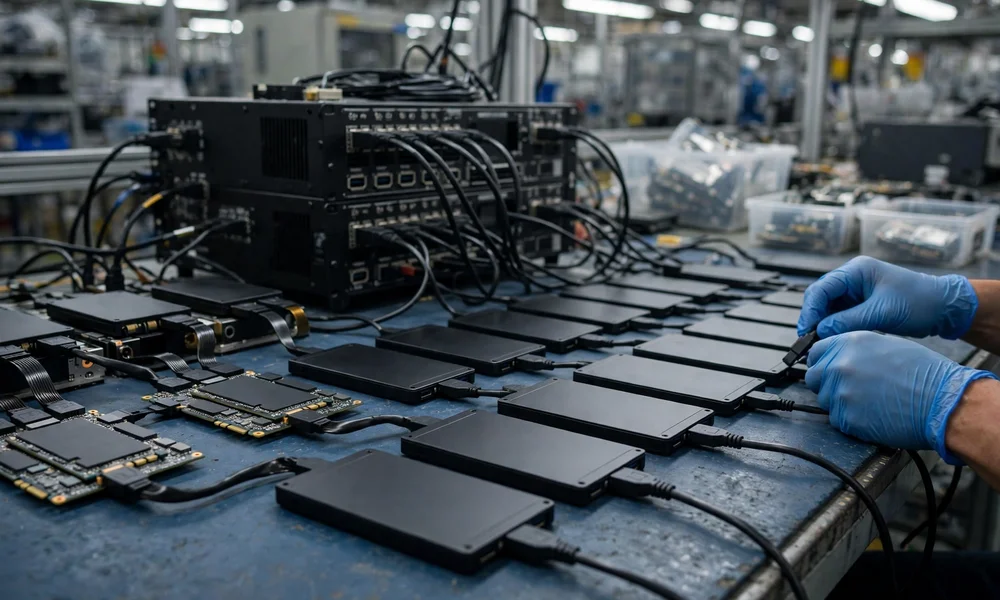
Before a drive ships, it is written to again and again, heated, cooled, and power-cycled, in a compressed simulation of years of use. Drives that show early signs of failure are rejected, and the survivors carry the cost of the ones that did not pass. The testing also verifies that the drive can survive a sudden power loss without corrupting data, a failure mode that would be catastrophic in a laptop or a server. That testing is never skipped, because a storage failure is the one failure a customer never forgives.
Reason 7: The market is concentrated, and the technology never stands still
Only a few companies make flash memory at scale, and each generation of the technology demands a new round of investment in factories and research. The move from one layer count to the next, from one cell design to another, costs billions, and the companies must recover it before the next generation arrives. Meanwhile the drives themselves must keep getting faster and cheaper, so the manufacturers invest constantly just to stay in place. The buyer pays for a drive that is, in effect, a small piece of the most expensive factory on earth.
Specifications
| Specification | Detail |
|---|---|
| Capacity | Typically 500 GB to 4 TB in consumer drives |
| Memory type | 3D NAND flash, stacked in more than 200 layers |
| Interface | NVMe over PCIe, several gigabytes per second |
| Controller | Multi-core controller with error correction and wear levelling |
| Endurance | Typically hundreds of terabytes written over the drive’s life |
| Form factor | Often M.2 2280, about 22 by 80 millimetres |
| Power | Usually under 10 watts under load |
| Moving parts | None |
Price
A 1 TB NVMe solid-state drive typically costs from around $60 to $150 (estimate), and a 2 TB flagship drive can cost $200 to $400 (estimate). Enterprise drives with far higher endurance can cost several thousand dollars (estimate). The price is in the three-dimensional fabrication, the yield losses, the controller, the testing, and the factory that must be paid for one drive at a time.
Rare Fact
The first solid-state drives sold to the public cost more than a thousand dollars for just 32 gigabytes, and they were slower than the hard drives they replaced. The technology that now fits two terabytes into a stick of gum was once a military curiosity, used in equipment where a spinning disk would shake itself apart. The price has fallen by more than a hundred times since then, yet the factories have only become more expensive, because each new generation of memory is harder to build than the last.
That is the quiet paradox of the solid-state drive: a device with no moving parts, no sound, and no drama, built in the most expensive factories on earth from towers of memory a few atoms thick. It costs so much because there is no cheap way to stack two hundred layers of perfect memory and guarantee that not one bit of it will ever be lost.


