A hypercar gearbox has one of the hardest jobs in engineering. It must take more than a thousand horsepower from an engine spinning past 9,000 revolutions per minute, and hand it to the wheels in a fraction of a second, gear after gear, without a jolt, a slip, or a failure. It does this while weighing little more than a suitcase, fitting into a space barely bigger than a shoebox, and surviving temperatures that would melt ordinary steel. When a driver pulls a paddle behind the steering wheel, the shift is over in about eight hundredths of a second — faster than a blink.
That speed is not an accident. A hypercar gearbox is built in a clean, quiet factory where every gear is cut, hardened, polished, and measured to tolerances finer than a human hair. There are no assembly lines here in the usual sense: small teams of specialists build each unit by hand, and each one is tested on a bench before it ever meets an engine. This is how a hypercar gearbox is made, from a solid bar of steel to a finished transmission.
How It’s Made
Step 1: Designing the gear set
Engineers begin with the engine’s power curve and the car’s top speed, then work out the ratios for seven or eight gears, each one chosen so the engine stays in its strongest rev range. The gears, shafts, and the dual-clutch pack are modelled in three dimensions, and every tooth is simulated under load to check it will not bend or chip. The casing is designed at the same time, because in many hypercars the gearbox is a structural part of the car, bolted directly to the engine and the rear suspension. Nothing is cut until the design has survived thousands of simulated shifts.
Step 2: Forging the gear blanks
Each gear starts as a disc of high-grade alloy steel, forged under immense pressure so the metal’s grain flows in the direction of the load. Forging makes the steel tougher than a gear cut from a plain bar, and it matters because a single gear tooth in a hypercar can carry several tonnes of force. The blanks are turned on a lathe to their rough shape, leaving a little extra material for the precision work that follows. At this stage they look like nothing more than heavy steel discs, but their chemistry and grain structure have already been checked and recorded.

Step 3: Cutting the teeth
The teeth are cut on computer-controlled gear hobbing and grinding machines that work to tolerances of a few microns — a micron is a thousandth of a millimetre. A gear that is even slightly out of shape would whine, vibrate, and wear out in hours, so the cutting is slow and the machine is checked constantly. Some makers finish the teeth by grinding them after cutting, which leaves a surface so smooth it looks polished. The gears are measured with a laser scanner after cutting, and any gear that falls outside tolerance is scrapped, however much work has gone into it.
Step 4: Hardening the gears
Cut gears are too soft to survive in a hypercar, so they are heat-treated in a vacuum furnace, heated to around 900°C and then quenched so the surface becomes extremely hard while the core stays tough. This is a delicate balance: too hard and the tooth becomes brittle, too soft and it wears away. Some gears are then shot-peened, blasted with tiny steel beads that compress the surface and help it resist fatigue cracks. After hardening, each gear is ground again to restore the exact tooth shape, because the heat treatment moves the metal by tiny but critical amounts.
Step 5: Assembling the gearbox
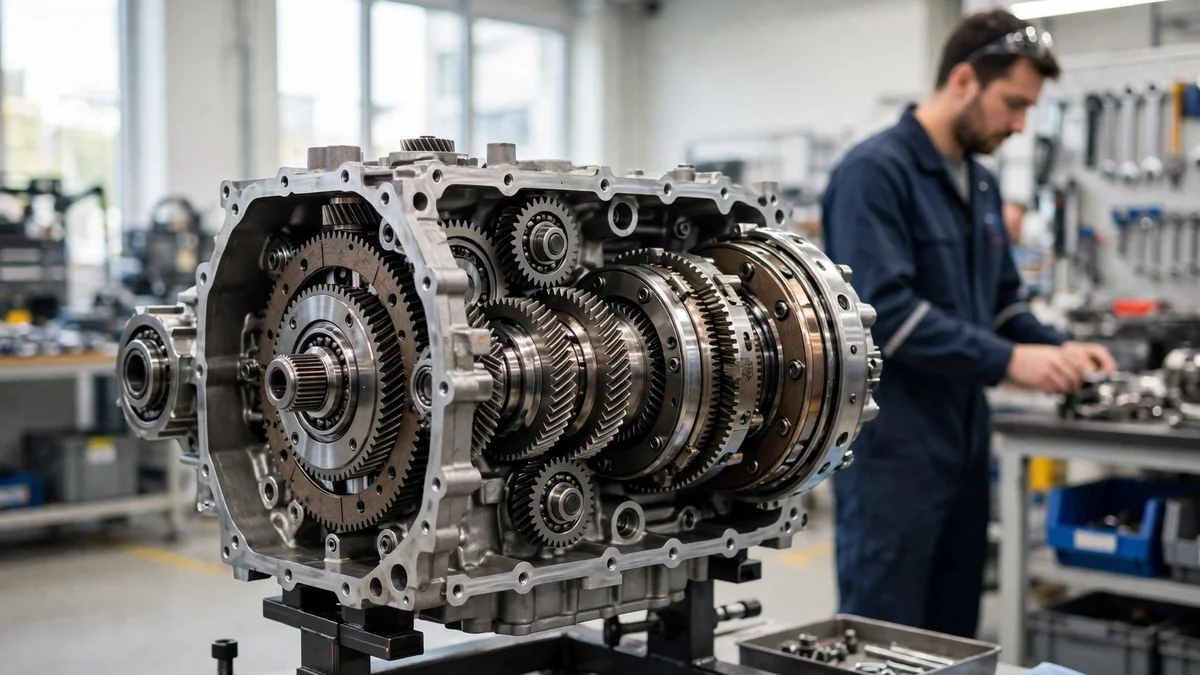
Assembly happens in a clean room, where technicians in gloves fit the gears onto their shafts, press on bearings, and build the two clutches that give a dual-clutch gearbox its speed. While one clutch drives the current gear, the other has already selected the next one, so a shift is just a swap from one clutch to the other — which is why the change feels instant. The hydraulic system that moves the clutches and the selector forks is fitted and bled, and the whole assembly is lowered into its casing, usually cast from magnesium or aluminium to save weight. Every bolt is tightened to a recorded torque, and the record stays with the gearbox for life.
Step 6: Testing on the bench
Before the gearbox leaves the factory, it is bolted to a test rig that spins it through every gear under load, shifting thousands of times while sensors listen for noise, vibration, and heat. Engineers check the shift times, the clutch pressures, and the oil temperature, and they run the box up to full speed to prove it can handle the engine it will be paired with. The oil is drained and checked for metal particles, which would betray a gear that is wearing badly. Only a gearbox that passes every test is signed off, crated, and sent to the car factory, where it meets the engine it was designed around.

Specs
| Specification | Typical figure |
|---|---|
| Gearbox type | Seven- or eight-speed dual-clutch |
| Shift time | About 0.08 seconds |
| Weight | Roughly 90–130 kg |
| Torque capacity | Up to around 1,500 Nm |
| Gear tooth tolerance | A few microns |
| Hardening temperature | About 900°C in a vacuum furnace |
| Casing material | Magnesium or aluminium alloy |
| Build time | Several days per unit, mostly by hand |
Price
A hypercar gearbox is not sold separately, but as an estimate, a dual-clutch unit for a hypercar costs roughly $40,000 to $80,000 to build, depending on the maker and the torque it must handle. The finished car typically costs $2 million or more, and the gearbox is one of its most expensive single parts, because the materials are exotic, the machining is slow, and the testing is exhaustive. These are estimates, and makers keep the true cost private.
A Rare Fact
The fastest gearbox in a road car changes gear in roughly eight hundredths of a second, but the clutch packs inside it are so precisely made that the two clutches overlap for only a few thousandths of a second during a shift. For that instant, both gears are briefly engaged at once, and the gearbox has to manage the handover without a jolt or a loss of drive. It is a trick that took racing engineers decades to perfect, and it is now hidden inside every hypercar.
The gearbox is the link between the engine’s fury and the road, and it has to be as clever as the engine itself — see how a hypercar gearbox is made for the full story of its parts. The way it actually works, with two clutches swapping drive in a blink, is explained in how a hypercar gearbox works, and the same dual-clutch idea appears in racing cars, as how a dual-clutch gearbox works shows. The next time a hypercar fires through its gears without pausing, remember the forged steel, the micron-perfect teeth, and the bench test that proved it could take the punishment.


