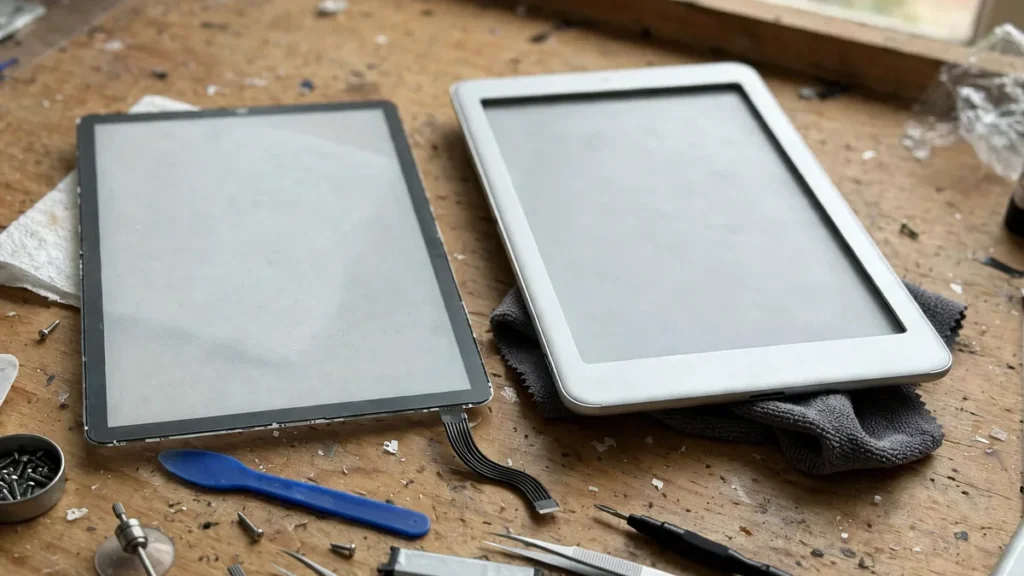
A page that never needs power to hold its words sounds like a trick, but it is sitting on millions of bedside tables right now. An e-ink display, the screen inside an e-reader, shows a page of text and then simply keeps showing it, with no battery drain at all, until you ask for the next page. It looks like printed paper because, in a sense, it is printed: millions of tiny capsules of black and white ink, trapped between sheets of plastic, moved around by electric fields.
The idea is older than the e-reader. The capsules themselves, each about the width of a human hair, hold charged particles of black and white pigment floating in clear fluid. Apply a voltage and the black particles rise to the surface, or the white ones do, and the capsule turns dark or light. Turn the power off and the particles stay where they are. That is the whole magic of electronic ink: the image is a physical arrangement of pigment, not a glow, which is why you can read it in bright sunlight and why a battery lasts for weeks.
Making a display out of that idea takes a factory that is part print works, part electronics plant, and part cleanroom. The film that carries the capsules is coated in rolls kilometres long, laminated to a sheet of electronics that can switch each tiny patch of the screen on its own, and then cut, tested, and sealed into the readers and labels that use it. Here is how an e-ink display is made.
How an E-Ink Display Is Made
Step 1: Making the microcapsule ink
The display starts not with glass or silicon but with ink, made in a chemical plant. Tiny capsules are formed by mixing black and white pigment particles into a clear fluid and then enclosing the mixture in microscopic shells, each capsule holding a small cloud of both pigments. The capsules are suspended in a liquid binder to make a printable ink, and the size of the capsules is controlled tightly, because capsules that are too large make the image grainy and capsules that are too small do not switch cleanly.
Step 2: Coating the e-ink film
The ink is coated onto a clear plastic film in a roll-to-roll process, much like printing a newspaper. The film unrolls through a coating machine that spreads the microcapsule ink in a layer only a few tens of micrometres thick, then dries it and covers it with a protective layer. The coating must be perfectly even, because a thick patch would switch slowly and a thin patch would look pale, and the whole roll is inspected by cameras as it moves.
Step 3: Building the transistor backplane
While the film is being coated, another line builds the backplane, the sheet of electronics that will switch the capsules. On a sheet of glass or flexible plastic, the factory deposits and patterns thin-film transistors, one for every pixel of the finished display, using photolithography and etching in a sequence that can run to a dozen layers. Each transistor is a tiny switch that will apply a voltage to the capsules above it, and the backplane also carries the thin metal electrodes that deliver that voltage. The work is done in a cleanroom, because a speck of dust on the backplane becomes a dead patch on the page.
Step 4: Laminating film to backplane
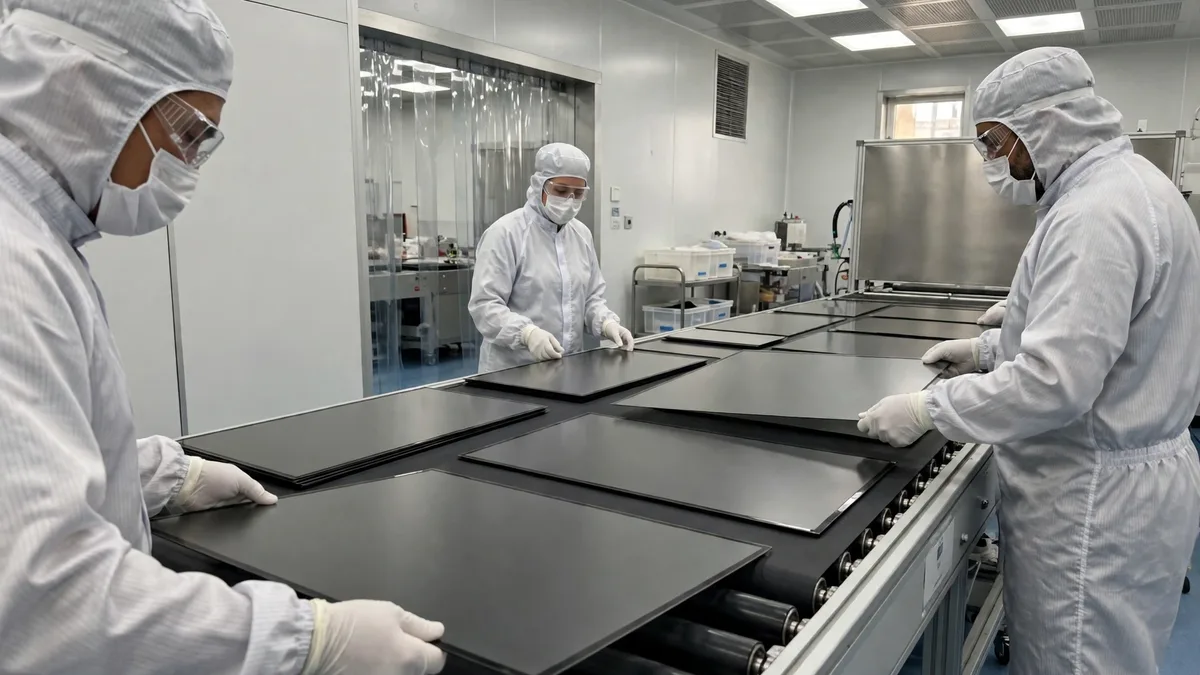
The two halves of the display meet in lamination. The coated e-ink film is unrolled, cut to size, and bonded onto the backplane with a transparent adhesive, pressed together by rollers that squeeze out every bubble of air. Alignment matters: the film must sit squarely on the backplane, and the edges must be sealed so that moisture cannot creep in and cloud the capsules. This is a quiet, slow step compared with the chemistry and the electronics that came before it, but it is the moment the display becomes a display, and a misaligned lamination cannot be undone.
Step 5: Cutting, bonding, and driving
The laminated sheet is cut into individual displays, each one bonded to its driver chip and flexible circuit, the electronics that will translate a page of text into the pattern of voltages the capsules need. A display that will live in an e-reader gets a different driver from one destined for a supermarket shelf label, but the bonding process is the same: fine wires or a flexible ribbon, attached under heat and pressure, and checked under a microscope. The materials behind the screen are covered in e-ink display materials engineering, and the numbers that define how it performs are covered in e-ink display specs explained.
Step 6: Testing, ageing, and packing
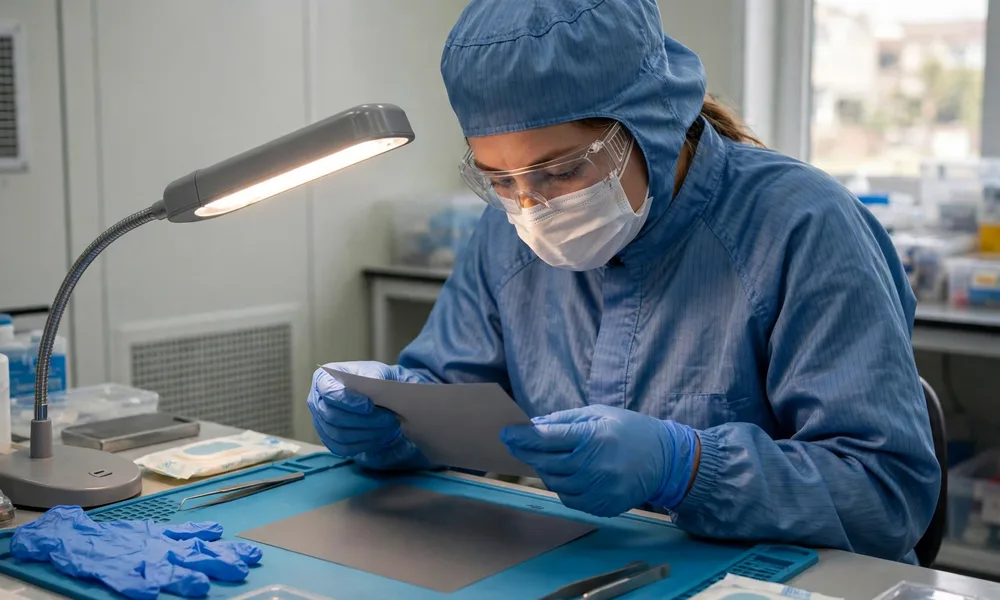
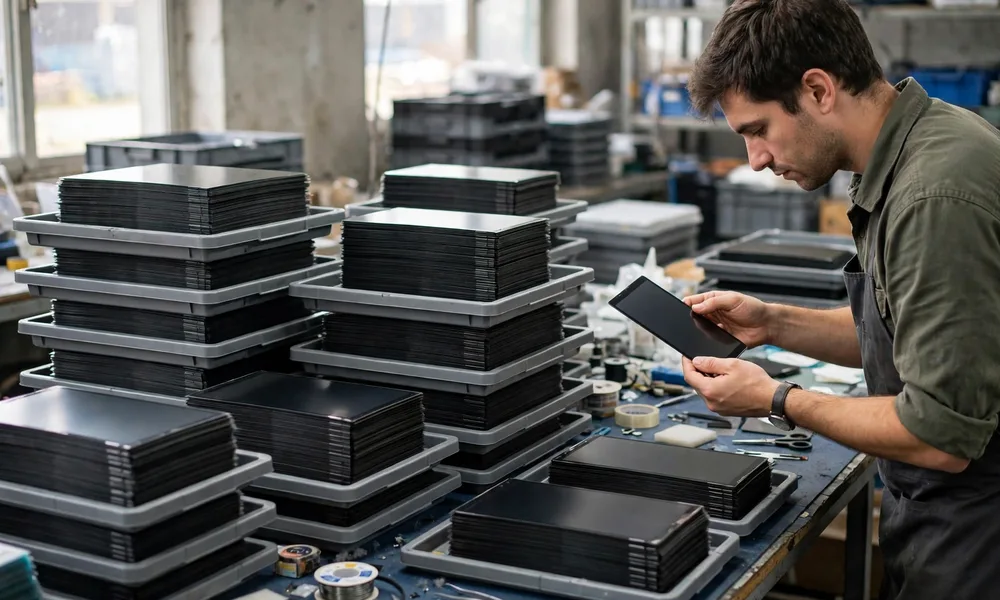
Every display is powered up and shown test patterns, while cameras look for patches that do not switch, lines that stay pale, and capsules that leak. The display is then aged, cycled through black and white many times so that any weak capsule fails in the factory rather than in a customer’s hands. Those that pass are cleaned, inspected by eye one last time, and packed in protective trays, ready for the reader or label factory. The closest rival technology, a screen that makes its own light, is covered in how an OLED display panel is built.
E-Ink Display Specs
| Specification | Typical range |
|---|---|
| Display type | Electrophoretic, microcapsule ink |
| Capsule size | About 40 to 100 micrometres across |
| Substrate | Glass, or flexible plastic film |
| Backplane | Thin-film transistors, one per pixel |
| Power use | Almost zero while holding a static image |
| Refresh time | About 0.3 to 1 second for a full page change |
| Contrast | About 10 to 1, similar to newsprint |
| Main weakness | Slow refresh and no light of its own |
What Does an E-Ink Display Cost?
E-ink displays are cheaper than glowing screens of the same size, and the price falls as the coated film lines run faster. A small e-reader display is estimated at roughly $15 to $40, depending on size and resolution, while a large shelf-label display is estimated at only a few dollars. The factory itself is the real cost: the coating lines, cleanrooms, and lamination equipment for a single plant are estimated at $100 million to $500 million to build. All prices are estimates only and vary widely by size, specification, and order volume.
A Rare Fact
The first e-ink screens were demonstrated in the late 1990s, and the capsules inside them were inspired by an unlikely source: the way squid and octopuses change colour. Those animals move pigment around inside tiny sacs in their skin to change shade in an instant, and the engineers behind electronic ink borrowed the trick, replacing living sacs with plastic capsules and muscles with electric fields. The result is a screen that behaves more like an animal’s skin than a television, and it still holds a page long after the power is gone.
An e-ink display is a quiet piece of engineering: ink in capsules, a sheet of tiny switches, and a bond between the two, made in a factory that prints its screens like newspapers and tests them like electronics. It does not glow, it does not flicker, and it does not hurry. It simply holds a page, patiently, until the reader is ready for the next one, and that patience is exactly why it works.