Stand on a city street and try to photograph a clock tower three blocks away with your phone. A decade ago, the result was a smear of pixels. Today the same phone, no thicker than a pencil, can pull that tower close enough to read the time. Yet the zoom is real, optical, and sharp. The secret is a fold.
A periscope zoom lens bends light through a right angle, laying the long optical path a telephoto needs flat along the width of the phone instead of sticking out of its back. A small prism at the camera window turns the light sideways, and it travels through a stack of tiny lenses to a sensor at the far end. The numbers on the spec sheet describe that folded journey: how far it reaches, how much light it gathers, and how steady it stays. Here is what each one means.
Optical Zoom and Focal Length
The headline number is the optical zoom, usually written as 5× or 10×, and it means the lens magnifies the scene that many times without cropping the image. A 5× periscope typically gives a focal length around 120 mm in full-frame equivalent terms, while a 10× module reaches roughly 230 mm. That is the difference between a portrait lens and a wildlife lens, folded into a phone. The zoom figure is measured against the phone’s main wide camera, so a 5× lens on a phone with a 24 mm main camera is a very different reach from 5× on a 28 mm one — always check the focal length in millimetres, not just the multiplier.
The Prism and the Folded Path
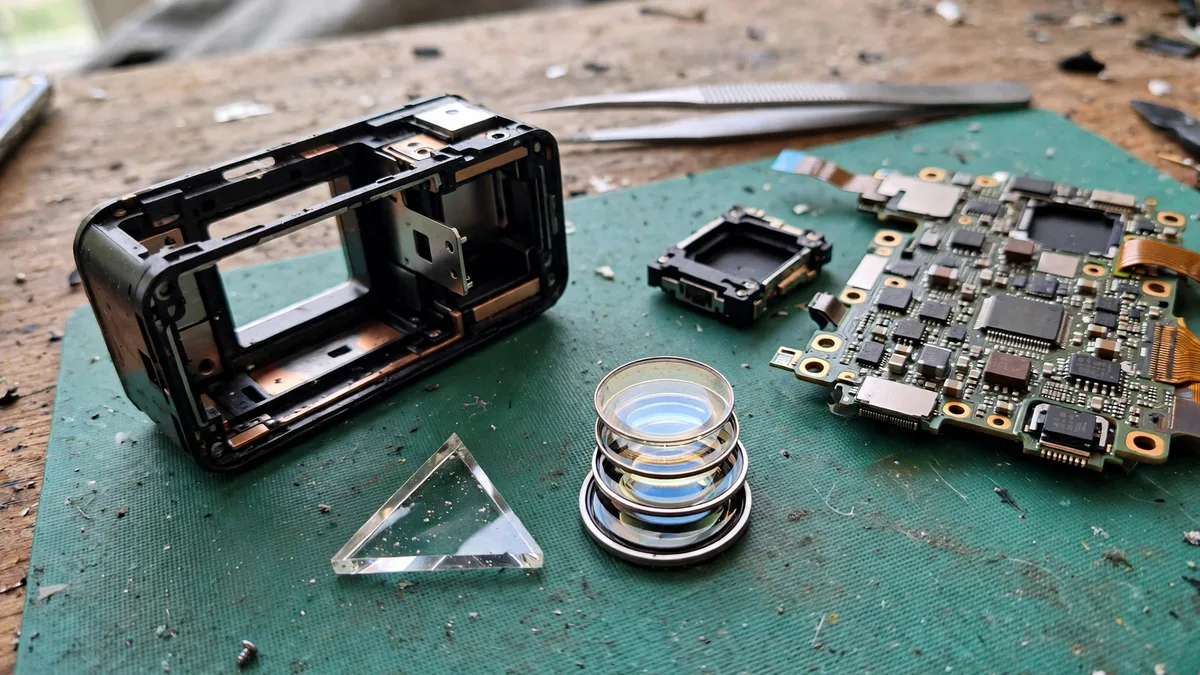
The prism is the part that makes the whole trick possible, and its spec is rarely printed on a box — yet it decides image quality. A good prism is a block of dense optical glass polished so precisely that light reflects off its angled face by total internal reflection, losing almost nothing in the turn. The fold also sets the module’s length: the longer the sideways run, the longer the focal length, which is why the most powerful periscope lenses stretch almost the full width of the phone. If you want to know how a periscope zoom lens works in detail, the folded light path is the place to start.
Aperture and Light Gathering
Aperture, written as an f-number like f/2.8 or f/3.4, describes how wide the lens opens to admit light. A smaller number means a wider opening and a brighter image, which matters most at dusk, indoors, or anywhere the light is poor. Periscope lenses almost always have narrower apertures than a phone’s main camera — f/2.8 to f/4.5 is typical — because the long folded path and the small front window limit how much light can enter. A 10× lens at f/4.5 gathers far less light than a 5× lens at f/2.8, so in dim conditions the shorter zoom often wins.
Sensor Size
Behind the lens sits the sensor, and its size is usually given as a fraction of an inch, such as 1/2 inch or 1/3.2 inch. A bigger sensor collects more light and produces less noise, which is why sensor size matters more than megapixels for image quality. Periscope modules generally use smaller sensors than main cameras — there is only so much room at the end of a folded tube — so a 48-megapixel periscope sensor can still be noisier than a 12-megapixel main sensor in low light. When comparing two phones, look at the sensor fraction first and the megapixels second.

Stabilisation
A telephoto lens magnifies shake as well as scenery: at 10×, a tremor of a millimetre in your hand becomes a blur several centimetres wide in the frame. That is why optical image stabilisation, or OIS, is essential in a periscope module. The spec to look for is the compensation range, often quoted in degrees — around 1 to 3 degrees of correction in a good module — or simply the number of axes, with five-axis stabilisation covering tilt, shift and rotation. The lens elements or the sensor float on tiny springs and magnets, shifting in the opposite direction to your hand in real time. Without it, a 10× zoom in daylight is usable but a 10× zoom at dusk is a lottery.
Focus Motor and Speed
Periscope lenses focus by sliding one or more lens elements along the folded path, driven by a voice-coil motor — the same kind of motor that moves a loudspeaker cone, shrunk to the size of a match head. The key specs are focus speed, usually a fraction of a second, and minimum focus distance, which tells you how close you can get to a subject and still have it sharp. Most periscope modules focus down to around 30 to 50 centimetres, so they are not macro lenses. The motor’s precision matters too: the elements must stop within a few micrometres of the right position, or the image softens.
Size and Thickness
The last spec is the one you can feel: module thickness, typically under 9 mm, and the camera bump it creates. Engineers fight for every tenth of a millimetre, because a taller module means a thicker phone or a bigger bump. The folded design keeps the phone slim, but the sideways run still needs width, which is why periscope cameras sit along the top edge of the phone. The materials behind the periscope zoom lens are chosen largely to survive in that cramped space: glass that bends light sharply so the stack can be shorter, and ceramics that guide the moving elements without wearing out.

The Specs at a Glance
| Optical zoom | 5× to 10×, around 120–230 mm equivalent |
| Prism | Dense optical glass, total internal reflection |
| Aperture | Typically f/2.8 to f/4.5 |
| Sensor | Usually 1/2 to 1/3.2 inch, 12–50 megapixels |
| Stabilisation | Optical, 1–3 degrees, up to five axes |
| Focus | Voice-coil motor, minimum distance 30–50 cm |
| Module thickness | Under 9 mm, folded sideways in the phone |
What Does It Cost?
A periscope zoom module costs several times more than an ordinary phone camera module (estimate) — typically tens of dollars per unit (estimate), against a few dollars for a basic fixed lens. The premium comes from the precision glass, the prism polishing, the miniature motors and the cleanroom assembly, all of which are lower-yield than standard camera parts. That is why the periscope zoom lens is so expensive compared with the rest of the camera system, and why it still appears mainly in flagship phones rather than budget models. As yields improve and more makers adopt the design, the price is falling, but the module remains one of the most expensive components after the display and the processor.
A Rare Fact
The periscope lens descends from a military invention: the first periscopes let submarines and trench soldiers see without being seen, folding light around a corner with prisms and mirrors. The phone version uses the same physics, shrunk a thousandfold. There is a pleasing symmetry in it — a technology built to let a submarine peer above the waves now lets a phone peer across a stadium — and the glass in your pocket is polished to the same standard as a surveyor’s telescope.