Seawater is a wonderful thing to sail in and a terrible thing to talk through. Radio waves that cross a continent in a blink fade to nothing within a few metres of salt water, which leaves a submarine with a simple problem: the deeper it goes, the quieter the world becomes. The answer is a piece of engineering that has to do two opposite jobs at once — stay hidden below the surface for hours at a time, and then rise above it to catch a signal.
That piece of engineering is the communications mast. It is a tall, slender column packed with antennas, cables and sensors, and it lives inside the submarine’s sail, raised on hydraulics when it is needed and lowered again when it is not. In the factory it is one of the most delicate assemblies on the boat, because everything about it has to work in a space barely wider than a person, under pressure, in salt water, after months at sea.
Building a mast is a job for two kinds of workshop at once: a heavy metal shop that can machine a column strong enough to take the force of the sea, and a clean electronics bench where antenna elements are fitted by hand. Our guide to how a submarine communications mast is made explains the parts and how they work together; this is the production story — the stages a mast passes through on its way from raw tube to a finished assembly ready to be fitted.

Building a Submarine Communications Mast
Step 1: Machining the mast column
The work begins with the column itself, a long tube of high-strength steel or a corrosion-resistant alloy, machined on a lathe big enough to take its full length. The outside must be smooth and round, because the mast slides up and down through seals in the submarine’s hull, and a rough surface would chew those seals out in weeks. The inside is machined for the cable runs and the lifting mechanism, and the wall thickness is checked all along its length, because a mast that bends under the drag of the sea is a mast that will jam.
Step 2: Fitting the antenna elements
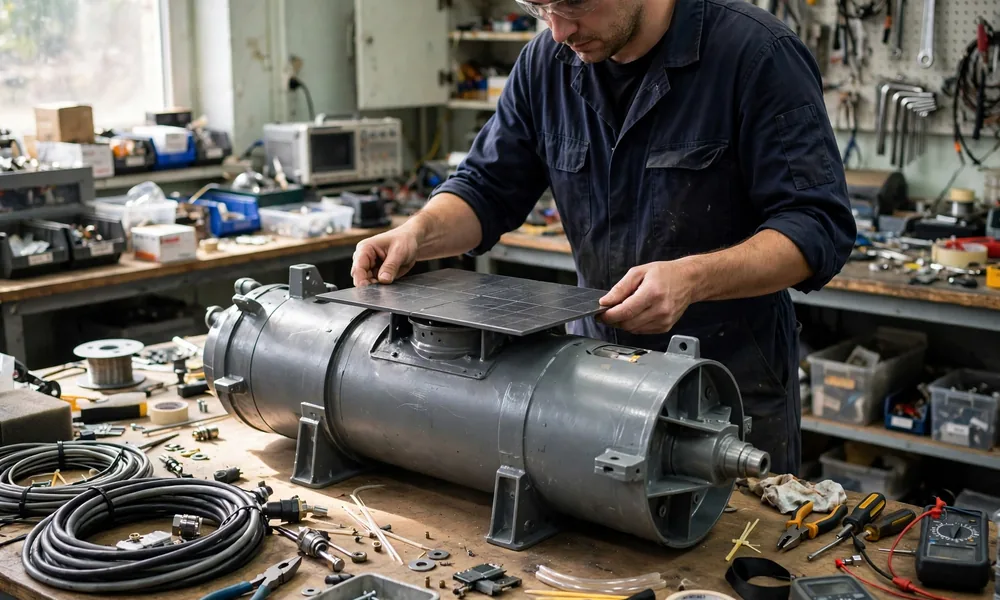
With the column ready, the antenna elements go on. These are flat panels, rods and loops, each tuned to a different band of radio, and they are fitted into housings along the mast so that they sit flush with the surface and do not catch the water. The fitting is done by hand on a bench, with the technician checking each element’s position against the drawing and sealing every joint against salt water. A mast carries several different antennas because no single one can do everything: some are for long-distance signals, some for short-range links, and some for navigation signals.
Step 3: Running the cables
The cables are the mast’s nervous system, and they are the hardest part to get right. Dozens of them run the length of the column — power, signal and control — and they have to survive being raised and lowered thousands of times without chafing, kinking or breaking. The factory routes them through guides and glands, ties them at intervals so they cannot move, and leaves just enough slack for the mast to extend fully. Each cable is labelled at both ends, and each one is tested for continuity and insulation before the mast moves on.
Step 4: Sealing against the sea
Salt water gets into everything, so the mast is sealed like a piece of diving equipment. O-rings sit in machined grooves at every joint, covers are bolted down over gaskets, and the whole assembly is pressure-tested in a tank to check for leaks. The seals around the raising mechanism get special attention, because they have to keep the sea out while the mast is moving, not just while it is still.
Step 5: Testing the raise and lower cycle
Before the mast leaves the factory, it is put through its paces on a test rig. Hydraulic rams raise it and lower it hundreds of times, and the engineers watch for smooth travel, correct speed and clean locking at the top and the bottom. They check that the mast stops exactly where it should, that the locking pins engage fully, and that the whole assembly can be raised quickly and lowered even faster.
Step 6: Final inspection and fitting
The last step is a full inspection and a trial fit into the submarine’s sail, where the mast will live. The factory checks every antenna’s signal against a test set, re-tests every cable, and signs off a file that records the mast’s measurements, test results and serial numbers. The hull it fits into is built from the same careful tradition: the ballast tanks that control the boat’s depth are covered in our guide to how submarine ballast tanks are made, and the titanium of the pressure hull is explained in our guide to submarine titanium hull materials. Once fitted, the mast will spend most of its life hidden away, raised only when the boat needs to hear from the world above.
Submarine Communications Mast Specs
| Specification | Typical range |
|---|---|
| Mast height when raised | About 5 to 10 metres above the sail, depending on boat class |
| Column material | High-strength steel or corrosion-resistant alloy |
| Antenna types | Several, covering different radio bands and navigation signals |
| Raise and lower | Hydraulic, with mechanical locking at top and bottom |
| Raise time | About 30 seconds to a few minutes, depending on design |
| Sealing | O-rings and gaskets at every joint, pressure-tested |
| Cable runs | Dozens of power, signal and control cables inside the column |
| Test cycles | Hundreds of raise and lower cycles before delivery |
What Does a Submarine Communications Mast Cost?
A complete submarine communications mast assembly is estimated to cost roughly $2 million to $8 million, depending on the number of antennas, the height of the mast and the class of submarine it is built for. That figure covers the machined column, the antenna elements, the cables, the hydraulics and the factory testing, but not the fitting into the submarine or the shore-side radio equipment it talks to. Prices are estimates only and vary by builder, specification and the number of masts ordered.
A Rare Fact
A submarine cannot use ordinary radio while it is submerged, because seawater absorbs most radio waves within a few metres. That is why the mast has to break the surface at all — and why crews keep it up for as short a time as possible.

The communications mast is a study in patience. It spends most of its life folded away, doing nothing, and then it is asked to work perfectly for a few minutes at a time, in the worst conditions a radio can face, with the sea trying to get into every joint. The factory that builds it works to the same standard: measure twice, seal everything, test it until it is boring. When the mast finally rises above a grey sea and the first signal comes through, all of that quiet work pays off at once.


