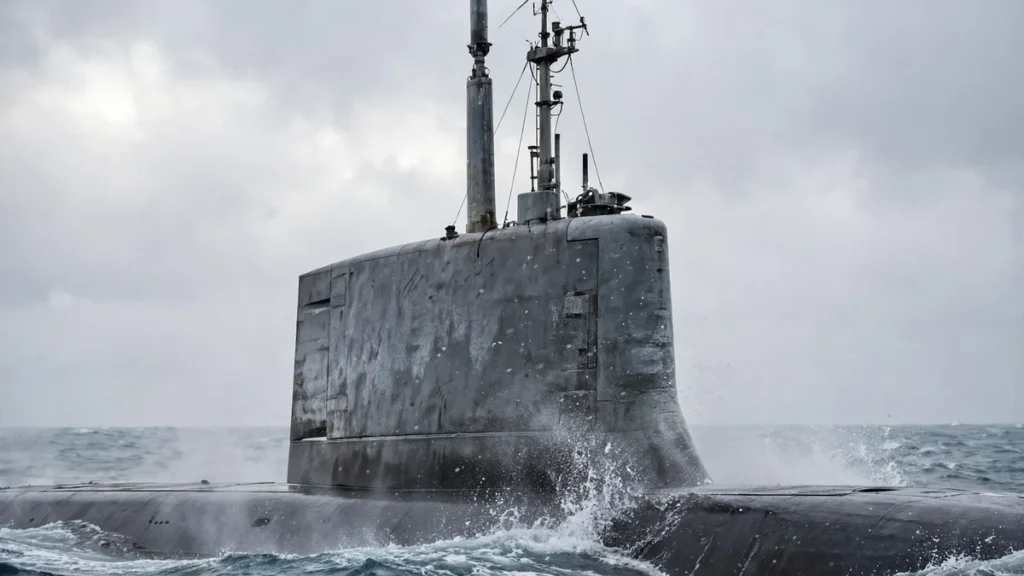
A submarine spends most of its life invisible. It runs deep, quiet and alone, hundreds of metres below the surface, and for weeks at a time no one on land hears a word from it. The only part of the boat that can do that talking is a slender tower of metal that rises from the sail, breaks the surface for a few minutes, and then slides silently back down into the hull. It is the communications mast, and it is one of the most delicate pieces of engineering on the whole submarine.
The mast is far more than a pole with an aerial on top. Inside a tube barely wider than a dinner plate sit radio aerials, satellite dishes, sensors and cables, all of them packed into a structure that must survive the crushing pressure of the deep sea, the salt water, the vibration of the engines and the shock of a dive. This is how that mast is made.

How It’s Made
Step 1: Designing the mast for pressure and stealth
The build begins on paper, years before any metal is cut. Engineers must fit a whole radio station into a tube that has to slide through a hole in the pressure hull, so every aerial, cable and motor is drawn to the millimetre. The mast has to be strong enough to stand up in a heavy sea at periscope depth, yet slim enough to leave almost no wake on the surface, because a wake can be seen from the air. The materials are chosen for the same reason: stainless steels and titanium alloys that resist salt water for decades, and special plastics that let radio waves pass through without blocking them.
Step 2: Machining the mast sections
With the design fixed, the mast is machined in sections. Each section is a hollow cylinder, turned on a lathe from a solid billet of stainless steel or titanium until its walls are only a few millimetres thick but perfectly round. The tolerances are brutally tight: a section that is even slightly out of round will jam in its guide tube, and a jammed mast is useless. The sections are built to telescope, sliding one inside the other like the tubes of an old spyglass, so the whole mast can collapse into the sail when the boat dives deep.

Step 3: Fitting the aerials and electronics
Next comes the part that makes the mast a radio station. Aerials for very-low-frequency radio, satellite links and navigation signals are mounted inside the top sections, where they are protected by covers made from a special composite that radio waves pass straight through. The aerials are wired to cables that run down the centre of the mast to the radio room below, and every joint is sealed against water. Technicians test each aerial as it is fitted, and a mast that fails is taken apart and rebuilt. The precision here is close to that of the sonar arrays fitted elsewhere on the boat, and the same care with tiny signals runs through both jobs, as in the submarine sonar array and its delicate listening gear.
Step 4: Sealing the mast against the sea
A communications mast is a hole through the pressure hull, and a hole is a risk. Every joint between the mast sections is fitted with seals that must keep the sea out at full diving depth, while still letting the mast slide up and down. The seals are made from tough rubber compounds that stay flexible in icy water, and they are tested in pressure chambers that squeeze them far harder than the ocean ever will. A single failed seal could flood the boat, so the testing is slow, repeated and unforgiving.
Step 5: Building the hoist and guide system
The mast does not rise by itself. Inside the sail sits a hoist: a hydraulic or electric drive that pushes the mast up through its guide tube and pulls it down again, smoothly and quietly, in less than a minute. The guide tube is a long, straight sleeve welded into the sail, and it must be perfectly aligned, because a mast that tilts will scrape, stick and wear out its seals. The same demand for smooth, reliable motion drives the design of the boat’s other retractable gear, including the submarine periscope, which rises and falls through the same crowded sail.

Step 6: Installing the mast in the sail
Only now does the mast meet the submarine. A crane lifts the finished assembly over the open sail and lowers it gently into the guide tube, while fitters guide it by hand and watch for the slightest catch. The mast is bolted to the hoist, the cables are connected to the radio room, and the seals around the hull penetration are fitted and torqued to their exact settings. The work is done inside the same steel tube that carries the crew, so every step is checked against the rules that govern the submarine pressure hull: nothing may weaken the hull, and nothing may be left loose to rattle at depth.
Step 7: Testing at sea
The final test cannot be done in a workshop. The submarine puts to sea, dives, and raises the mast at periscope depth in a real swell. The crew sends and receives messages, checks the satellite link, and listens for leaks or vibration. Only then is the boat cleared for patrol, and from that day the mast carries the only words the boat exchanges with the world above.
Specs
| Specification | Typical figure |
|---|---|
| Mast material | Stainless steel and titanium alloy, with radio-transparent composite covers |
| Mast height when raised | Several metres above the sail, depending on the boat |
| Sections | Usually 2 to 4 telescoping sections |
| Raise and lower time | Under a minute |
| Seals | Multiple rubber pressure seals, tested beyond full diving depth |
| Systems carried | Radio aerials, satellite links, navigation sensors and cables |
| Drive | Hydraulic or electric hoist inside the sail |
| Design life | 20 to 30 years, with seal replacement at refits |
Price
A submarine communications mast is never sold on its own, and navies do not publish a price for one. As an estimate, a complete mast assembly with its hoist, seals and electronics typically costs roughly $1 million to $5 million, depending on the systems it carries and the depth rating of the boat — these are estimates, and the final figure depends on the mast’s size and the electronics fitted. It is a small fraction of the cost of the submarine itself, but it is the fraction that keeps the boat in touch with the world.
A Rare Fact
Early submarines had no masts at all: they communicated by surfacing and waving flags, or by sending a crewman on deck with a lamp. The first radio masts were fixed poles that had to be unbolted and stowed before every dive, a slow and dangerous job in a rough sea. The modern telescoping mast changed all that, but it created a new problem — a raised mast leaves a thin white wake on the surface that aircraft can spot.
From a drawing on a draughtsman’s table to a whisper of radio from beneath the waves, the communications mast is a small machine with an enormous job. It must be strong, silent, watertight and invisible, all at once.