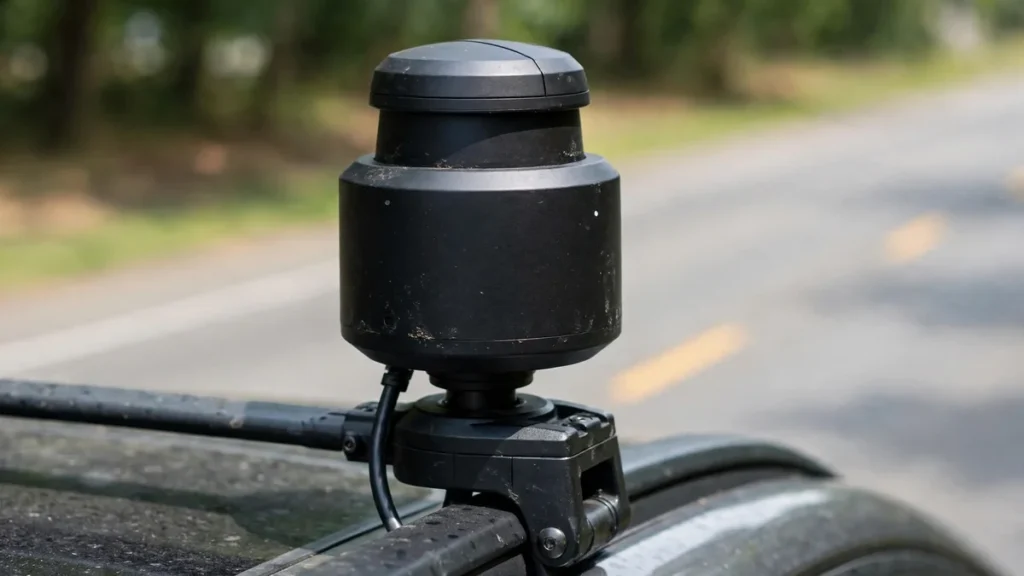
A LiDAR sensor sees the world in laser light. It fires millions of invisible pulses every second, times how long each one takes to bounce back, and builds a three-dimensional map of everything around it — a pedestrian stepping off a kerb, a cyclist in the rain, a wall a hundred metres away. Self-driving cars, robots, and survey drones all depend on that map, and they depend on it being right. A sensor that misjudges a distance by a few centimetres is a sensor that cannot be trusted.
That trust is earned in a factory that looks more like a laboratory than a production line. The work happens in clean rooms where a single speck of dust can ruin a lens, and where technicians in white suits assemble optics, lasers, and detectors by hand under microscopes. Each sensor is calibrated against targets at known distances before it leaves the building. Here is how a LiDAR sensor is produced, from a bare circuit board to a sealed unit ready for the road.

How It’s Made
Step 1: Designing the optics and the range
Engineers begin by choosing the sensor’s range, resolution, and field of view — how far it must see, how finely it must measure, and how wide an area it must cover. A long-range sensor for a motorway car may need to see 250 metres ahead, while a robot vacuum needs only a few metres but in every direction. The laser wavelength is chosen at the same time, usually 905 or 1,550 nanometres, because the wavelength decides how the light behaves in rain and fog and how safe it is for human eyes. The whole optical path is modelled in software before anything is built, since a lens a fraction of a millimetre out of place blurs the entire map.
Step 2: Making the laser and the detector
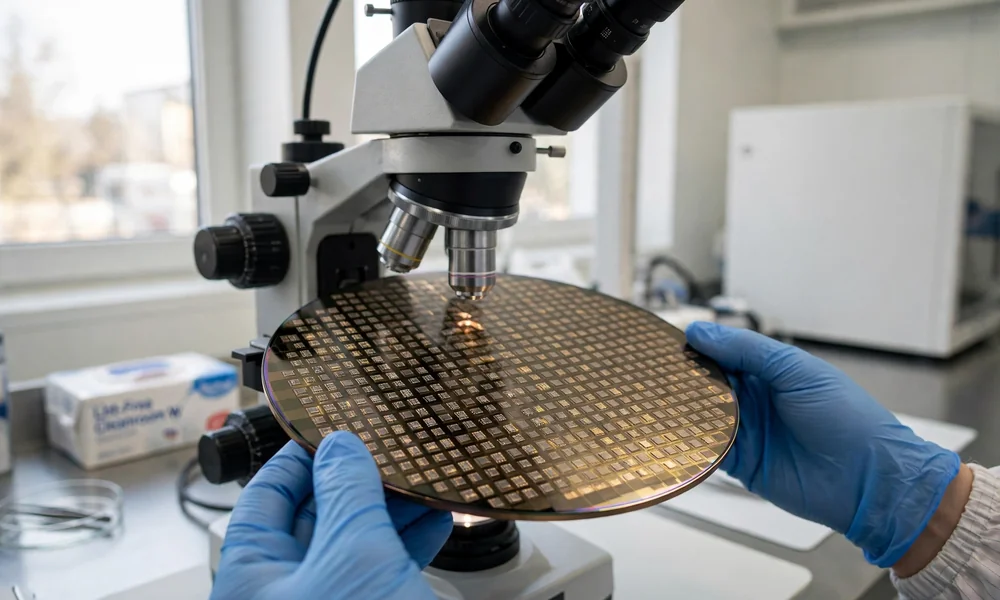
The heart of the sensor is its laser emitter and its detector, both made from semiconductor wafers in a chip factory. The laser is usually a vertical-cavity surface-emitting laser, a chip that fires a beam straight up from its surface, and it is grown layer by layer on a wafer, then cut into thousands of tiny dies. The detector, often an avalanche photodiode or a single-photon detector, is made the same way, and it must be sensitive enough to catch a handful of photons returning from a dark object a hundred metres away. Each die is tested on the wafer before it is cut out, and any that fail are marked and discarded.
Step 3: Assembling the optical module
The laser, the detector, and the lenses are assembled into an optical module in a clean room, where the air is filtered and the workers wear full suits, gloves, and masks. A single dust particle on a lens would scatter the laser beam and create false readings, so the assembly is done under microscopes with tweezers and vacuum pickups. The lenses are aligned to the laser with micrometre precision, then fixed in place with adhesive that is cured by ultraviolet light. In spinning sensors, the whole module is mounted on a motor that rotates it hundreds of times a minute, while in solid-state sensors the beam is steered by a tiny moving mirror or by switching between many fixed lasers.
Step 4: Building the electronics
While the optics are assembled, the sensor’s circuit boards are built on a separate line. A timing chip measures the flight time of each laser pulse to picosecond accuracy — a picosecond is a trillionth of a second — and a processor turns billions of those measurements into a point cloud, the three-dimensional map the car or robot actually uses. The boards are populated by pick-and-place machines that set hundreds of tiny components in seconds, then soldered in a reflow oven and tested electrically. The firmware that drives the sensor is loaded at this stage, and each board is given a serial number that follows it through the rest of the factory.
Step 5: Sealing the housing
The optical module and the electronics are fitted into a housing, usually aluminium, that must keep out dust and water while letting the laser pass through a window. The window is a special glass, coated to be transparent to the laser’s wavelength and tough enough to survive stones, rain, and car washes. The housing is sealed with gaskets and adhesive, then tested for leaks, because a sensor that fogs up from the inside is useless. A heater is often fitted behind the window to clear ice and condensation, and the whole unit is designed to survive the vibration, heat, and cold of life on a vehicle. The way the finished sensor actually maps its surroundings is explained in how a LiDAR sensor works.
Step 6: Calibrating and testing
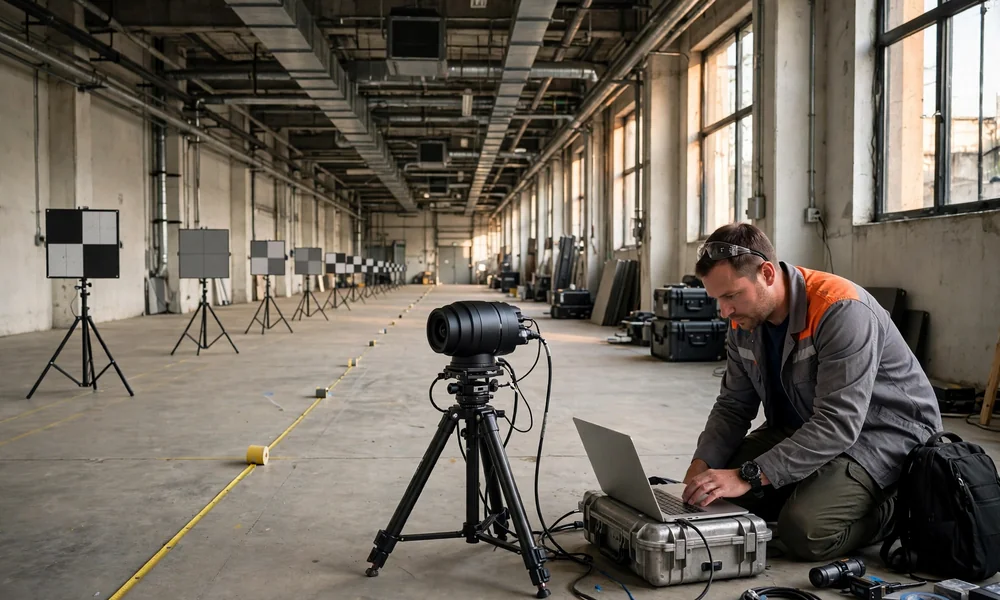
Every sensor is calibrated before it leaves the factory. It is aimed at targets placed at precisely known distances in a long test hall, and its measurements are compared with the truth and corrected in software. It is then tested for temperature, from freezing cold to desert heat, shaken on a vibration rig, and sprayed with water to prove its sealing. A final test runs the sensor for hours to catch any unit that drifts or fails early. Only a sensor whose map matches reality to within a few centimetres at every distance is passed, labelled, and packed for the customer.
Specs
| Specification | Typical figure |
|---|---|
| Sensor type | Time-of-flight LiDAR |
| Laser wavelength | 905 or 1,550 nanometres |
| Maximum range | Up to about 250 metres |
| Points per second | Over one million |
| Range accuracy | Within a few centimetres |
| Field of view | Up to 360 degrees, model dependent |
| Operating temperature | Roughly −40°C to 85°C |
| Build time | Hours of assembly plus calibration |
Price
A LiDAR sensor for a car is, as an estimate, roughly $500 to $1,000 for a mass-produced solid-state unit, while a high-end long-range mechanical sensor can cost several thousand dollars. Prices have fallen sharply in recent years as production volumes have grown, and makers expect them to keep falling. These are estimates, and the real price depends on range, resolution, and order size.
A Rare Fact
The timing inside a LiDAR sensor is so precise that it can measure a distance by timing light, which travels about 30 centimetres in a single nanosecond. To measure a distance to within a few centimetres, the sensor’s clock must be accurate to a fraction of a nanosecond — a level of timing that, only a few decades ago, existed only in physics laboratories. Today it fits in a box smaller than a shoebox, on the roof of a car.
LiDAR has quietly spread far beyond cars: the same sensing idea, shrunk down, helps robot vacuums map a living room, as robot vacuum LiDAR materials engineering shows, and other sensors that read the world in invisible light, like thermal cameras, are built with the same obsession with precision, as thermal camera sensor materials engineering explains. The next time a car slows itself for a pedestrian you had not even noticed, remember the clean room, the wafer of lasers, and the long hall of targets that taught its sensor to see.