Above the steel hull of a superyacht, everything you see is the superstructure: the white decks, the bridge, the saloons, and the cabins, rising in tiers toward the sky. On most modern superyachts, that whole upper world is made of aluminium. It is light enough to keep the yacht stable, strong enough to carry the bridge and the masts, and it can be shaped into the smooth, flowing curves that make a superyacht look fast even when it is standing still.
An aluminium superstructure is not a single piece. It is hundreds of plates, stiffeners, and frames, welded together in a shipyard shed, then lifted by crane and joined to the steel hull below. The join between aluminium and steel is one of the trickiest in shipbuilding, because the two metals expand at different rates and corrode each other if they touch. Getting it right takes a special strip of metal, careful welding, and a patience that shows in the finished yacht’s flawless paint.
Building a superstructure is slow, skilled, and very expensive work. Here is how it is made, from flat aluminium plate to the gleaming upper decks of a superyacht.

How a Superyacht Aluminium Superstructure Is Made
Step 1: Cutting the aluminium plates
The superstructure starts as plates of marine-grade aluminium alloy, usually the 5083 or 6082 grades, chosen for strength, weldability, and resistance to salt water. The plates are cut to shape on computer-controlled plasma or water-jet machines, following digital drawings that map every deck, bulkhead, and window opening. The cut edges are cleaned and prepared, because aluminium oxidises quickly in air, and a weld made through that oxide layer will be weak.
Step 2: Forming the panels and frames
Flat plates become curved panels in press brakes and rolling machines, bent to the gentle curves of the yacht’s design. Stiffeners, long bars of aluminium that give the thin plates their strength, are welded to the back of each panel, and frames are built up to carry the decks and support the weight above. The panels are assembled into blocks, sections of the superstructure built upside down or on their side for easier welding, each block checked against the drawings before it moves on.

Step 3: Welding the blocks together
The blocks are welded together with MIG or TIG welding, using filler wire matched to the aluminium alloy, in a process that demands clean metal, steady hands, and shielding gas to keep oxygen away from the molten weld. Aluminium welding is harder than steel welding: the metal conducts heat away quickly, it has no colour change to show its temperature, and it distorts easily if the heat is uneven. Welders work in a set sequence, balancing the heat across the structure so it does not warp, and every weld is inspected, visually and with dye penetrant or ultrasound, for cracks and pores.
Step 4: Joining aluminium to the steel hull
The finished superstructure must sit on a steel hull, and aluminium and steel cannot simply be welded together. The join is made with a bimetallic strip, a strip of aluminium explosively bonded to steel, welded to the aluminium on one side and to the steel on the other, with an insulating barrier to stop galvanic corrosion where the two metals meet. The strip runs around the whole perimeter of the superstructure, and it is one of the most critical joints on the yacht.
Step 5: Fairing the surfaces
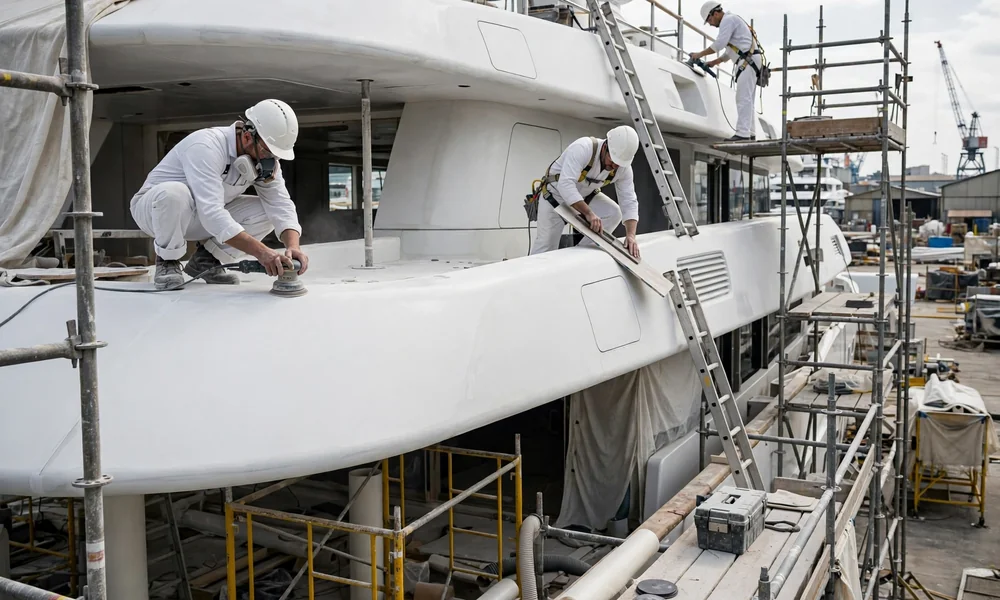
A superyacht is judged by its surfaces, and aluminium, for all its virtues, is not naturally smooth. After welding, the superstructure is faired: filler is applied to the welded seams and low spots, sanded by hand and machine in long, sweeping strokes, and checked with straightedges and lights that reveal every ripple. Fairing is the most labour-intensive part of the build, taking thousands of hours on a large yacht, and it is done by craftsmen who can feel a bump of a fraction of a millimetre through their fingertips. The goal is a surface so smooth that the paint will look like glass, with no hint of the plates and welds underneath.
Step 6: Painting and fitting out
The faired superstructure is primed, painted, and polished, usually in a white or pale colour that reflects the sun and keeps the interior cool. The paint system is built up in layers, primer, filler, topcoat, and clear coat, each one sanded and cured before the next, until the finish is deep and mirror-smooth. Windows are fitted into their openings with flexible seals that let the aluminium move without cracking the glass, and the interior is fitted out, cabins, saloons, and the bridge, with joinery, wiring, and air conditioning. Only then is the superstructure lifted by crane and lowered onto the hull, bolted and welded into place. The steel hull it sits on is covered in how a superyacht steel hull is made, the decks that crown it are covered in how a yacht teak deck is made, and the paint that finishes it is covered in how a superyacht paint system works.
Superyacht Aluminium Superstructure Specs
| Specification | Typical range |
|---|---|
| Main material | Marine-grade aluminium alloy, 5083 or 6082 |
| Plate thickness | About 5 to 12 mm, depending on location |
| Weight saving | About 60 percent lighter than an equivalent steel structure |
| Welding method | MIG and TIG, with matched filler wire |
| Hull join | Bimetallic transition strip, aluminium to steel |
| Fairing | Thousands of hours of hand sanding on a large yacht |
| Paint system | Primer, filler, topcoat, and clear coat |
| Inspection | Visual, dye penetrant, and ultrasound of welds |
What Does a Superyacht Aluminium Superstructure Cost?
There is no catalogue price for a superstructure, because every superyacht is built to order. The numbers around it still tell the story. A 50-metre superyacht is estimated at roughly $30 million to $60 million, a 70-metre yacht is estimated at $80 million to $150 million, and the superstructure accounts for a large share of the aluminium, labour, and fairing time in that bill. All prices are estimates only and vary widely by size, design, and yard. The white decks above the waterline cost more than most houses, and they are the part of the yacht everyone sees.
A Rare Fact
Aluminium superstructures were once considered a risk, not a luxury. Early aluminium yachts in the 1950s and 1960s suffered from corrosion where the aluminium met steel fittings, and from welds that cracked under the flexing of the hull at sea. The turning point came with better alloys, better welding, and the bimetallic transition joint, which finally made an aluminium top on a steel hull reliable. Today, almost every large superyacht is built that way, steel below the waterline for strength and weight low down, aluminium above for lightness and height. The combination is now so standard that a steel superstructure on a large yacht is the exception, not the rule.
A superyacht superstructure is, in the end, a piece of engineering disguised as a piece of sculpture. It is hundreds of aluminium plates, welded, faired, and painted until no trace of the work remains, carrying the bridge, the cabins, and the decks that make a yacht a home at sea. It is light, it is strong, and it is beautiful, and it is the reason a superyacht looks the way it does, long before anyone notices the hull beneath it.