On a superyacht, the most expensive square metres of deck are the ones a helicopter lands on. A helideck is a small airport welded onto a ship: a flat steel circle that must take the weight of a helicopter dropping out of the sky, stay level while the yacht rolls, drain fuel and seawater in seconds, and not catch fire if something goes wrong.
The deck is built in the yard, not bought off a shelf. Steel plate is cut, stiffened, welded and faired into a platform, then fitted with a landing grid, a firefighting system and lights that can be seen from the air. Every weld is tested, every surface is checked for flatness, and the whole deck is certified before the first helicopter ever touches it.
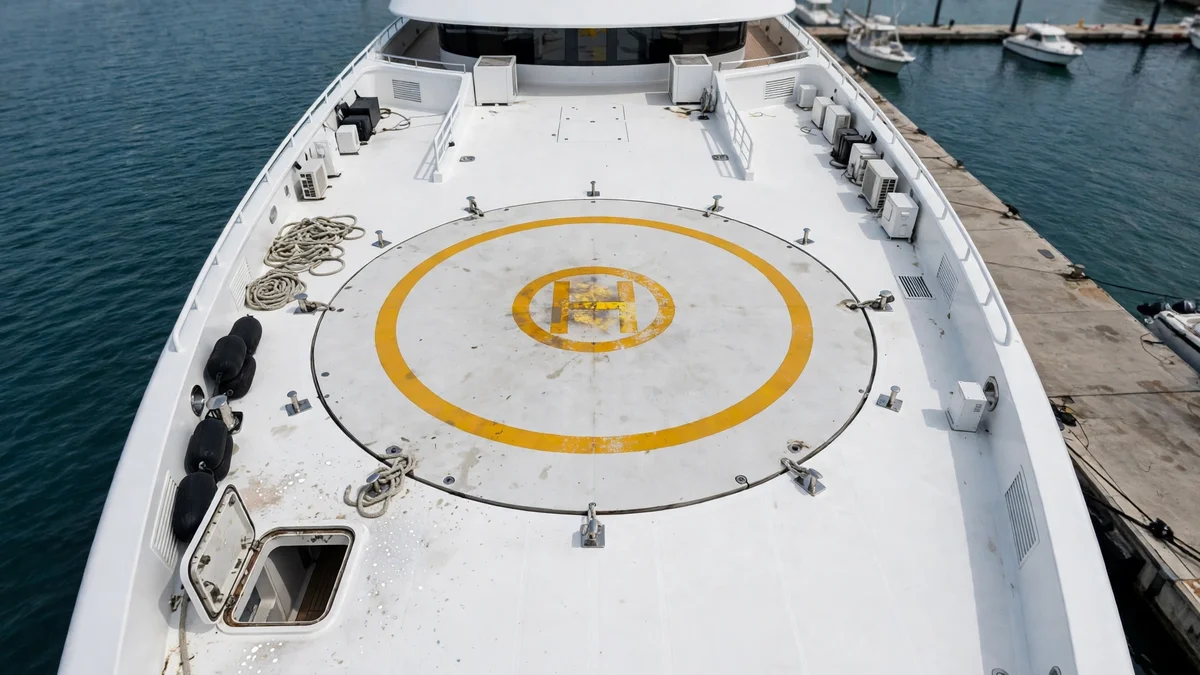
How a Superyacht Helicopter Deck Is Made
Step 1: Designing the deck around the helicopter
Every helideck starts with the helicopter it must serve. The designer takes the aircraft’s weight, its rotor diameter, its wheelbase and the loads it puts down when it lands hard, then sizes the deck to take it with a margin. A medium helicopter weighs about four tonnes; a heavy one can weigh more than ten. The deck must also fit the yacht: it usually sits forward, over the tender garage or the crew cabins, where the structure below can carry it. The design is checked against aviation rules for size, slope and clear space, because a deck too small or too close to the mast cannot be certified.
Step 2: Cutting and stiffening the steel plate
The deck itself is steel plate, typically 8–12 millimetres thick, cut to shape on a plasma or laser table and stiffened underneath with beams and brackets. The stiffeners are what make a thin plate strong: a flat sheet flexes under a helicopter’s wheels, but the same sheet with a grid of stiffeners welded beneath it stays rigid. The plate is assembled upside down on the shop floor, welded from below, then turned over and checked for flatness with straightedges and lasers. Almost no dip or crown is allowed — a helicopter on a slope will slide, and its rotors must clear the mast and antennas.
Step 3: Welding the deck into the yacht
Once the deck panel is flat, it is lifted by crane and welded into the yacht’s structure, joining the deckhouse and the bulkheads below. The welds are full-penetration, the strongest kind, and they are tested with ultrasound or dye penetrant to find any crack or void. This is the same heavy steelwork that shapes the rest of the vessel, and the hull that carries the deck’s loads is built in the yards that produce superyacht steel hulls. While the deck is welded in, the drains are fitted: a helideck must shed seawater and spilt fuel fast, so it is built with a slight fall to scuppers at the edges.
Step 4: Fitting the landing grid and tie-downs
A helicopter does not just sit on a helideck; it is locked to it. The centre of the deck carries a landing grid — a steel mesh or a set of recessed fittings that the helicopter’s wheels or skids lock into — and a ring of tie-down points around it. The tie-downs are flush fittings set into the deck, each rated to hold several tonnes, and the crew chains the helicopter down within minutes of landing. The fittings are welded in, tested to proof load, and covered with flush caps when the deck is used for sunbathing, so bare feet never find a sharp edge.
Step 5: Firefighting, lighting and safety systems
A helideck is a fire risk, so it carries its own firefighting system: foam monitors at the deck edges, a foam tank below, and a water deluge system that can flood the deck in seconds. The lighting is fitted next — a ring of green perimeter lights, a floodlit landing circle and an illuminated wind indicator — all of it flush or low-profile so nothing snags a rotor or a foot. The lights are wired to a control panel on the bridge, and the pilot and the bridge talk on a dedicated radio channel during every landing. The deck is finished in a yard that also handles ship dry dock work.

Step 6: Surfacing, marking and non-slip finish
The deck surface is coated with a non-slip finish, usually a grit-loaded paint or a bonded aggregate, so a helicopter’s wheels grip and crew can walk safely in rain. The landing circle and the yacht’s identification marking are painted in, and the whole surface is checked for flatness one more time — paint and filler can hide a dip, but they cannot fix one. On some yachts the deck is finished in teak or a pale composite to match the rest of the yacht. The finish must survive jet fuel, salt water and rotor wash, which strips ordinary paint in a season.
Step 7: Certification, trials and the first landing
Before the yacht is delivered, the helideck is certified: its dimensions, load ratings, firefighting system and lighting are inspected against the aviation rules, and the certificate is issued for a specific helicopter type. Then comes the trial — a real helicopter, a real pilot, and a landing on the new deck, watched by the yard, the owner and the surveyor. The pilot checks the approach and the tie-downs, and the yacht’s crew rehearse the fire drill. If the trial passes, the deck is cleared for service. The composite panels and fairings around the deck often come from the same shops that build composite layup parts for the yacht’s superstructure.
Superyacht Helicopter Deck at a Glance
| Specification | Typical Value |
|---|---|
| Main material | Marine-grade steel plate, 8–12 mm, stiffened underneath |
| Deck diameter | About 15–25 m, depending on helicopter type |
| Design load | About 4–12 tonnes, plus a hard-landing margin |
| Deck flatness | Almost no dip or crown allowed across the landing circle |
| Firefighting | Foam monitors and a water deluge system at the deck edges |
| Lighting | Green perimeter lights, floodlit circle, wind indicator |
| Tie-down rating | Several tonnes per fitting, flush with the deck |
| Key advantage | A certified landing area that doubles as open deck space |
What Does It Cost?
A certified helideck adds $500,000–$2 million (estimates) to the cost of a superyacht, depending on size, firefighting system and certification. The steelwork itself is a small part of the bill: the firefighting plant, the lighting, the landing grid and the certification trials cost far more than the plate. But for an owner who wants to fly from the yacht to a city or a remote beach, it is the feature that makes the yacht a base, not just a boat.

A Rare Fact
The largest superyacht helidecks are certified for helicopters so heavy that the deck must be strong enough to take the aircraft landing with one engine out, dropping harder than any normal landing. And there is a detail few guests ever notice: the helideck is the only part of a superyacht that is built to aviation rules rather than marine rules, so its drawings are checked by aviation surveyors who have never built a ship. On some yachts the helideck doubles as a dance floor at anchor — the crew roll out a carpet over the landing circle, and by morning the helicopter is back and the carpet is gone.


