A sailing yacht is held together by string. Not rope from a chandler’s shelf, but a web of wire, rod and fibre so precisely made that a single strand can carry the weight of a small car, and the whole set can hold a mast taller than a house steady in a gale. The standing rigging — the stays and shrouds that hold the mast up — does the quietest, hardest job on the boat. It never moves, never makes a sound, and if it fails, the mast comes down in seconds.
Making that rigging sits between a wire-rope factory and a sail loft. Coils of stainless wire, bars of rod and spools of black carbon fibre arrive, and leave as a numbered set of stays, each cut to the millimetre and tested before it ships.

How Yacht Sail Rigging Is Made
Step 1: Measuring the mast and the boat
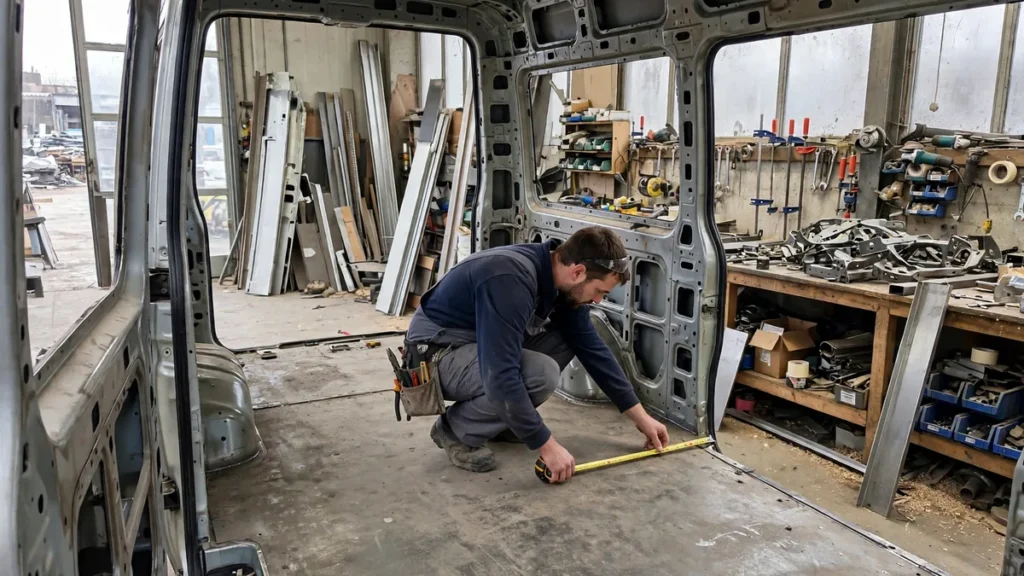
Nothing is cut until the boat is measured. The rigger takes the mast height, the chainplate positions, the spreader angles and the rake of the mast — how far it leans aft — and turns them into a cutting list. On a new build the numbers come from the naval architect’s drawings; on a refit they come from a tape measure run up the mast. A forestay ten millimetres too long changes the shape of the headsail and the balance of the boat, so the measurements are checked twice.
Step 2: Choosing the wire, rod or fibre
Most cruising yachts still use stainless steel wire rope, made of many fine strands twisted together so it bends around sheaves and fittings. Racing yachts use rod rigging — solid stainless rod, stiffer and lighter, with less stretch — or carbon fibre, which is lighter still and barely stretches at all. The choice is a trade-off: wire is cheap and forgiving, rod is fast and demanding, carbon is the lightest and the most expensive. The same judgement about materials shapes the deck around the rigging, where yacht teak decks are built to take the same salt, sun and load without splitting.
Step 3: Cutting and swaging the terminals
Each stay is cut to length, then a terminal is fitted to each end — the eye, fork or stud that connects the stay to the mast or the deck. The common method is swaging: the terminal is a sleeve that slides over the wire and is squeezed onto it in a hydraulic press, cold-forming the metal around the strands so the wire and the fitting become one piece. A swaged terminal, done well, is as strong as the wire itself. Rod rigging ends are cold-headed instead, rolled into a mushroom shape that locks into a fitting.
Step 4: Building the turnbuckles and fittings
The tension in the rig is set by turnbuckles — bronze or stainless bodies with a threaded stud at each end that draw the stay tight when turned. Turnbuckles are machined, polished and assembled in the same workshop, and each one is matched to its stay. The other fittings — toggles that let a stay swing, spreader tips, mast tangs — are made to the same standard. A toggle that cannot move freely loads the wire sideways, and sideways load is what breaks wire.
Step 5: Running rigging and the sail-handling gear
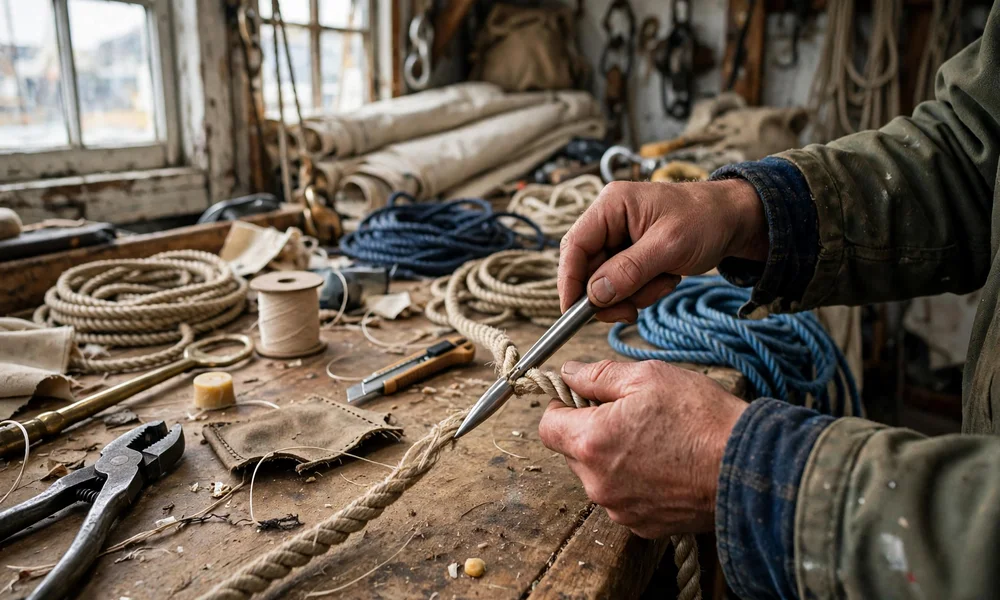
Standing rigging holds the mast up; running rigging moves the sails. Halyards, sheets and control lines are made from braided rope, often with a Dyneema core for strength and a polyester cover for grip in a winch. The lines are spliced, not knotted — a splice keeps almost all the rope’s strength, while a knot can lose half of it. The workshop splices eyes into halyards, whips the ends so they cannot fray, and marks each line with coloured whipping so the crew knows which line is which in the dark. A halyard that jams is a sail that cannot come down, so every splice is checked under load.
Step 6: Proof loading and testing
Before a rigging set leaves the workshop, each stay is pulled to a proof load — typically about half its breaking strength — on a hydraulic test bed. The pull stretches the wire slightly, seats the terminals, and reveals any weak point before the boat does. Carbon rigging is inspected with ultrasound for voids in the laminate and proof-loaded in smaller steps, because carbon gives no warning before it breaks. Anything that fails or stretches too far is cut out and remade.
Step 7: Labelling, packing and stepping the mast
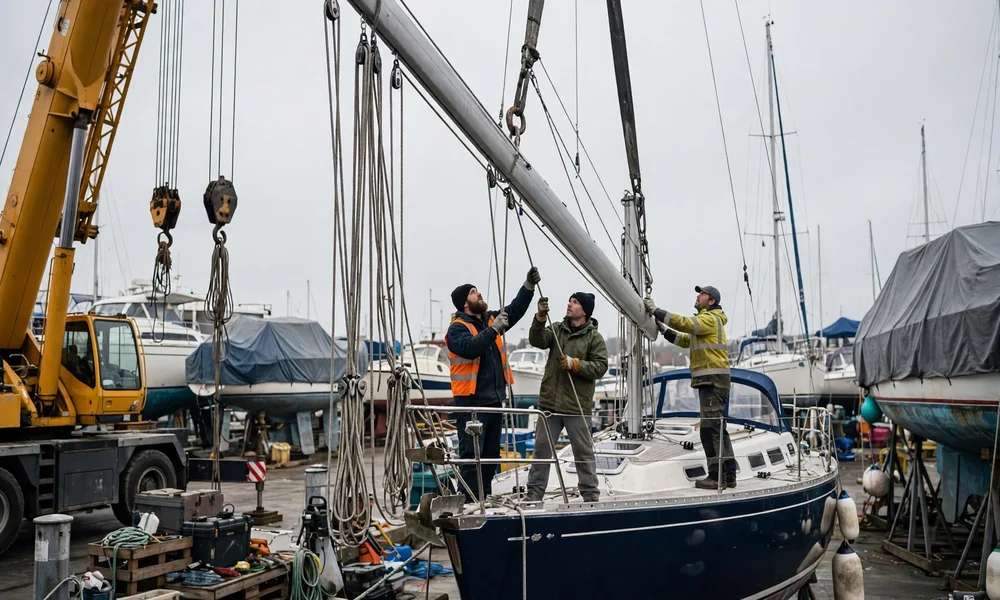
The finished set is labelled stay by stay — forestay, backstay, port and starboard shrouds, inner stays — coiled, and packed so nothing kinks. Wire that is kinked is wire that is ruined. At the yard the mast is stepped, the stays are pinned to their chainplates, and the rig is tensioned with a gauge until the mast is straight and the tension matches the designer’s numbers. The final check is a sail in a breeze: if the mast bends evenly and the rigging hums at the right pitch, the job is done. The hull below is built to the same discipline, and the steelwork that carries those chainplate loads is part of how superyacht steel hulls are made.
Yacht Sail Rigging at a Glance
| Specification | Typical Value |
|---|---|
| Main materials | Stainless steel wire or rod; carbon fibre on racing yachts |
| Wire breaking load | About 3–20 tonnes per stay, depending on size |
| Rod rigging stretch | Roughly half the stretch of equivalent wire |
| Carbon rigging weight | Up to 80% lighter than stainless steel for the same strength |
| Proof load | About 50% of breaking load, held on a test bed |
| Terminal method | Swaged sleeves for wire; cold-headed ends for rod |
| Service life | About 10–15 years for stainless wire; inspect annually |
| Key advantage | Huge strength for very little weight, tuned to the millimetre |
What Does It Cost?
A full standing rigging set for a 40-foot cruising yacht typically costs $5,000–$15,000 (estimates), including wire, terminals, turnbuckles and fitting. Carbon rigging for a racing yacht of the same size can cost $30,000–$80,000 (estimates), and a superyacht rigging set runs into hundreds of thousands of dollars. The wire itself is only part of the bill: the labour of measuring, swaging, splicing and proof-loading is what owners budget for. Skimping on rigging is the most expensive saving in sailing — a failed stay costs a mast, and a lost mast can cost a boat.
A Rare Fact
The wire in a yacht’s rigging is made the same way as the cables of a suspension bridge, strand by strand, but the most extreme rigging in the world is not on a yacht at all. The rigging on a racing multihull is so highly loaded that its carbon stays are built in the same autoclaves as aircraft parts. And there is a quiet tradition among riggers: the first time a new rig is tensioned, they tap each stay and listen. A stay at the right tension rings at a true note, and an experienced rigger can hear a slack stay the way a musician hears a flat string. The same fibre science behind those stays also shapes how carbon fibre weave is made, where the cloth itself is the starting point.