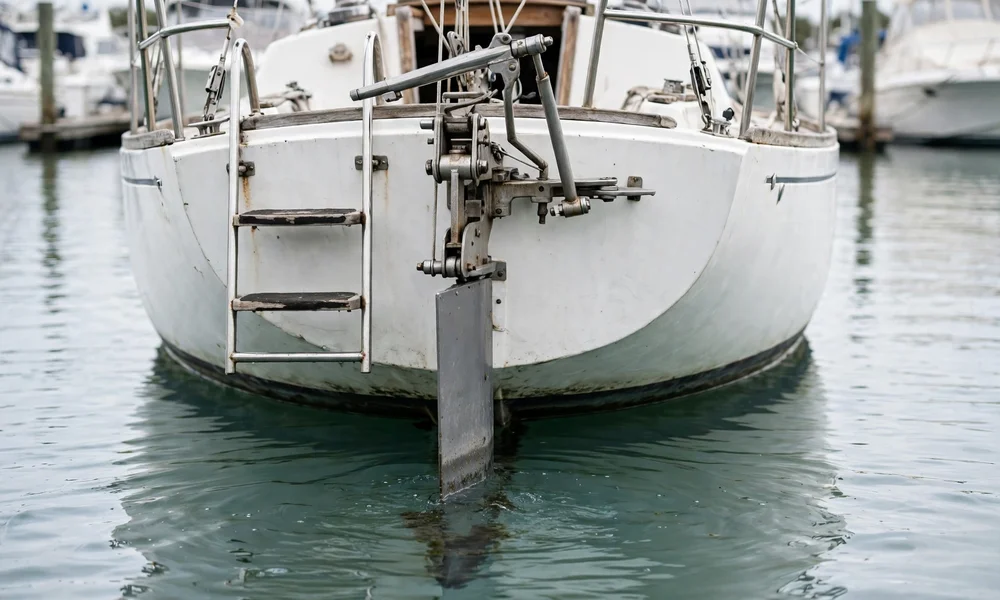
Turn a yacht’s wheel and something remarkable happens below the waterline: a flat blade the size of a door swings sideways, the water piles up against it, and a vessel weighing twenty tonnes changes direction. That blade is the rudder, and for all its quiet work it is one of the most heavily engineered parts on the boat. It must steer precisely at three knots in a marina and survive a storm at twenty, while living permanently underwater in salt and pressure.
A rudder looks simple from the dock — a fin hanging off the stern — but inside the factory it is a careful sandwich of metal, composite and engineering. A single failure can leave a yacht unsteerable hundreds of miles from land, so builders treat the rudder the way aircraft factories treat a wing. Here is how it is made, from raw stock to the final sea trial.

How It’s Made
Step 1: Designing the blade and stock
Everything starts with the naval architect’s calculations. The rudder’s size is set by the yacht’s displacement, sail area and top speed: too small and the boat will not answer the helm in a blow, too large and it drags through the water, costing speed on every mile. The blade is drawn as a foil section, like an aeroplane wing on its side, so flowing water generates lift that turns the boat. The designer also sizes the rudder stock — the vertical shaft that carries the blade — because the twisting force, or torque, on that shaft can reach several tonne-metres on a large yacht. The drawings specify the stock diameter, bearing positions and internal frame, and the factory follows them exactly.
Step 2: Building the internal frame
Inside most modern rudders is a skeleton of stainless steel. Flat plates are cut to the blade’s profile on a plasma or waterjet table, then welded into a frame of horizontal arms radiating from the stock, with a tang at the top and bottom to lock everything together. The welds are ground smooth and inspected, since a sharp edge inside can become a stress point years later. On smaller yachts the frame may be a single plate; on a superyacht it is a lattice weighing hundreds of kilograms. The finished frame is checked against the drawings with a template, and only then does the factory start closing it up.
Step 3: Shaping the skin
The blade’s skin is usually glassfibre or carbon fibre laid over a mould, or welded stainless steel plate on a metal rudder. In a composite rudder, the factory lays resin-soaked cloth into a two-half mould until the skin reaches its thickness, then places the steel frame inside and closes the mould. The whole assembly is vacuum-bagged and cured, squeezing out trapped air so the skin bonds tightly to the frame. In a steel rudder, plates are rolled to the foil curve, welded to the frame and ground flush. Either way the goal is the same: a perfectly smooth, symmetrical foil, because a lumpy rudder hums, vibrates and wastes energy. The keel below the hull is built to the same foil discipline, and the two foils work as a pair every time the yacht turns.
Step 4: Fitting the stock, bearings and seals
With the blade shaped, the factory turns to the stock. It is machined from solid stainless steel or high-strength bronze on a lathe, its bearing journals polished to a mirror finish so the rudder swings without friction. The stock is welded or keyed to the frame, and the joint is dye-tested for cracks invisible to the eye. Bearings — usually self-lubricating composite or bronze bushes — are pressed into the rudder tube, and seals are fitted to keep seawater out of the hull. A poorly sealed stock lets water into the blade, where it freezes, expands and slowly destroys the structure from within. Good factories pressure-test the seal before the rudder leaves the bench.
Step 5: Fairing, balancing and coating
A raw rudder is faired — coated with epoxy filler and sanded, sometimes three or four times — until a straightedge shows no gaps along its surface. The blade is then balanced: it is hung from its stock and checked to see whether it swings true, because an unbalanced rudder loads the steering gear unevenly and makes the autopilot work twice as hard. Finally the blade is coated with epoxy primer and antifouling paint, the same hard-wearing finish that protects the hull. The stabilizer fins on a larger yacht go through an almost identical fairing routine, since they too are foils that must stay smooth to work.
Step 6: Testing and fitting to the yacht
Before delivery, the rudder is load-tested: the factory applies the design torque to the stock and measures how much the blade deflects, checking it against the architect’s limits. The bearings are tested for play, the seals for leaks, and the whole unit is weighed to confirm the blade will not make the yacht stern-heavy. On installation day the rudder is lifted into place, the stock slid up through the rudder tube, and the steering quadrant bolted on. The yard then swings the rudder hard over to port and starboard, checking for full travel with no binding. Only after a sea trial at speed is the rudder signed off. A bow thruster at the other end of the yacht handles the slow-speed nudges, but at sea the rudder does all the real steering.

Yacht Rudder Specifications
| Specification | Typical Value |
|---|---|
| Blade construction | GRP or carbon skin over welded stainless frame |
| Stock material | Stainless steel or high-strength bronze |
| Blade area | 1.5–6 m², depending on yacht size |
| Stock diameter | 60–150 mm |
| Maximum rudder angle | 35° each side |
| Bearing type | Composite or bronze self-lubricating bushes |
| Design torque | Up to 30,000 Nm on a large yacht |
| Service life | 20+ years with regular seal and bearing checks |
What a Yacht Rudder Costs
Prices are estimates and vary with yacht size, materials and the yard. A replacement rudder blade for a 12-metre cruising yacht typically costs an estimated $4,000–$9,000, while a stock and bearing set adds an estimated $1,500–$3,500. A custom carbon rudder for a 20-metre performance yacht can reach an estimated $25,000–$45,000, and a superyacht rudder, with its engineered stock, twin bearings and hydraulic steering interface, can cost an estimated $120,000–$300,000 or more. Fitting, alignment and sea-trial time usually add an estimated 15–25% on top. A failed stock or waterlogged blade can cost ten times the rudder’s price in haul-outs and repairs.
A Rare Fact
Some of the fastest racing yachts carry rudders with small horizontal wings, called winglets, on the bottom of the blade. The winglet does not steer — it generates lift that pulls the stern down, keeping the yacht level when flying downwind. The idea was borrowed from aircraft winglets, and on a racing yacht it can be worth a fraction of a knot that, over an ocean race, turns into hours.
The rudder is the part of a yacht you never admire and always depend on. It is built slowly, tested hard and finished by hand — because when the wind rises and the coast is a lee shore, the whole boat is only ever as good as the blade hanging off its stern.