The marina was crowded, the wind was pushing the yacht sideways towards a gleaming hull it really did not want to touch, and the skipper had perhaps a metre of room on either side. He tapped a small joystick on the console. Under the waterline, at the very front of the boat, a small propeller spun up inside a tunnel, pushed a jet of water sideways, and the bow slid gently away from danger as if an invisible hand had moved it. That is the entire job of a bow thruster: to move the front of a yacht sideways, on demand, in exactly the places where there is no room to make a mistake.
A bow thruster is a small propeller in a tunnel through the bow, driven by an electric motor or a hydraulic pump, and controlled from the helm. The tunnel has to be bored through the strongest part of the hull without weakening it, the propeller has to survive cavitation and debris, the seals have to keep the sea out of the motor, and the whole thing has to work after months of sitting unused in a marina. Building one is a mix of precision machining and heavy marine engineering, and every unit is tested in water before it is trusted.
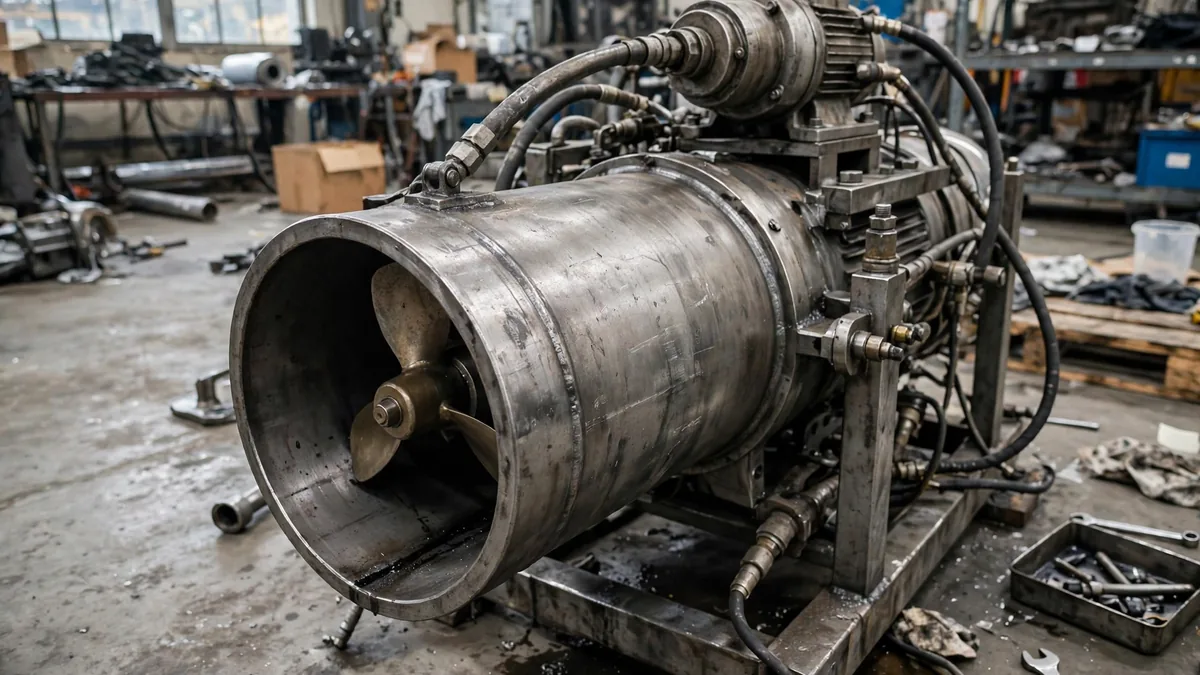
Inside the Factory
Step 1: The tunnel
Every bow thruster starts with a tunnel — a tube of glass-reinforced plastic or steel that passes through the bow from one side to the other. The tunnel is moulded or rolled to an exact diameter, because the propeller inside it needs a precise gap to the tunnel wall: too wide and the thrust leaks away around the blades, too tight and the propeller strikes the wall. The ends of the tunnel are flared into a smooth bell shape, so water flows in cleanly instead of tumbling.
Step 2: The propeller
The propeller is small — often no bigger than a dinner plate — but it is machined like a piece of aerospace hardware. It is usually cast or machined from bronze or a composite, then balanced to a fine tolerance, because an unbalanced propeller at several thousand revolutions per minute vibrates, and vibration in a tunnel bolted to the hull is felt all over the yacht. The blades are shaped to push water equally well in both directions, since the thruster must move the bow to port and to starboard. The size, thrust and power of the unit are set out in yacht bow thruster specs explained, from tunnel diameter to motor rating.

Step 3: The motor and gearbox
The motor that drives the propeller is either a powerful electric motor or a hydraulic motor fed by a pump, and it sits in a sealed housing at the centre of the tunnel. Electric motors are chosen for smaller yachts, where a battery bank can supply the short, sharp bursts a thruster needs; hydraulic motors are chosen for larger yachts, where they can run for longer without overheating. The motor is coupled to the propeller through a gearbox that turns high speed into high torque, and the whole assembly is sealed with multiple shaft seals.
Step 4: The seals
Seals are the difference between a thruster and a leak. The propeller shaft passes from the dry motor housing into the wet tunnel, and the seals on that shaft have to keep the sea out while the shaft spins at full speed. Most thrusters use double lip seals with a grease barrier between them, so that if the outer seal weeps, the inner seal still holds. The seals are fitted by hand, inspected under a magnifier, and pressure-tested before the unit is assembled. How the seals, motor and propeller work together under way is explained in how a yacht bow thruster works, from the joystick to the jet of water.
Step 5: The controls and safety interlocks
The thruster is controlled from the helm by a joystick or a pair of buttons, and the control system is as carefully built as the hardware. The electronics limit how long the thruster can run continuously, so the motor cannot overheat, and they lock the thruster out when the yacht is moving too fast, because a thruster at speed does nothing but waste power and risk damage. The system is tested end to end on the bench — joystick in, propeller out — before it is packed, because a thruster that does not answer the helm is worse than no thruster at all.
Step 6: Water testing and the final check
No bow thruster leaves the factory without being tested in water. Each unit is mounted in a test tank, run in both directions, and measured for thrust, current draw and noise. Engineers watch for cavitation — the tiny bubbles that form when a propeller spins too fast and eat away at the blades — and for vibration that would shake the hull. The full build, from tunnel to test tank, is laid out in how a yacht bow thruster is made, step by step from the mould to the water.

Yacht Bow Thruster at a Glance
| Specification | Detail |
|---|---|
| Tunnel material | Glass-reinforced plastic or steel, flared ends |
| Propeller | Bronze or composite, balanced, works in both directions |
| Drive | Electric motor or hydraulic motor, sealed gearbox |
| Typical thrust | Roughly 30–200 kg of sideways force, depending on yacht size |
| Tunnel diameter | Commonly 125–300 mm for cruising and superyachts |
| Seals | Double lip seals with a grease barrier on the propeller shaft |
| Key test | Thrust and current measurement in a test tank, plus heat-soak runs |
| Main weakness | Cavitation damage to blades, and seal failure letting in salt water |
What Does It Cost?
A bow thruster for a cruising yacht typically costs around $3,000 to $8,000 for the unit, while a full installation — tunnel, thruster, wiring, controls and labour — usually runs to roughly $6,000 to $15,000. Larger yachts with hydraulic systems and bigger tunnels can cost $20,000 to $50,000 or more installed. The price climbs with the size of the yacht, because a heavier bow needs more thrust, a bigger tunnel and a stronger motor, and retrofitting a tunnel into a finished hull costs far more than fitting one during construction. Those figures are estimates, not quotes, and they do not include the cost of a bigger battery bank for electric systems.
A Rare Fact
Bow thrusters were once the preserve of large ships, where they have been used since the mid-twentieth century to manoeuvre in harbours without tugboats. The technology trickled down to yachts as electric motors and batteries improved, and the first yacht thrusters were little more than adapted industrial motors bolted into a hole in the bow. Today, some superyachts carry thrusters so powerful they can hold the entire vessel against a strong crosswind while it waits for a berth — a party trick that would have needed a tugboat fifty years ago.
The bow thruster is the part of a yacht that earns its keep in the worst moments — a crowded marina, a gusty crosswind, a berth with a metre to spare. It does nothing on the open sea, and everything in the last fifty metres.


