There is an engine in the world with no camshafts, three cylinders, and more power per litre than almost anything ever bolted into a road car. It is called the Tiny Friendly Giant, and it sits in the middle of the Koenigsegg Gemera, a four-seat grand tourer that does 0 to 100 kilometres per hour in under two seconds. The engine is a two-litre, twin-turbo, three-cylinder unit — the kind of specification you would expect in a small family hatchback — yet it produces 600 horsepower on its own, before its electric motors add another 1,100. It costs what it does because almost nothing about it is normal.
Koenigsegg is a company of a few hundred people in a small town in Sweden, and it builds cars in the dozens, not the thousands. Every Gemera engine is assembled by hand, from parts mostly made in-house or by a handful of specialist suppliers. There is no shared platform, no parts bin from a bigger manufacturer. What you are paying for is an engine that exists because a small team of engineers decided to throw away a century of convention — starting with the camshaft.
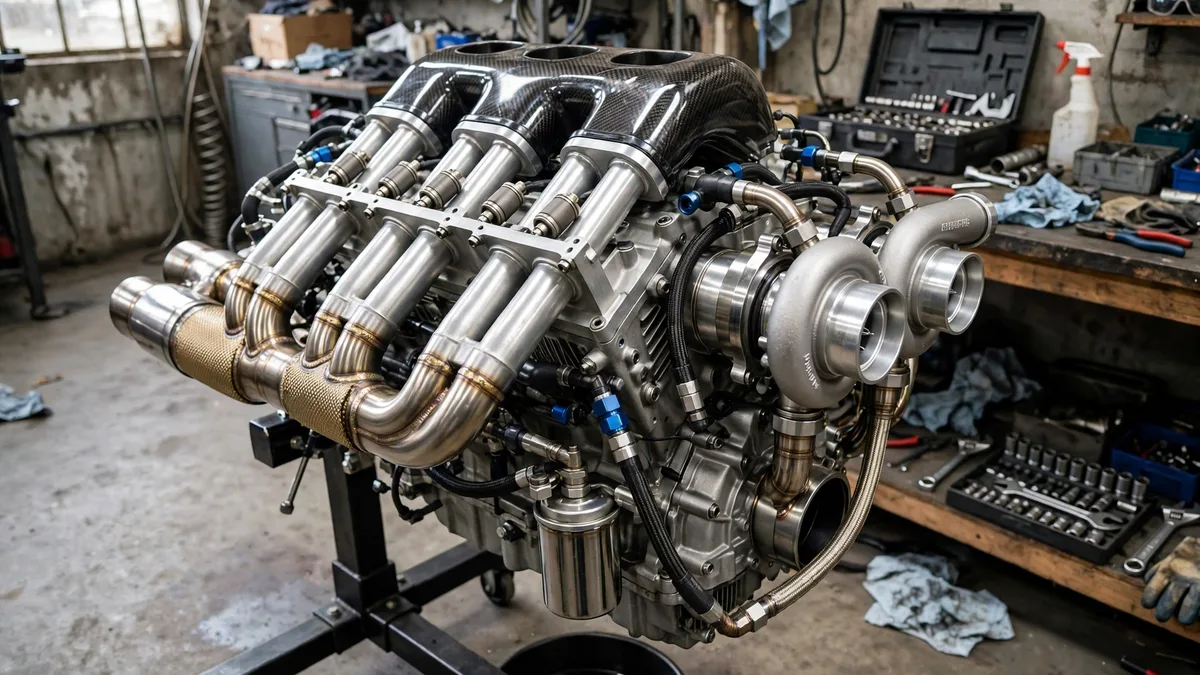
The Gemera’s Tiny Engine and Its Huge Price
The Gemera engine costs so much because it is a hand-built, camless, twin-turbo experiment in getting supercar power from a hatchback-sized block. Seven things explain the bill.
1. It has no camshafts at all
The most radical thing about the engine is what it does not have. Instead of camshafts opening the valves on a fixed schedule, each valve is opened by its own pneumatic and hydraulic actuator, controlled by software — a system Koenigsegg calls Freevalve. The valves can open at any time, for any length, at any lift, letting the engine breathe perfectly at every speed without a throttle body. The actuators are precision devices built to survive heat, pressure and millions of cycles, and the software that drives them took years to develop.
2. It makes 300 horsepower per litre
Most road-car engines make somewhere between 70 and 150 horsepower per litre. The Gemera’s engine makes 300. That is possible only because every part inside it is built to a standard closer to a racing engine than a road engine: forged pistons, a forged crankshaft, reinforced cylinder walls, and cooling and lubrication designed for forces that would destroy an ordinary block. The twin turbochargers are small, fast-spooling units that push enormous pressure into cylinders barely bigger than a drinks can.
3. The parts are made in tiny numbers
A mainstream engine shares its pistons, valves and castings with hundreds of thousands of identical units, which spreads the cost of tooling across a huge volume. The Gemera engine shares almost nothing with anything else. Its castings, forgings and machined parts are made in batches of dozens, so the cost of every mould, jig and cutting tool is carried by a handful of engines. Koenigsegg machines many parts itself, in-house.
4. It is assembled by hand, by one person
Each Gemera engine is assembled by a single technician who signs the finished unit, much like a watchmaker signs a movement. Assembly takes days, and every clearance is measured, recorded and adjusted by hand. There is no production line. The skill required is rare, the training takes years, and the person who builds your engine is one of a small team in the world who can do it.
5. It works with three electric motors, not against them
The engine does not work alone. It is paired with three electric motors: one on the crankshaft and one on each rear wheel, adding more than 1,100 horsepower and giving the Gemera torque vectoring that no mechanical system can match. Making a combustion engine and an electric drivetrain work together smoothly — handing over power seamlessly, sharing cooling, surviving the same heat — requires control software of extraordinary complexity and thousands of hours of testing. The engine is not just an engine; it is one half of a hybrid system invented from scratch. The same hybrid thinking shapes other flagships — the Rimac Nevera battery shows how much engineering goes into the electric half of the equation.
6. It runs on renewable fuel and drinks it differently
The Gemera engine is designed to run on E85, a fuel made mostly from renewable ethanol, and even on carbon-neutral methanol in some markets. Burning alcohol-based fuel at this power demands different materials for fuel lines, injectors and seals — and the engine can deactivate cylinders and change its character entirely through software. That flexibility is a deliberate answer to the question of how a combustion engine survives in a world turning electric.
7. It is tested like a racing engine, then warranted like a road car
Before it is fitted, each engine is run on a dynamometer, taken through its full rev range, and checked for power, emissions and reliability. Then it is installed in a car that Koenigsegg will warranty, support and service for years, with parts that must remain available for a production run of only 300 cars. The cost of that testing, and of standing behind an engine this extreme, is built into the price of every Gemera.

Gemera Engine at a Glance
| Specification | Detail |
|---|---|
| Engine name | Tiny Friendly Giant (TFG) |
| Configuration | 2.0-litre twin-turbo three-cylinder |
| Power (engine alone) | 600 hp (448 kW) |
| Torque (engine alone) | 600 Nm |
| Valvetrain | Freevalve — camless, software-controlled valves |
| Electric motors | Three, adding 1,100 hp |
| Total system output | 1,700 hp (1,268 kW) |
| Fuel | E85 ethanol or carbon-neutral methanol |
| Production run | 300 cars |
How Much Does the Gemera Engine Cost?
Koenigsegg does not sell the engine separately, so there is no official price — but the numbers around it tell the story. The Gemera itself is estimated to cost around £1.4 million, and the engine and hybrid system are estimated to account for a large share of that figure, with the hand-built camless engine alone estimated at several hundred thousand pounds per unit once development, tooling and the tiny production run are counted. For comparison, a mass-produced two-litre engine costs a manufacturer a few thousand pounds. The Gemera engine costs roughly a hundred times more, because it is a racing engine, a research project and a hand-built jewel in one. The Bugatti W16 engine follows the same economics — enormous power, tiny numbers, and a price set by handwork rather than materials. It is the same logic that makes a Lamborghini Revuelto V12 so costly to build — hand assembly, tiny volumes and a promise that it will last.

A Rare Fact
The Gemera’s engine can run on just two of its three cylinders when cruising, the Freevalve system shutting the third down entirely — but it can also do something no camshaft engine ever could: open its valves to let the engine act as an air pump, and even help start itself without a conventional starter motor. Because each valve is controlled independently by software, the engine can change its personality from one revolution to the next, from a quiet cruiser to a 600-horsepower screamer.