A nurse once told a watchmaker that the hardest place to measure a heartbeat is not a hospital bed but a wrist in motion — on a run, in the rain, under a sleeve. A modern smartwatch tries to do exactly that, all day and all night, with a sensor no bigger than a shirt button. The health sensor on the back of a premium smartwatch reads your pulse, your blood oxygen and sometimes your temperature, your heart rhythm and even your stress, and it does it through skin, hair, sweat and movement. It looks like a small dark window. Behind it is one of the most expensive pieces of sensing engineering ever put into something you wear.
The sensor works by shining light into your wrist and listening for what comes back. Tiny green, red and infrared LEDs flash thousands of times a second, and photodiodes measure how much light the blood absorbs as it pulses. That much is simple. The hard part is that the signal is faint, the wrist is always moving, and the difference between a healthy reading and a misleading one can be a fraction of a percent of light. Building a sensor that stays honest in those conditions is what makes it rare — and costly.
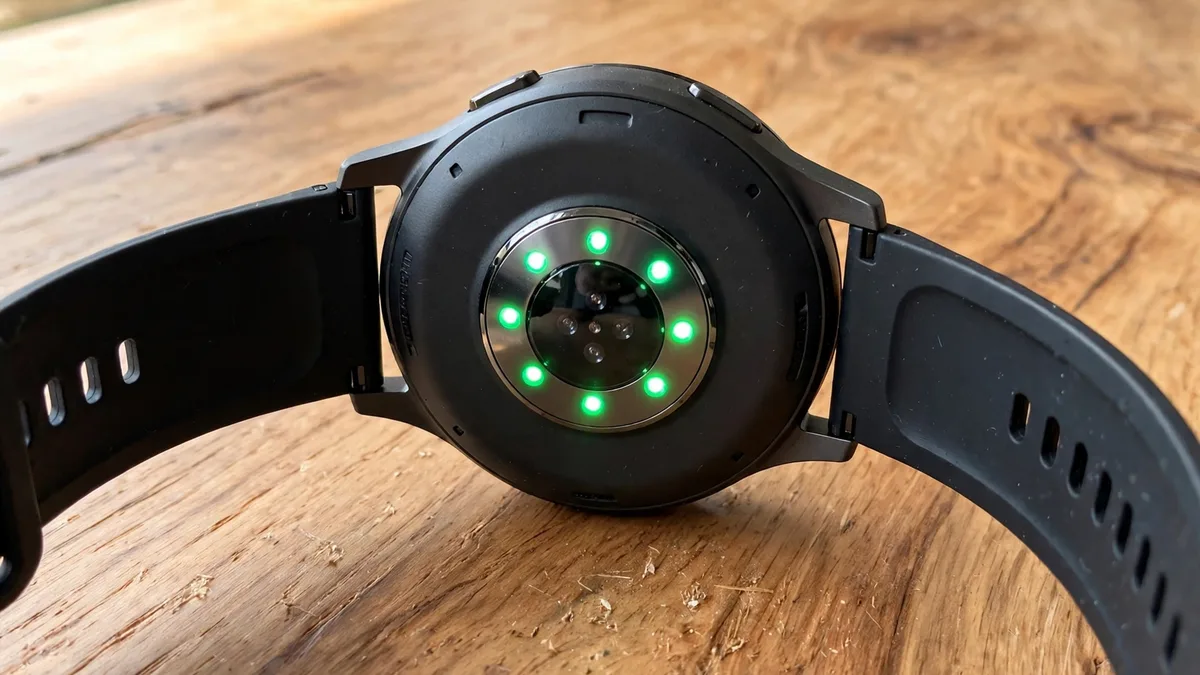
What Makes a Health Sensor So Costly
The cost of a smartwatch health sensor is spread across exotic optics, medical-grade chips, painstaking calibration and a certification process that most consumer electronics never face. Seven factors carry most of the price.
1. The LEDs are not ordinary lights
The LEDs in a health sensor are precision emitters tuned to exact wavelengths — green for heart rate, red and infrared for blood oxygen — because each wavelength is absorbed differently by oxygen-rich and oxygen-poor blood. The chips are grown on wafers in clean rooms, sorted by wavelength and brightness, and only a fraction of each batch meets the narrow specification. A cheaper LED drifts as it warms up, and a drifting LED means a drifting heart rate.
2. The photodiodes must hear a whisper
For every flash of light, only a tiny fraction bounces back from the blood to the photodiodes. These light detectors must pick up a signal thousands of times weaker than the light that went in, while ignoring sunlight, room light and the glow of the watch’s own screen. That takes low-noise amplifier chips designed for the job, shielding against electrical interference, and optical barriers moulded into the sensor housing.
3. The glass window is an optical instrument
The dark window on the back of the watch is not ordinary glass. It is a sapphire or hardened-glass lens, shaped and coated to let the right wavelengths through while blocking the rest, and polished so flat that it sits perfectly against the skin. Sapphire is second only to diamond in hardness, which is why it survives years of scraping against desks and gym equipment, but it is slow and expensive to grow, cut and polish.
4. Motion is the enemy, and cancelling it is expensive
A wrist moves constantly, and every movement changes how the light hits the blood. To keep the readings honest, the sensor is paired with accelerometers and gyroscopes that track the arm’s motion thousands of times a second, and with software that subtracts the movement from the optical signal in real time. That software is trained on data from thousands of volunteers — runners, swimmers, people with different skin tones, tattoos and wrist sizes — because skin and motion vary enormously. The data collection alone costs millions, and it is why two watches can have similar hardware and very different accuracy.
5. Calibration takes a laboratory, not a production line
Each sensor is calibrated against reference instruments in the factory, and the design is validated against hospital equipment on real people. Blood-oxygen readings are checked against arterial blood samples; heart-rate readings against chest straps and ECG machines. This is medical-grade validation, requiring clinical trials, ethics approvals and teams of physiologists.
6. The chip must sip power all day
The sensor runs for hours at a time on a battery smaller than a coin, so its chips are designed to use almost no power while sampling thousands of times a second. That means custom low-power silicon, careful power management and firmware written to wake, measure and sleep in microseconds. Low-power chips are harder to design than fast ones, and the teams that build them are small and sought after. The same squeeze applies to other miniature parts: a wireless earbuds driver faces the same battle between size, power and performance.
7. Few suppliers can build the whole module
The finished sensor is a module — LEDs, photodiodes, lens, chips and housing assembled into one sealed unit — and only a handful of suppliers in the world can build it to flagship standard. The optical alignment inside the module is measured in microns, the assembly happens in clean rooms, and the yield is never perfect. Other optical sensors face the same battle with faint signals: the lidar sensor is engineered around the same problem.
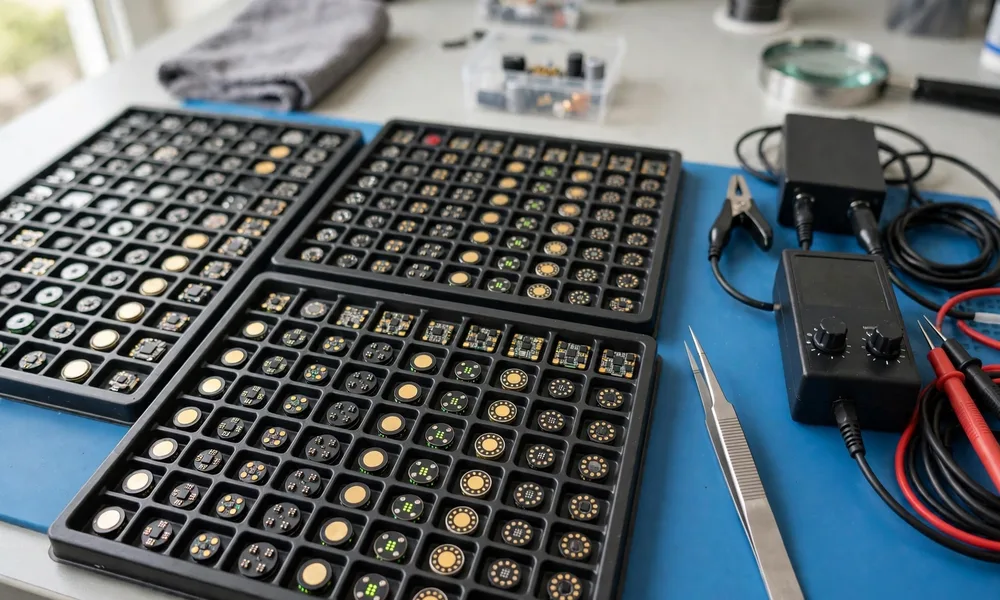
Inside a Smartwatch Health Sensor
| Part | Material | Typical size | Role |
|---|---|---|---|
| Green LEDs | Gallium nitride on sapphire | Under 1 mm each | Measure heart rate through blood flow |
| Red and infrared LEDs | Gallium arsenide | Under 1 mm each | Measure blood oxygen levels |
| Photodiodes | Silicon, low-noise design | Under 2 mm across | Detect the faint returning light |
| Sensor window | Sapphire crystal or hardened glass | About 20 mm across | Protects the optics and touches the skin |
| Motion sensors | MEMS accelerometer and gyroscope | About 2 mm square | Track wrist movement for noise cancellation |
| Processor | Custom low-power silicon | Under 5 mm square | Filters the signal and runs the health algorithms |
How Much Does a Health Sensor Cost?
The sensor module is one of the most expensive parts of a smartwatch after the display and the processor. As an estimate, the optical sensor module in a mid-range watch costs roughly £5 to £10. In a flagship watch with multi-wavelength LEDs, a sapphire window and medical-grade validation, the module is estimated at roughly £20 to £45, with the research and clinical testing behind it adding far more per unit sold. Precision optics are a recurring theme in wearables and cameras alike — the camera autofocus motor is another tiny machine whose price is set by microns, not grams.

A Rare Fact
The green light in a health sensor is green for a reason: haemoglobin, the molecule that carries oxygen in blood, absorbs green light far more strongly than red, so the sensor can see the pulse clearly even through the skin. But green light does not travel far into tissue, which is why the sensor must sit flat against the wrist and why a loose strap ruins the reading. Some flagship watches now add infrared LEDs that reach deeper into the tissue to measure blood oxygen, trading the clarity of green for the depth of infrared.


