The gas arrives as a liquid colder than the coldest winter night on Earth. Liquefied natural gas travels at minus 162 degrees Celsius, cold enough to turn ordinary steel as brittle as glass, and the tanks that carry it are among the most demanding structures ever built for a ship. They must hold a cargo shrunk to a six-hundredth of its volume, keep it frozen with almost no outside help, and survive storms, collisions and decades of service.
Step aboard an LNG carrier and the tanks are the first thing you see: four huge spheres rising above the deck like pale moons, or flat-topped boxes hidden inside the hull. Either way, the materials inside them are doing something extraordinary, holding back cold that would shatter a normal ship with walls only a few millimetres thick, and insulation so good the cargo boils away at less than a tenth of a percent a day.
Here are the materials inside LNG carrier tanks, why engineers chose them, how they are shaped, and what happens when they fail.

The Materials Behind the LNG Carrier Tanks
1. Nine percent nickel steel, the cold-proof workhorse
Most LNG tanks are built from steel containing nine percent nickel, an alloy that stays tough at minus 162 degrees. Ordinary ship steel turns brittle in the cold and can crack like a frozen pipe, but nine percent nickel steel keeps its strength and flexibility down to the temperature of the cargo. Engineers choose it because it is weldable, well understood, and strong enough to last the life of the ship. The plates are rolled, cut, and welded into curved sections in the shipyard. When it fails, it is usually at a weld: a tiny flaw, left unnoticed, can grow under the repeated stress of loading and unloading cold cargo until it opens a crack.
2. Invar, the metal that barely moves
Some LNG tanks use a very different metal called Invar, an alloy of iron and 36 percent nickel that barely expands or contracts with temperature. A tank that shrinks when filled with cold gas puts enormous stress on its supports, but an Invar tank shrinks so little the problem almost disappears. Engineers choose Invar for membrane tanks, where a thin inner skin holds the gas and the hull carries the load. The metal is rolled into sheets 0.7 millimetres thick, thinner than a credit card, and welded into a continuous membrane. When Invar fails, it is usually a weld defect or a dent: the skin is so thin that a dropped tool can crease it, and a crease becomes a weak point.
3. Stainless steel membrane, the thin gas-tight skin
Other membrane tanks use a corrugated skin of 304L stainless steel, about 1.2 millimetres thick. The corrugations are the clever part: they let the steel shrink and grow as the temperature changes, folding and unfolding like a concertina instead of tearing. Engineers choose stainless steel because it resists corrosion, stays tough in the cold, and welds into a perfectly gas-tight skin. The sheets are pressed into their wavy shape, welded together, and tested for leaks. When the membrane fails, it is usually a fatigue crack in a corrugation: thousands of heating and cooling cycles work the same fold back and forth until it splits.
4. Reinforced polyurethane foam, the insulation that does the freezing
Between the cold cargo and the warm steel of the ship sits layer upon layer of reinforced polyurethane foam. This foam is chosen because it insulates brilliantly and carries real structural loads, and because it can be made in panels that fit the curved shape of a tank. The foam is poured and cut into blocks, then reinforced with glass fibre so it does not crush under the weight of the cargo. When the foam fails, it is usually moisture: water that gets into the insulation freezes, expands, and cracks the foam, and the damaged patch lets heat leak in, so more cargo boils away.
5. Plywood and perlite, the quiet second line of defence
Behind the foam, many tanks hide a second layer of insulation made from plywood boxes filled with perlite, a light volcanic glass puffed up like popcorn in a furnace. Plywood is chosen because it is strong, cheap and easy to cut, and perlite because it insulates well, does not burn, and shrugs off moisture. The boxes are built in the shipyard, filled with perlite, and stacked into a blanket around the tank. When this layer fails, it is usually the plywood that goes first: damp plywood rots, sags, and leaves a gap the foam cannot cover.
6. Aluminium alloy, the light spheres
The great spherical Moss tanks are built from aluminium alloy, welded into spheres up to 40 metres across. Aluminium is chosen because it is light, which lets the ship carry more cargo, and because it stays tough at low temperatures without the nickel steel needs. The alloy is rolled into curved plates, welded into a sphere, and set on a single skirt so it can shrink freely when filled. When aluminium tanks fail, it is usually corrosion or fatigue at the welds: salt air attacks the outside, and the cycle of filling and emptying works the welds until a crack begins.
LNG Carrier Tanks Materials
| Material | Where it is used | Why it is chosen |
|---|---|---|
| Nine percent nickel steel | Tank walls and supports | Stays tough at minus 162 degrees |
| Invar | Membrane tank skin | Barely expands or contracts with cold |
| 304L stainless steel | Corrugated membrane skin | Gas-tight, folds with temperature change |
| Reinforced polyurethane foam | Main insulation | Insulates brilliantly, carries loads |
| Plywood and perlite | Second insulation layer | Strong, fireproof, shrugs off moisture |
| Aluminium alloy | Spherical Moss tanks | Light, tough in the cold |
LNG Carrier Tanks Specifications
| Specification | Typical value |
|---|---|
| Cargo temperature | Minus 162 degrees Celsius |
| Nine percent nickel steel | Plates welded into tank sections |
| Invar membrane | About 0.7 millimetres thick |
| Stainless steel membrane | About 1.2 millimetres, corrugated |
| Insulation | Foam panels plus plywood and perlite |
| Spherical tanks | Aluminium alloy, up to about 40 metres across |
| Boil-off rate | Less than 0.1 percent of cargo per day |
| Service life | Tanks last the life of the ship with inspection |
The way the whole tank system is assembled is described in how LNG carrier tanks are made, and the steel hull that carries them is covered in the materials behind the container ship hull, whose building is explored in how a container ship hull is made.
A Rare Fact
When the first LNG carriers were designed in the 1950s, nobody was sure the cargo would stay cold enough to survive the voyage, so the earliest ships carried their tanks inside wooden boxes packed with balsa wood, the light wood used in model aeroplanes. Balsa proved a superb insulator, and the first cargoes arrived with most of their gas intact. Modern foam and perlite have replaced the balsa, but the idea has never changed: the tank is only as good as the insulation wrapped around it.
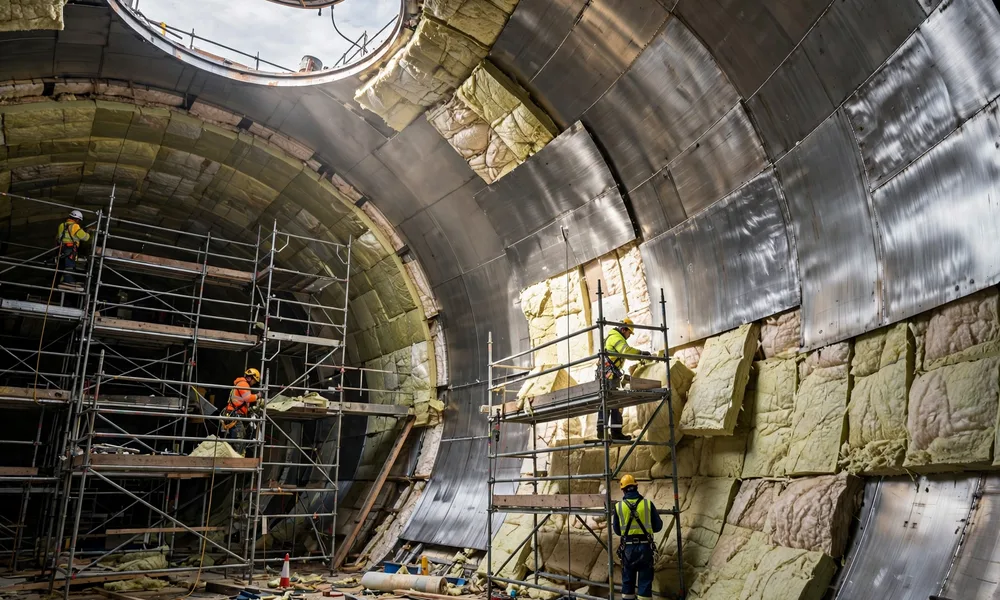

An LNG carrier tank looks like a giant thermos flask, and that is exactly what it is. Nine percent nickel steel and aluminium hold the shape, Invar and stainless steel form a skin thin enough to flex with the cold, and foam, plywood and perlite keep the heat out. When every layer does its job, a cargo colder than the coldest winter night can cross an ocean and still arrive frozen.