A luxury chase boat is the superyacht’s shadow, and its specification sheet reads like a dare. It is a smaller boat built to run ahead of the mother ship, carry the toys, fetch the guests, and get back before dinner — and the numbers describe a machine that is expected to do all of that at speeds a superyacht can only dream of. Every figure on it is about speed, and everything else is about surviving that speed in comfort.
Chase boats are also called support boats or tenders, but a luxury chase boat is a step beyond a tender. It is larger, faster and more capable, often 12 to 20 metres long, with its own cabin, a proper helm and room for a dozen guests.
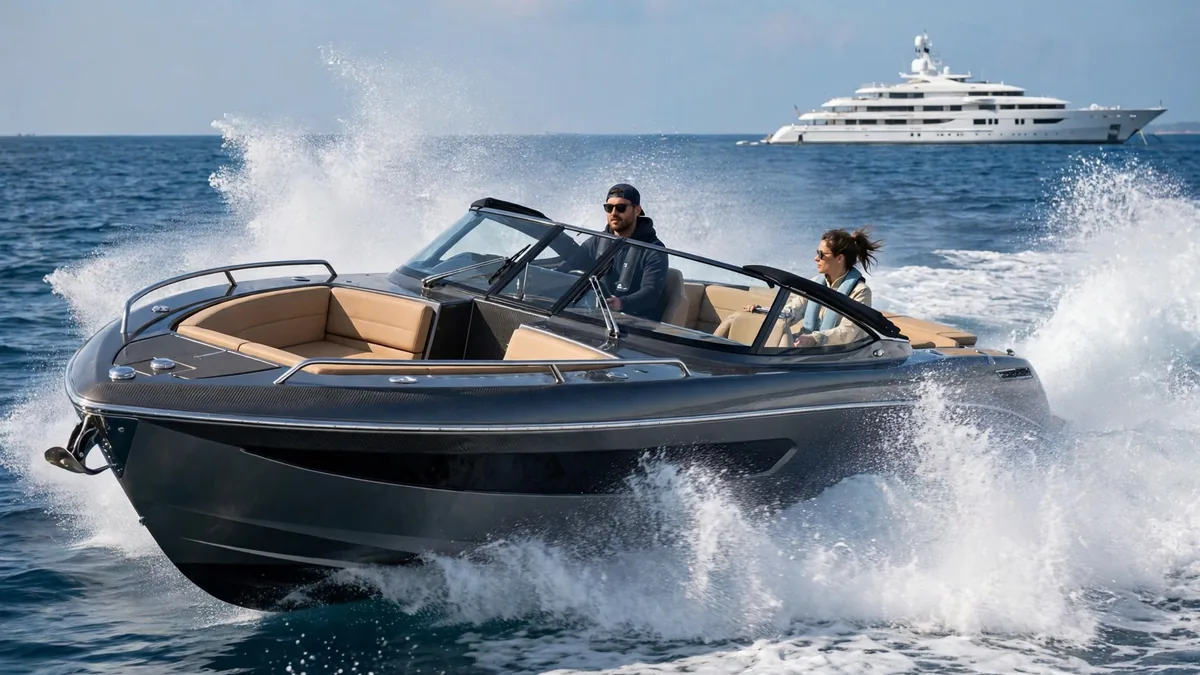
The numbers that actually matter
The first figure is top speed, and on a chase boat it is the headline for a reason. A luxury chase boat typically reaches 40 to 55 knots, with the fastest touching 60, which is more than twice the speed of the superyacht it serves. That speed comes from a deep-V hull, light construction and very large engines, and it is what lets the boat outrun weather and cover long distances between anchorages. The sheet will also list a cruising speed, usually 30 to 40 knots, and that is the figure that matters day to day.
The second figure is engine power, and the numbers are startling. A 15-metre chase boat commonly carries twin or triple outboards, or twin inboard diesels, totalling 1,000 to 1,800 horsepower. Triple outboards are popular because they are easy to service and easy to replace, and losing one engine still leaves enough power to get home. Inboards are quieter and keep the transom clear for swimming and boarding, but they take up space inside the hull.
The third figure is range, which is the chase boat’s quiet compromise. At cruising speed, a luxury chase boat typically covers 200 to 350 nautical miles, but at full speed that can fall to half as much, because fuel consumption rises steeply with speed. The fuel tank is large — often 1,000 to 2,000 litres — and the sheet’s range figure is always tied to a stated speed. A buyer who plans long runs to distant dive sites needs to read the range table carefully.
The fourth figure is payload and seating, which is where luxury shows. A chase boat in this class typically seats 10 to 14 people, carries diving gear, paddleboards, a jet ski or a small tender of its own, and still has a shaded seating area, a sunpad and a proper head. The sheet lists the passenger count and the load capacity in kilograms, and the two together say whether the boat is a serious workhorse or a fair-weather toy carrier.
Reading the spec table
Put together, a typical luxury chase boat in the 12 to 20 metre class reads something like the table below. These are representative figures for the class, not the specification of any single boat.
| Specification | Typical figure | What it means |
|---|---|---|
| Length overall | 12–20 metres | The size class; bigger boats carry more, smaller ones go faster |
| Top speed | 40–55 knots | Short bursts in calm water; not a cruising speed |
| Cruising speed | 30–40 knots | The speed at which range is measured |
| Engine power | 1,000–1,800 hp | Twin or triple outboards, or twin inboard diesels |
| Fuel capacity | 1,000–2,000 litres | Diesel or petrol, depending on the engines |
| Range at cruise | 200–350 nautical miles | Less at full speed; less again in rough water |
| Passengers | 10–14 people | Guests plus crew, with seating for all |
| Payload | 1,500–3,000 kg | People, toys, diving gear and stores |
| Hull | Deep-V, carbon or GRP | Deep-V cuts through waves; carbon saves weight |
| Draft | 0.6–1.0 metres | Shallow enough for beaches and close anchorages |

Hull, ride and handling
The hull is where a chase boat earns its reputation. A deep-V hull, with a sharp entry at the bow, slices through waves rather than slamming over them, and the sheet will quote a deadrise angle — often 20 to 24 degrees at the transom — which is the measure of how sharp that V is. A deeper V gives a softer ride in rough water but needs more power to push, which is why chase boats carry such large engines.
Construction matters too. Many luxury chase boats use carbon fibre in the hull and deck, which saves weight and lets the boat go faster on the same power, while others use glass-reinforced plastic for toughness and easier repair. Carbon boats are lighter and faster but more expensive to fix if they hit something; GRP boats are heavier but shrug off the knocks of daily use.
Seakeeping is the figure the sheet never quite captures. A chase boat that is comfortable at 40 knots in a flat calm may be punishing at 30 knots in a short chop, and the difference comes down to hull shape, weight distribution and the skill of the person at the helm. Owners learn this on a sea trial, not on paper, which is why every serious buyer insists on one. The full working of the boat, from hull to helm, is set out in how a luxury chase boat works, which is the natural companion to the figures here.
What the price tag means
A luxury chase boat of 12 to 20 metres typically costs an estimated $500,000 to $2.5 million, depending on size, engines and finish, with fully bespoke carbon boats rising above that range. The engines alone can account for an estimated $200,000 to $500,000 of the price. Running costs are high: fuel consumption at cruising speed can reach 150 to 300 litres per hour, servicing three large outboards is not cheap, and the boat needs the same care as the superyacht it serves.
That role, and the cost that comes with it, is why chase boats sit at the expensive end of their size class, as covered in why a luxury chase boat is so expensive. The hull, the engines and the finish each add cost, and the boat is built in small numbers to a high standard.

A rare fact worth knowing
Here is the detail that surprises people who have only seen chase boats at speed: the best ones are designed to be driven slowly as well as fast. A chase boat spends much of its life idling alongside a superyacht, nosing into a beach, or holding position while divers climb aboard, and a hull tuned only for 50 knots would be miserable at five. Builders shape the hull and tune the engines so the boat is stable and manoeuvrable at low speed too. The speed is the headline, but the slow-speed manners are what the crew notice every day.
The steel that goes into the mother ship’s hull is part of the same story — a superyacht’s strength and a chase boat’s speed are two answers to the same question of how to build a boat that survives the sea, as explained in how a superyacht steel hull is made. Read the spec sheet with that in mind, and the numbers stop being a list of boasts.


