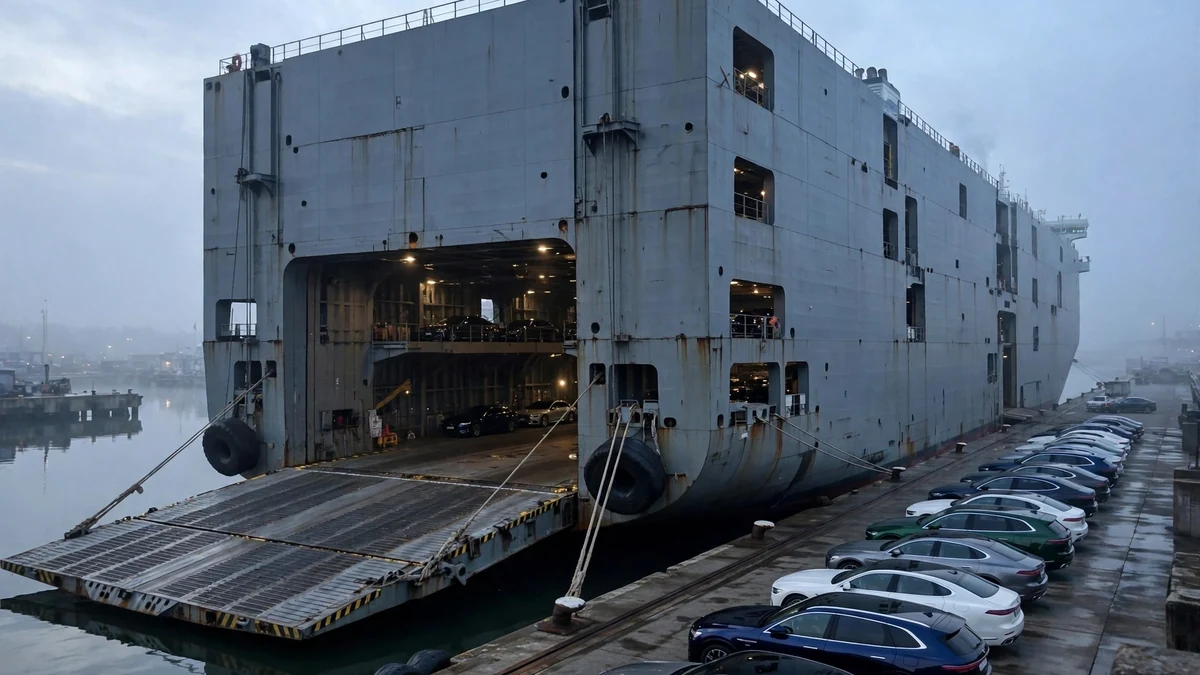
At first light in a car export port, the ship that dominates the harbour does not look like a ship at all. It looks like a floating multi-storey car park, a huge slab-sided box with a stern ramp the size of a motorway slip road and not a single container in sight. Inside that box, stacked across a dozen decks, are five or six thousand new cars, fresh from the factory, each one worth more than most people earn in a year. A luxury car carrier is a roll-on, roll-off vessel built for a single job: moving finished vehicles across oceans without a scratch, without a dead battery and without a single dent, and doing it on a schedule the car factories plan their whole production around.
The luxury label belongs to the top end of this world, where the cargo is not ordinary family hatchbacks but high-value cars: luxury saloons, sports cars, electric flagships and the occasional hypercar, shipped in climate-controlled decks with extra lashing, extra security and crews trained to handle vehicles worth six figures. The ship itself is a marvel of internal engineering. Its decks move up and down, its ramps fold away, its ventilation system keeps thousands of engines from filling the holds with fumes, and its stability systems keep a tall, boxy hull upright in a storm. Decode the spec sheet, and the floating car park starts to make sense.
How a luxury car carrier is built
A car carrier is built around its decks. Everything else, the hull, the engine, the accommodation, is arranged to serve a stack of vehicle decks that must be loaded fast, ventilated constantly and kept perfectly stable. Here is how it comes together.
Step 1: The hull is shaped like a box, on purpose
Unlike a sleek container ship, a car carrier has a wide, boxy hull with a flat bottom and near-vertical sides, because the cargo is light for its volume and the ship needs maximum internal space. The boxy shape gives the vessel a high centre of gravity when loaded, which is a stability challenge the naval architects solve with a wide beam, careful ballasting and anti-roll systems. It is not a beautiful shape, but it is an honest one: form follows the cargo.
Step 2: A dozen decks are fitted inside
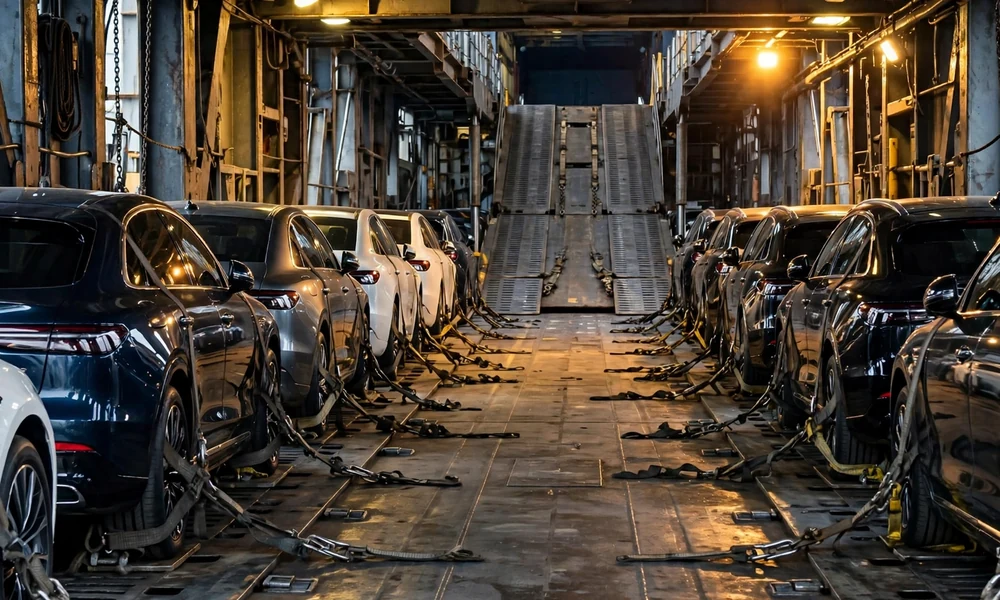
Inside the hull, the ship is divided into up to thirteen decks, several of them movable. Hoistable decks can be raised or lowered to fit taller vehicles on one voyage and more small cars on the next, so the same ship can carry a load of tall SUVs this month and a load of low sports cars the next. Each deck is a steel floor with drainage, fire detection and lashing points, and the clear height between decks is measured in centimetres, because every spare centimetre is another row of cars.
Step 3: Ramps and the stern door go in
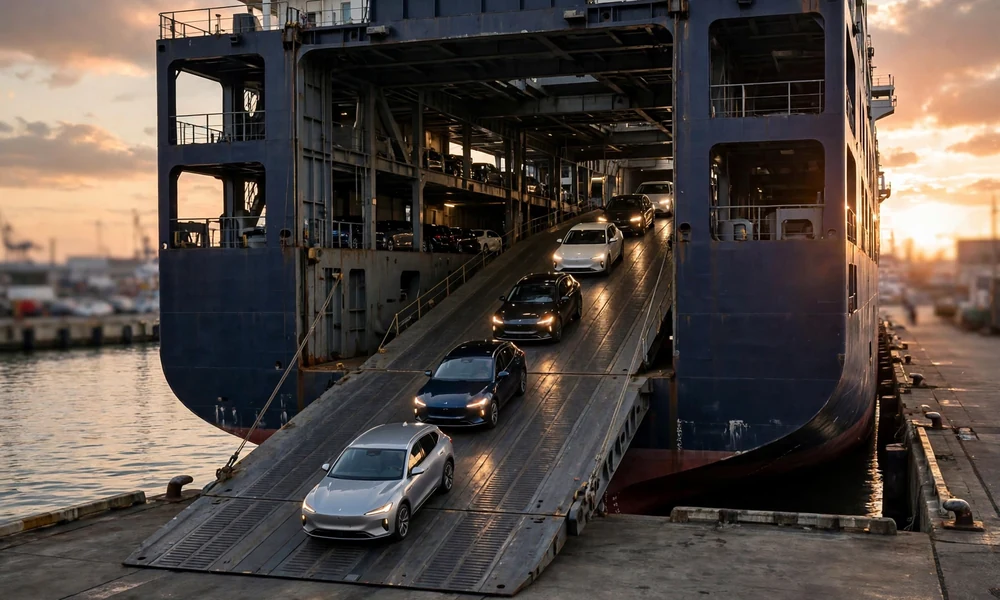
Cars drive on and off under their own power, through a huge stern ramp that doubles as a watertight door when closed. The ramp is lowered to the quay, cars are driven aboard in a steady stream, and internal ramps carry them up to their assigned deck. Loading a full ship takes twelve to twenty-four hours of continuous driving, with marshals guiding every vehicle into a bay barely wider than the car itself, and the whole operation is choreographed like a ballet.
Step 4: Ventilation and fire systems are installed
Thousands of cars with fuel in their tanks and batteries connected, parked in an enclosed steel box, is a fire risk that has to be engineered away. Powerful ventilation fans change the air in the cargo decks many times an hour, carbon monoxide sensors watch the air quality, and water mist and carbon dioxide systems stand ready on every deck. On high-specification carriers, the decks carrying the most valuable cars get extra detection, extra extinguishers and stricter rules about fuel levels and battery isolation.
Step 5: The engine and propulsion are fitted
Most large car carriers use a single slow-speed diesel engine driving one propeller, tuned for a service speed of around eighteen to twenty knots, faster than a tanker, because car factories work to tight delivery schedules. The engine is sized for sustained ocean speed rather than sprinting, and the ship carries large ballast tanks that are pumped in and out as cars are loaded and discharged, keeping the vessel upright and at the right draught at every stage.
The spec sheet, decoded
The table below uses a typical large pure car and truck carrier, the class that moves most of the world’s new cars by sea.
| Specification | Typical figure | What it tells you |
|---|---|---|
| Length overall | 200 metres | About two football pitches long |
| Beam | 32 metres | Wide and boxy, for maximum deck space |
| Vehicle capacity | 5,000 to 7,000 cars | A small town’s worth of new vehicles |
| Vehicle decks | 10 to 13 decks | Several decks can move up and down |
| Service speed | 18 to 20 knots | Faster than a tanker, on a tight schedule |
| Main engine power | 15,000 to 20,000 kW | One large slow-speed diesel engine |
| Deadweight | 18,000 to 22,000 tonnes | Cars are light for their volume |
| Maximum deck height | Up to 5 metres | Fits tall trucks and machinery too |
| Crew | 20 to 25 people | Small crew for a very large ship |
| Loading rate | 300 to 400 cars per hour | A full ship loads in under a day |
Vehicle capacity is the headline number, but deck count and maximum deck height tell you how flexible the ship is. The propeller that drives it is a single huge bronze screw, and how a ship propeller works explains why one slow propeller beats several fast ones, while how a ferry hull works shows how a boxy hull is balanced against stability.
What a luxury car carrier costs
Prices here are estimates, because new car carriers are ordered in small numbers and priced by contract. A new large carrier is estimated at roughly 90 to 120 million dollars to build, with a high-specification version at the upper end of that range. Chartering one is estimated at roughly 30,000 to 60,000 dollars a day, and running costs are estimated at roughly 10,000 to 15,000 dollars a day before fuel. The ship only earns when it is full, so a half-empty sailing loses money fast.
A rare fact worth knowing
A car carrier’s greatest enemy is not a storm but a fire, often starting in the batteries or fuel systems of the cargo itself. Because the decks are enclosed, a fire in the middle of a load can be almost impossible to reach, which is why modern carriers are fitted with water mist systems, and why some operators refuse certain damaged electric vehicles. The ship is a floating garage with no fire escape for its cargo.
The verdict
Read the spec sheet as a balance between capacity, flexibility and schedule. The luxury is in the hoistable decks, the ventilation and the lashings that hold every vehicle still in a storm, and in the anchor gear that holds the whole floating car park safely in port, as how a ship anchor chain works explains. A car carrier is a warehouse that crosses oceans, and judged as a warehouse, it is an extraordinarily clever one.