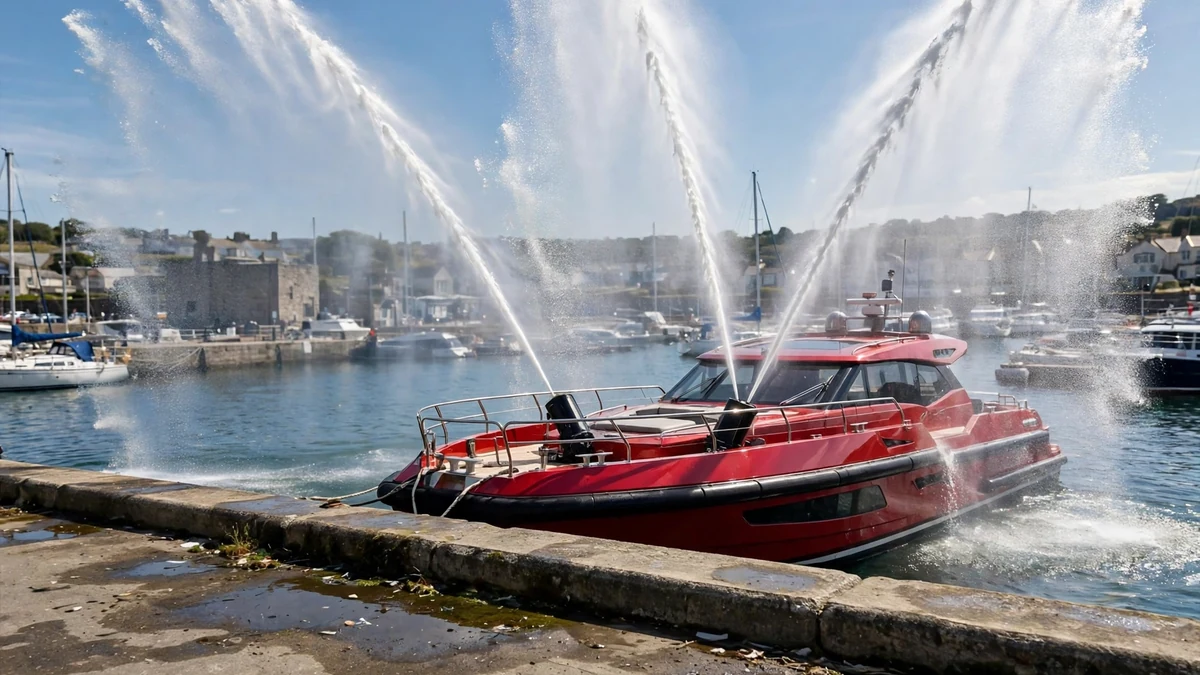
When a fire breaks out on a ship in port, or a warehouse blazes along the waterfront, the vessel that answers is not a big ship and not a fast one. It is a short, broad, unmistakably red boat that arrives throwing more water in a minute than a street of fire engines could manage in an hour. A luxury fireboat is that vessel taken to its highest specification: a purpose-built firefighting ship with pumps, monitors, foam systems, rescue equipment and a crew trained to work in the worst conditions a harbour can produce. It looks simple from the quay. Under the deck, it is one of the most specialised and expensive small ships a port can buy.
The expense is easy to misunderstand. A fireboat is not expensive because it is large or luxurious: its cabins are plain and its paint is chosen for visibility. It is expensive because almost every system is duplicated, oversized or built to a standard no ordinary workboat meets. The pumps alone can cost more than a whole small tugboat, and the hull must stay stable while throwing thousands of tonnes of water sideways.
How a luxury fireboat is built
A fireboat is built around its pumps. The hull, the engines, the crew spaces and the electronics are all arranged to serve a firefighting system that must work at full power, for hours, in smoke, heat and rough water. Here is how it comes together.
Step 1: A broad, stable hull is laid down
The hull is short and broad, with a flat bottom and a wide beam, because the boat must stay upright while its monitors throw water sideways with enormous force. A narrow hull would heel over dangerously under that thrust. The steel is thicker than on an ordinary workboat, and the bow is reinforced for pushing against ships and piers. Stability, not speed, is the first design requirement, and it shapes everything that follows.
Step 2: The fire pumps go in
The heart of the boat is a set of fire pumps, often driven by dedicated diesel engines separate from the propulsion engines, so the boat can fight a fire at full power even if its main engines are damaged. A high-specification fireboat can pump 10,000 to 20,000 litres of water a minute, and the pumps, their intakes, their sea chests and their pipework are the single most expensive part of the vessel. The intakes are fitted with screens and strainers, because a pump that swallows harbour debris in the middle of a fire is a pump that stops working.
Step 3: Monitors, foam and the water curtain are fitted
On deck, the pumps feed monitors, the large remotely controlled nozzles that throw water or foam in a high arc. A luxury fireboat carries several, including a tall mast monitor that can reach over the deck of a ship or into the upper floors of a waterfront building. Foam proportioning systems mix concentrate into the water for fuel fires, and a water curtain system can spray a protective wall of water over the boat itself, so it can approach a burning vessel closely enough to be useful.
Step 4: Propulsion is built for holding station, not speed
A fireboat does not need to be fast, but it does need to hold its position precisely, in wind, current and the wash of other vessels, while its monitors are firing. That means powerful bow and stern thrusters, and on the best boats a dynamic positioning system that holds the vessel on a point while the crew concentrates on the fire. The main engines are sized to run the boat and the pumps at the same time, and the fuel tanks are sized for many hours of continuous full-power operation.
Step 5: The bridge, crew spaces and rescue gear are finished
The bridge is fitted with thermal imaging cameras, so the crew can see through smoke and find the hot spots, and with radios that link the boat to the shore fire service, the port authority and the vessel in distress. Below deck, the boat carries breathing apparatus, rescue boats, medical equipment, diving gear and lighting for night operations. The crew of eight to twelve works in shifts, and the boat is kept ready to sail within minutes, twenty-four hours a day, which means its systems are maintained to a standard few working boats ever see.
The spec sheet, decoded
The table below uses a typical high-specification harbour fireboat, the class that protects major commercial ports.
| Specification | Typical figure | What it tells you |
|---|---|---|
| Length overall | 25 to 35 metres | Small, but very heavily built |
| Beam | 8 to 10 metres | Broad, for stability under fire |
| Fire pump capacity | 10,000 to 20,000 litres per minute | More than a street of fire engines |
| Monitor throw | 80 to 120 metres | Reaches over ships and waterfront buildings |
| Service speed | 12 to 14 knots | Fast enough to reach any berth quickly |
| Main engine power | 2,000 to 4,000 kW | Plus separate pump engines |
| Foam capacity | 5,000 to 10,000 litres | For fuel and chemical fires |
| Crew | 8 to 12 people | Firefighters and mariners in one crew |
| Hull material | Steel, thickened and reinforced | Built to push and to take punishment |
| Endurance | 24 hours at full firefighting power | Stays on scene until the fire is out |
Fire pump capacity defines the boat, and monitor throw defines how useful it is. The tugboat world shares the same demand for power in a small hull, and how a luxury tugboat is made shows how a working boat is built around a single demanding job, while how a ship bridge works explains the navigation and communication systems its bridge depends on.

Where the money goes
A new high-specification harbour fireboat is estimated at roughly 8 to 15 million dollars to build, and a large one for a major port is estimated at 20 million dollars or more. The fire pumps and their engines are estimated at roughly a quarter of the total, the thick steel hull at another quarter, and the monitors, foam systems and thermal imaging at a further fifth. Running costs are estimated at roughly 1 to 2 million dollars a year, because the boat is crewed and maintained around the clock.
The cost drivers are specialisation, redundancy and readiness: almost nothing on a fireboat is off the shelf, its pumps and engines are duplicated so it cannot fail mid-fire, and it is an insurance policy paid for year after year whether it is used or not.
A rare fact worth knowing
Some of the most famous fireboats in the world are over a century old and still in service, because their hulls were built so heavily and their pumps were so simple that they outlasted every vessel they were designed to protect. A fireboat is not bought for a decade but for generations, and its price must be judged against a working life that can span a century.

The verdict
A luxury fireboat is expensive because it is a small ship built to stand next to a burning vessel and throw more water than a fire station, for as long as it takes, without failing. Ports do not buy fireboats because they are good value, but because a major ship fire with no vessel able to fight it is unthinkable. The tug shares its harbour and its demand for power in a small hull, and how a tugboat works shows how a small vessel pushes far larger ships. A fireboat is the tug’s more expensive cousin, built not to move ships but to save them.


