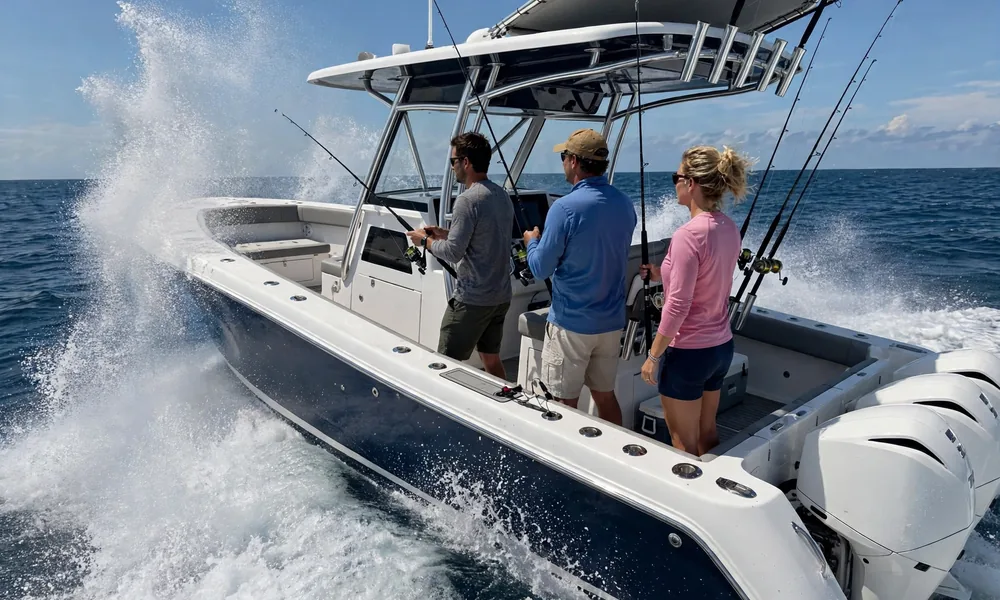
A buyer standing on the dock beside a luxury center console boat usually does the same thing first: he walks the length of the hull, runs a hand along the gunwale, and then asks for the spec sheet. The boat in front of him might be 32 feet of gleaming white fibreglass with three outboards on the transom, and it looks simple enough. Then he opens the sheet and finds forty lines of numbers, abbreviations and options, and the simple boat suddenly looks like a puzzle. Length overall, beam, deadrise, fuel capacity, horsepower, draft, displacement, livewell gallons, rod holders, seating capacity. Every number matters, but not every number matters in the same way, and knowing which ones to read first is what separates a good purchase from an expensive lesson.
A broker in Florida once told a story that still circulates among center console buyers. A client had fallen in love with a 36-foot boat because its top speed was listed at 68 miles per hour, the fastest in its class. He bought it, took it offshore, and discovered that the speed figure had been recorded with a light fuel load, two people aboard and a flat sea. Loaded for a real fishing trip, with four anglers, ice, bait and full tanks, the same boat cruised comfortably at 38 miles per hour and topped out near 55. He still loved the boat, but he had bought it for a number that described a day he would never have.

The hull numbers come first
Every center console spec sheet starts with the hull, and the first figure is length overall, usually between 25 and 42 feet for luxury models. Length decides almost everything else: how much deck space there is, how many people can fish comfortably, and how the boat handles a chop. A 28-foot boat is a capable day boat for two or three anglers. A 35-foot boat is a different animal, with room for a full crew, a bigger fuel tank and a ride that stays dry in seas that would send the smaller boat home. Buyers sometimes treat length as a status number, but on the water it is a working number, and a foot or two changes the day more than any gadget on the console.
Deadrise is the figure most buyers skip and most captains read first. It is the angle of the hull’s V at the transom, usually between 20 and 24 degrees on a luxury center console. A deeper V, around 24 degrees, cuts through waves and gives a softer ride in rough water, but it needs more power to push and burns more fuel at rest. A shallower V, near 20 degrees, is more efficient and more stable at anchor, but it pounds harder in a chop. There is no right answer, only a choice about where the boat will spend its time. A boat built for the canyons off the Northeast wants the deep V. A boat built for the flats of the Gulf wants the shallow one.
Power, fuel and range
The power line on a center console spec sheet is usually the loudest number on the page, and it deserves a calmer reading than it gets. Luxury models are commonly rated for 600 to 1,200 total horsepower, delivered by two or three outboards, and a few large boats carry four. The sheet lists both the maximum rated horsepower and the standard power package, and those two are often different. A boat rated for 1,200 horsepower might come standard with 900, and the extra 300 is an option that costs as much as a small car. What matters is not the maximum but the power-to-weight ratio at the load the buyer will actually carry, because an underpowered big boat is a miserable boat, and an overpowered small one is a wasteful one.
Fuel capacity is the quiet partner of horsepower. A luxury center console typically carries 250 to 500 gallons, and the number on the sheet is only half the story. Range is what the buyer actually wants, and range depends on fuel capacity, cruising speed and the engines’ appetite at that speed. A boat with 400 gallons that burns 30 gallons per hour at a 35-mile-per-hour cruise has a practical range of roughly 350 to 400 miles once a sensible reserve is kept. Ask for the fuel burn at the cruise speed you plan to use, then do the arithmetic yourself.

The build and the price
Price is the one figure the spec sheet rarely prints, because a luxury center console is sold as a base boat plus options, and the options list is long. As an estimate, a well-equipped luxury center console in the 30 to 36-foot range typically sells for roughly $500,000 to $900,000, with larger quad-engine models passing $1 million once electronics, a second station and a custom trailer are added. The engines alone can account for a third of the total, and the electronics package, with radar, sonar and multiple displays, can add tens of thousands more. None of this is on the spec sheet, but every number on the sheet points at it: more length, more beam, more power and more fuel all cost money, and the sheet is honest about what the buyer is paying for, even when it never prints the price.
A rare fact worth knowing
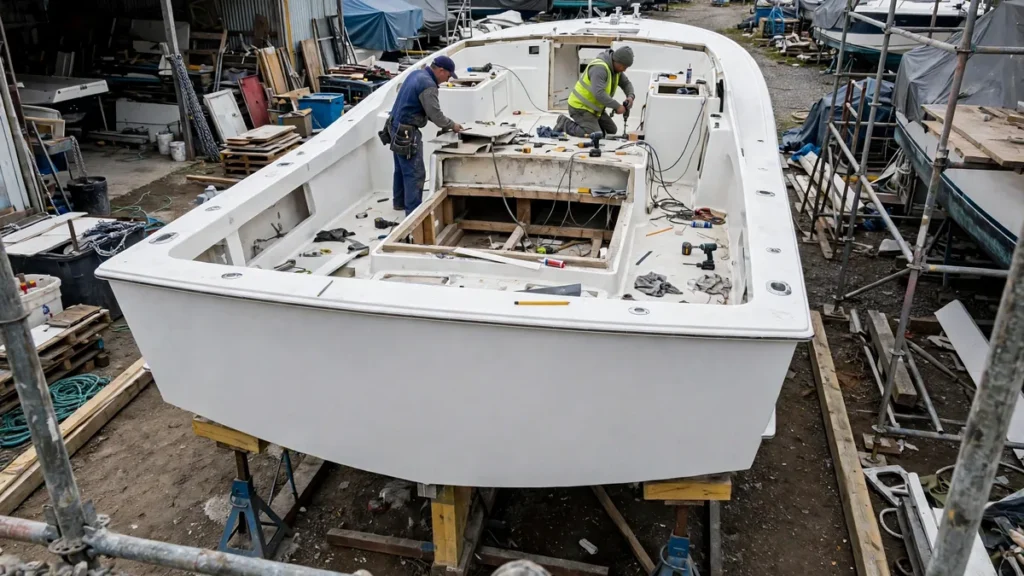
Here is a detail that rarely appears on any spec sheet and that captains love to share. On some of the finest luxury center consoles, the hulls are built in a female mould and then vacuum-infused with resin, a process that squeezes out excess resin and leaves a laminate that is both lighter and stronger than a hand-laid hull. The result is a boat that weighs less but sounds more solid, and the giveaway is the silence: tap the hull of a vacuum-infused boat and it rings like a drum with a short, tight note, while a heavier hand-laid hull thuds. Builders do not print the tap test on the sheet, but a buyer who knows it can learn more from one knuckle on the hull side than from a page of numbers. The sheet tells the buyer what the boat is. The tap tells him how it was made.
The best way to read a luxury center console spec sheet is to read it backwards from the day the buyer actually wants to have, starting with the fishing, then the fuel and range, then the power and the hull. The boat that fits that day is the right boat, even if another boat has a bigger top speed. For a closer look at how these boats run, see how a luxury center console boat works, and for the money side, see why a luxury center console boat is so expensive. A similar reading exercise for a different boat is the luxury chase boat spec sheet.
| Specification | Typical luxury range | What it decides |
|---|---|---|
| Length overall | 28–42 ft | Deck space and offshore ability |
| Beam | 8.5–12 ft | Stability and fishing room |
| Deadrise at transom | 20–24 degrees | Ride softness versus efficiency |
| Total horsepower | 600–1,200 hp | Speed and load carrying |
| Fuel capacity | 250–500 gal | Range with reserve |
| Draft | 18–24 in | Shallow-water access |
| Livewell capacity | 40–100 gal | Bait health on long days |
| Price (estimate) | $500,000–$1,000,000+ | Size, power and options |