The train left the station without a sound that anyone could name. There was no rumble of wheels, no clatter of joints, no shudder as it gathered speed, only a smooth push in the back and a city sliding past the window faster than a car on an open road. At three hundred kilometres an hour the carriage was quieter than a lift, and the only sign of the speed was the way the fields outside blurred into green. A passenger who closed her eyes could have believed the train was standing still.
That is the strange gift of a maglev train. It does not run on rails in the ordinary sense, because it floats on magnets, held a few centimetres above a concrete guideway by forces that never touch. The word maglev is short for magnetic levitation, and it means the train has no wheels, no axles and no friction with the track, which is why it can go faster than any wheeled train and do it in near silence. A luxury maglev takes that idea and wraps it in quiet cabins, wide seats and the kind of service you would expect on a first-class flight.

The spec sheet at a glance
| Figure | Typical luxury maglev train | What it tells you |
|---|---|---|
| Top speed | 400 to 600 kilometres per hour | How fast the train can run in service |
| Cruising speed | 350 to 450 kilometres per hour | How fast it travels day to day |
| Levitation gap | 8 to 15 centimetres | How high the train floats above the guideway |
| Acceleration | 0 to 300 km/h in about 2 to 3 minutes | How quickly it reaches cruising speed |
| Train length | 100 to 250 metres | How long the train is, and how many cars it has |
| Passenger capacity | 300 to 800 people | How many seats the train carries |
| Power | 10 to 20 megawatts | How much electricity the train draws at speed |
| Guideway | Elevated concrete beam | What the train floats above |
| Noise at speed | Roughly 70 to 80 decibels at 400 km/h | How loud the train is to people nearby |
| Price | Roughly $50 million to $100 million per trainset, as an estimate | What one train costs to build |
Speed: the number that defines the maglev
Top speed is the headline number, and on a luxury maglev it usually runs from 400 to 600 kilometres per hour. The fastest maglevs in testing have gone even quicker, but the service speed is what matters, because it is the speed the train can hold for hours with passengers aboard. The cruising speed, 350 to 450 kilometres per hour, is the speed the train actually runs at on most of its route, and it is set by the curves, the stations and the timetable rather than by what the magnets can do.
Acceleration is the number passengers feel rather than read, and a maglev reaches 300 kilometres per hour in about two to three minutes. That sounds slow next to a sports car, but a train weighs hundreds of tonnes and carries hundreds of people, and the smooth, steady push is part of the luxury: there is no jolt, no wheel slip and no vibration, only a gentle pressure that fades as the train settles at speed. The lack of wheels is what makes it possible, because a wheeled train at these speeds would shake itself apart, while a maglev simply floats faster. The closest cousins in spirit are other machines that lift themselves clear of their medium, as the guide to luxury hovercraft specs explained shows, where a cushion of air does the job that magnets do here.
Levitation: floating on magnets
The levitation gap is the most maglev number on the whole sheet, and it is usually 8 to 15 centimetres. That is the distance between the train and the guideway, a gap held open by magnets that pull the train up from below or push it away from the guideway, depending on the system. The gap is kept constant by computers that adjust the magnetic field thousands of times a second, and if the power fails, the train simply settles down onto skids and stops, which is why the system is considered safe even though it looks like magic. The gap is small enough that the train feels firmly planted, but large enough that the train never touches the track, and that is the whole secret of the speed.
Power, propulsion and the guideway
The guideway is the other half of the machine, and it is usually an elevated concrete beam, raised on pillars so the train runs above the ground. Building it is the most expensive part of any maglev project, far more than the trains themselves, because the beam must be straight to within millimetres over hundreds of kilometres, and it must carry the weight of a train passing at 400 kilometres per hour without flexing. The guideway is also the reason maglev networks are small: a conventional train can use existing tracks, but a maglev needs its own dedicated line, built from scratch, and that is a decision a country makes once in a generation. The same leap, from a familiar machine to one that floats, is what makes a tiltrotor different from an ordinary aircraft, as the guide to luxury tiltrotor specs explained shows.
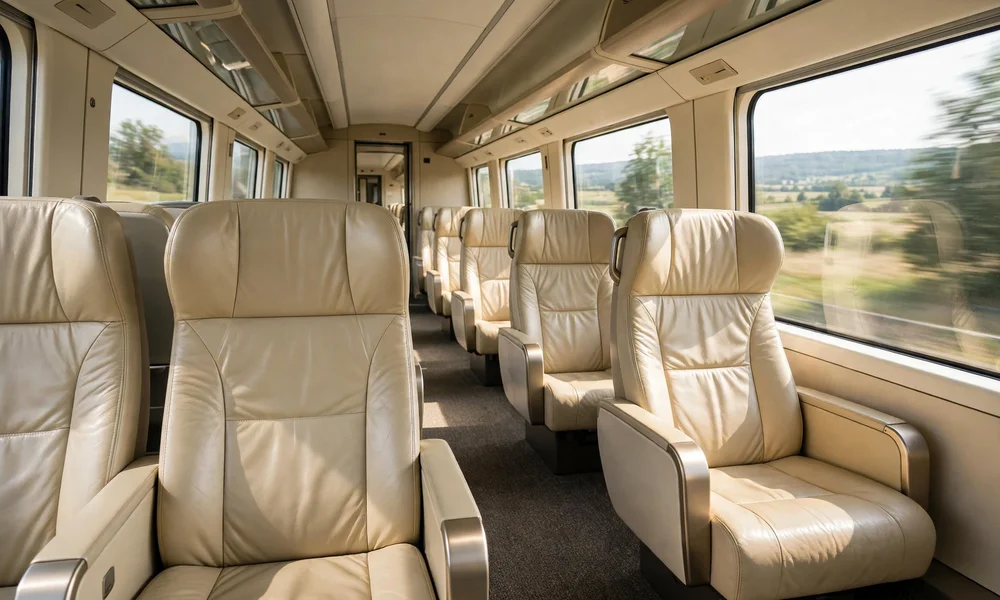
Capacity, comfort and noise
Noise is measured at about 70 to 80 decibels beside the track at 400 kilometres per hour, which is roughly the sound of a busy street, and most of that noise is the air rushing past the train rather than the machinery. Inside the cabin it is far quieter, closer to the sound of a car on a smooth motorway, and the windows are double-glazed to keep it that way. The low noise is one reason maglev lines can pass near towns, though the elevated guideway is still a visible structure, and communities along the route tend to have strong opinions about it. Electric propulsion is the quiet thread that runs through the newest luxury transport, and the same idea at sea is set out in the guide to how a luxury electric ferry works.
What it costs
One maglev trainset costs roughly $50 million to $100 million to build, as an estimate, but the trains are the cheap part. The guideway can cost $50 million or more per kilometre to build, which is why a maglev line of a few hundred kilometres costs tens of billions, and why only a handful of countries have built one. The economics only work on busy routes between big cities, where the trains run full all day, and that is why maglevs are rare even though the technology has existed for decades.
A rare fact
When a maglev train passes at full speed, the air it pushes aside can be felt on the platform of a station it does not stop at, and the pressure wave is strong enough to rattle windows in buildings beside the track. Engineers call it the piston effect, and it is the reason some maglev stations have sealed platform doors and tunnels with pressure relief shafts. The train itself feels nothing, floating on its magnets in a pocket of still air, while the world outside feels the wind it leaves behind.