Stand beside a luxury electric hypercar and the first thing that strikes you is how little of it there is. The body sits so low that the roof barely reaches your waist, the doors cut into the roof itself, and the whole car looks as if it were poured rather than built. There is no exhaust, no grille to feed an engine, and no bulge over the bonnet, because there is nothing under it that needs air. It is a shape drawn by the wind, and the electric motors inside it are almost an afterthought to the eye.
The spec sheet tells the other half of the story. An electric hypercar is the fastest accelerating machine most people will ever sit in, yet it makes its speed in complete silence, without gears and without drama. The numbers are extreme in every direction: power measured in four figures, acceleration measured in two seconds, and a price that buys a house in most cities. Reading the sheet properly means understanding which of those numbers matter on a real road, and which only matter on a drag strip.

Luxury Electric Hypercar Specs at a Glance
| Spec | Detail |
|---|---|
| Maximum power | About 1,000 to 2,000 horsepower from two to four motors |
| Acceleration | Zero to 60 miles per hour in about 1.8 to 2.5 seconds |
| Top speed | Roughly 200 to 260 miles per hour, often limited electronically |
| Battery capacity | About 100 to 120 kilowatt-hours, shaped around the cabin |
| Driving range | Around 250 to 350 miles in gentle driving, far less at full speed |
| Weight | About 1,800 to 2,200 kilograms, mostly battery and structure |
| Downforce | Up to about 1,000 kilograms of aerodynamic push at top speed |
| Charging speed | Around 350 kilowatts peak on a suitable fast charger |
These are typical figures, not promises. One maker may chase top speed while another chases cornering, and the numbers only make sense together.
Power and the Two-Second Launch
Power is the headline, and in an electric hypercar it is almost hard to believe. Two to four motors can deliver 1,000 to 2,000 horsepower, several times what a family car makes, and they deliver it all at once. There is no waiting for revs to build and no gear change to interrupt the push. The car simply grips the road and goes, and the launch feels less like driving than being fired from something.
The trick is not just the motors. It is the way each wheel can be driven separately, with software deciding in milliseconds how much power each tyre can take. A wheel that starts to slip gets less, a wheel with grip gets more, and the car stays straight while a petrol hypercar would be fighting its own rear end. The luxury hypercar specs show the same idea in a petrol car, where the engine must send its power through a gearbox and a differential, and the electric version skips all of that machinery entirely.
Top speed is the number that matters least, though it is the one everyone quotes. A car that can reach 250 miles per hour will almost never do so, because no public road allows it and few tracks are long enough. What matters is how quickly it gets to motorway speed and how often it can repeat the trick without the battery overheating, and that is a cooling question, not a power question.
The Battery Hidden Inside the Shape
The battery in a hypercar is a piece of sculpture as much as a power source. At 100 to 120 kilowatt-hours it is smaller than the pack in a luxury electric truck, because weight is the enemy of speed, yet it must still deliver enormous bursts of current without overheating. The cells are packed into a slim case that forms the floor and the spine of the car, and the cooling channels wind between them like veins, carrying heat away on every hard lap.
Range is the quiet compromise. A gentle drive may cover 250 to 350 miles, but a few minutes at full throttle on a track can drain the pack far faster, and the car will then limit its own power to protect the cells. The how the luxury hypercar is made story shows how the battery case is bolted into the carbon tub, so the pack is part of the structure, and replacing it is a factory job rather than a service item.
Charging at 350 kilowatts is fast by any standard, and a hypercar can add a useful charge in the time it takes to drink a coffee. The catch is finding a charger that can actually deliver that rate, and a battery cool enough to accept it. On a hot day after hard driving, the car may charge far more slowly while its cooling system catches up.
Downforce, Weight and the Corner
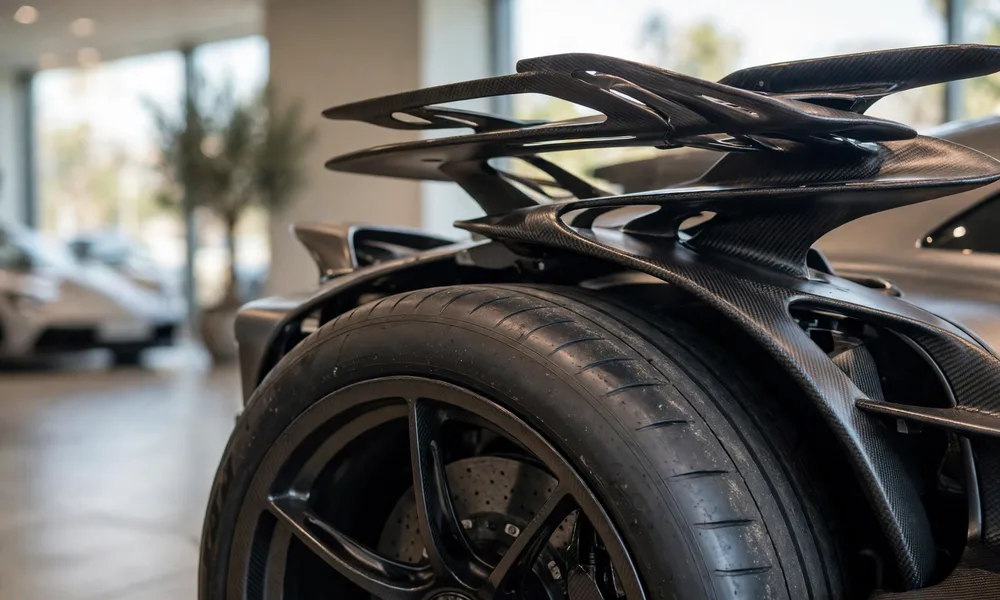
Downforce is the secret number, and it is what separates a hypercar from a fast car. At top speed the wings, the floor and the diffusers press the car into the road with up to 1,000 kilograms of force, more than half the weight of the car itself. That invisible push lets the tyres grip far harder than weight alone would allow, so the car can corner at speeds that would throw a normal car off the road.
Weight fights against all of it. At 1,800 to 2,200 kilograms, an electric hypercar is heavy for its size, and most of that weight is the battery. Carbon fibre bodywork and titanium parts save kilograms wherever they can, but the battery cannot be lightened without losing range. The luxury supercar specs show the same battle in a petrol car, where the engine is the heavy part, and the electric version trades one heavy heart for another.
As an estimate, a luxury electric hypercar costs about $2 million to $3 million, a set of tyres about $5,000 to $10,000, and an annual service about $10,000 to $20,000. The car is a fortune, but its running costs are lower than a petrol hypercar of the same speed, because there is no engine to rebuild and no gearbox to service, and the gap grows with every mile driven gently.
A Rare Fact From the World of Hypercars
Here is a detail few car lovers ever learn: an electric hypercar can be quieter inside at full speed than a family car on the motorway. With no engine noise to mask it, the engineers had to hunt down every whistle from the mirrors, every hum from the tyres and every rattle from the trim, because the driver would hear them all. The result is a cabin so quiet that some owners say the loudest sound at 150 miles per hour is the air moving over the roof, and that silence is the hardest luxury of all to engineer.
What the Specs Mean for You
If you are comparing electric hypercars, start with four numbers: power, repeatable acceleration, downforce and weight. A car with huge power it can use again and again, downforce that holds it through corners and weight kept as low as the battery allows is worth its price. Top speed matters less than the brochures suggest, and range matters more than anyone admits, because a hypercar that cannot reach the track and back is a sculpture. The best electric hypercar is the one whose numbers hold up on the third lap, not just the first.