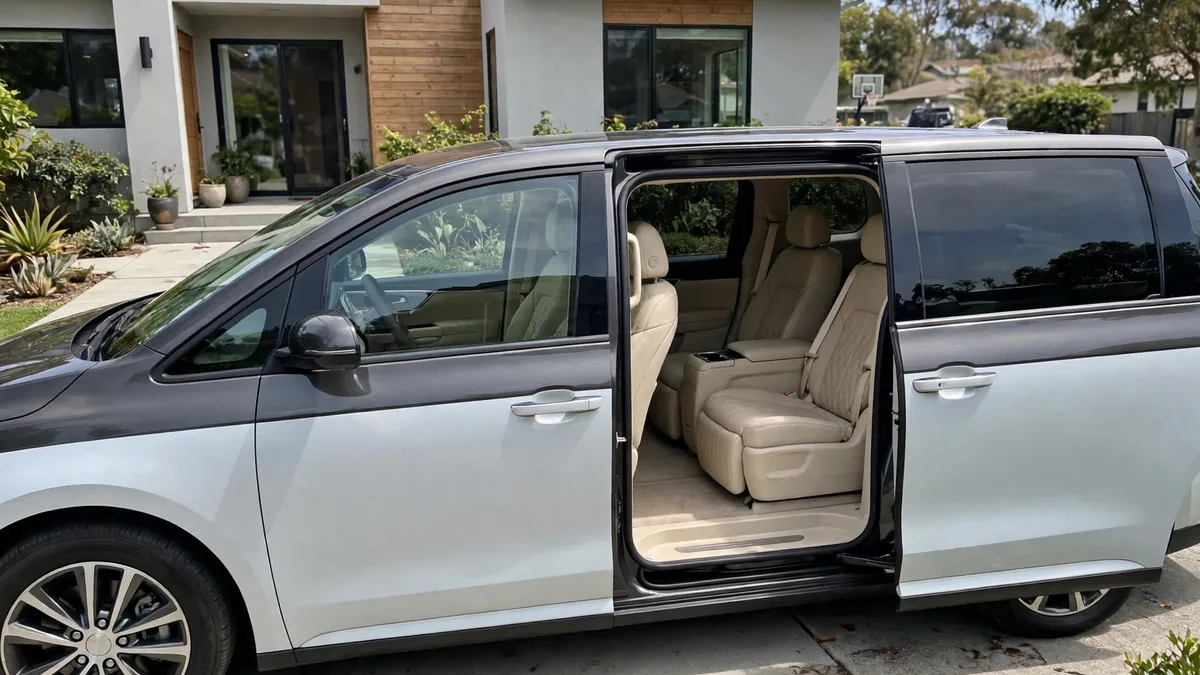
The school gate was busy at half past three, and among the big SUVs and the tired family hatchbacks sat a minivan that did not look like a minivan at all. Its paint was a deep metallic blue, its wheels were far too large, and when the sliding door opened by itself, the inside looked less like a family car and more like a first-class lounge. A child climbed in, pressed a button, and the seat slid back as the door closed silently behind her.
That quiet luxury is the point of a luxury electric minivan, and its spec sheet is the last place you would expect to find it. The numbers look like family-car numbers — seats, doors, range — but they describe a vehicle built to move seven people in silence and comfort. This guide translates every figure into plain English.
Seats: seven people, no compromises
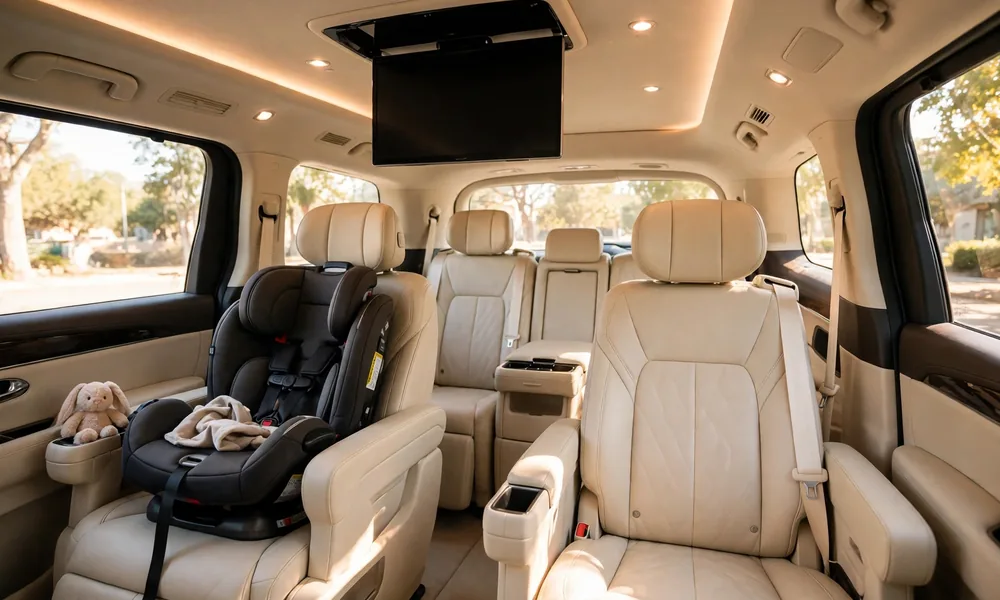
Seating capacity is the first number on any minivan spec sheet, and a luxury electric minivan usually seats six or seven people across three rows. The difference from an ordinary minivan is what those seats are: the middle row is usually two individual captain chairs with armrests, heating, ventilation and their own leg rests, while the third row is a proper bench rather than a punishment for the smallest passengers.
Legroom is the number that tells you whether the third row is usable, and a luxury minivan offers generous space in every row because the flat electric floor leaves no transmission tunnel in the way. The guide to luxury minivan specs explained covers the same seating numbers on a petrol minivan, and the comparison shows how much room the electric floor frees up. The guide to how a luxury minivan works explains how the sliding seats and the flat floor work together.
Range: the family road trip test
Range is the number that decides whether a minivan can do a family holiday, and a luxury electric minivan usually offers between 450 and 600 kilometres on a full charge. That is a strong figure for such a large vehicle, and it is possible because the minivan is big enough to carry a very large battery underneath. A full family, a boot full of luggage and the air conditioning running will cut into that figure, but the starting point is generous.
Battery size: the biggest in the family
Battery size is measured in kilowatt-hours, and a luxury electric minivan usually carries between 90 and 115 kilowatt-hours, one of the largest batteries fitted to any passenger car. The battery has to be big, because the minivan is heavy, boxy, and built to carry seven people plus their luggage at motorway speed. A small battery would empty itself before the first service station.
Power: more than a family car needs
Power in a luxury electric minivan is usually between 350 and 500 horsepower, from one or two electric motors. That sounds like far too much for a family car, and in one sense it is, but the power has a practical purpose. A minivan loaded with seven people and luggage can weigh close to three tonnes, and it still needs to join a motorway safely and overtake a lorry without drama.
Acceleration is quoted as 0 to 100 kilometres per hour, and a luxury electric minivan usually does it in 5 to 6 seconds, which is quicker than most family cars and many sports cars from a decade ago. The electric motors deliver their push instantly and silently, so the acceleration feels calm rather than violent, which is exactly what sleeping children in the back require.
Charging speed: the holiday stop
Charging speed is measured in kilowatts, and a luxury electric minivan usually accepts between 200 and 350 kilowatts from a fast charger. That is a very fast rate, and it is necessary because the battery is so large: a slow charger would take all day to fill it. At full speed, the minivan can add roughly 300 kilometres of range in about half an hour.
Cargo space: the boot that swallows everything
Cargo space is measured in litres, and a luxury electric minivan offers between 500 and 900 litres behind the third row, and well over 2,000 litres with the rear seats folded flat. Those are enormous figures, and they are the reason the minivan still beats every SUV for family life. Pushchairs, suitcases, sports kit and a weekly shop all fit without the roof box that an SUV would need.
The flat floor helps here too, because there is no step or slope to lift heavy things over. The sliding doors are the other quiet advantage: they open in tight car parks where a normal door would hit the car next door, and children can climb in and out without a parent worrying about dents. The guide to luxury electric car specs explained covers cargo numbers on a smaller electric car, and the gap shows what the minivan shape buys.
Weight and towing
Weight is the number that surprises people most. A luxury electric minivan usually weighs between 2,400 and 2,700 kilograms, which is heavy for a family car, and almost all of the extra weight is the battery. The weight is carried low, so the minivan feels stable, but it still means bigger brakes, stronger tyres, and more energy used on every trip.
The numbers at a glance
| Specification | Typical electric minivan | Top electric minivan |
|---|---|---|
| Seats | 7 | 7 |
| Battery | 95 kWh | 115 kWh |
| Range | 480 km | 600 km |
| Power | 380 hp | 500 hp |
| 0 to 100 km/h | 5.8 seconds | 5.0 seconds |
| Fast charging | 200 kW | 350 kW |
| 10 to 80% charge | 35 minutes | 25 minutes |
| Cargo space | 600 litres | 900 litres |
| Weight | 2,500 kg | 2,700 kg |
What a luxury electric minivan costs
A luxury electric minivan costs an estimated 90,000 to 140,000 dollars, and the most luxurious models cost an estimated 180,000 dollars or more. The battery is the largest single cost, followed by the motors and the hand-finished interior. Running costs are gentle for such a large car: electricity is cheap, servicing is simple, and the brakes last longer because the motors do much of the slowing.
A rare fact
Some luxury electric minivans have a karaoke system built into the rear screens, complete with microphones, so the back seats can sing along on long trips. The strangest detail is that the seats in a few models can turn to face each other, turning the middle of the minivan into a small lounge, which is a feature borrowed from trains rather than from any other car.

The next time a minivan spec sheet lists its numbers, read them as family numbers. The seats buy the peace, the battery buys the range, and the charging speed buys the holiday. A luxury electric minivan will never be the fastest or the prettiest car in the car park, but it is the one that carries seven people, their luggage, and their arguments in silence and comfort. That is a harder trick than speed.


