There is a moment, about three days out of port, when a trawler yacht shows you what it is for. The coast is gone. The sea is empty in every direction. The engine is turning at the same unhurried pace it has held since dawn, the stabilisers are quietly ironing out the swell, and the fuel gauge has barely moved. On any other yacht this would be the middle of nowhere. On a trawler yacht, it is exactly the point.
A luxury trawler yacht is the slowest, heaviest, most deliberate machine in the yachting world, and its owners would not have it any other way. It is built to cross oceans at the speed of a bicycle, carrying enough fuel, water and food to stay away from land for weeks. The spec sheet reads like a dare: modest speed, enormous range, a single engine doing the work of two, and a hull that pushes water aside instead of climbing over it.
Read those numbers properly and the trawler yacht stops looking underpowered and starts looking like the most honest boat on the water. Range matters more than speed. Fuel burn matters more than horsepower. And the displacement hull — the shape that makes the boat slow — is the same shape that makes it possible to cross an ocean in comfort. This is what the figures mean.
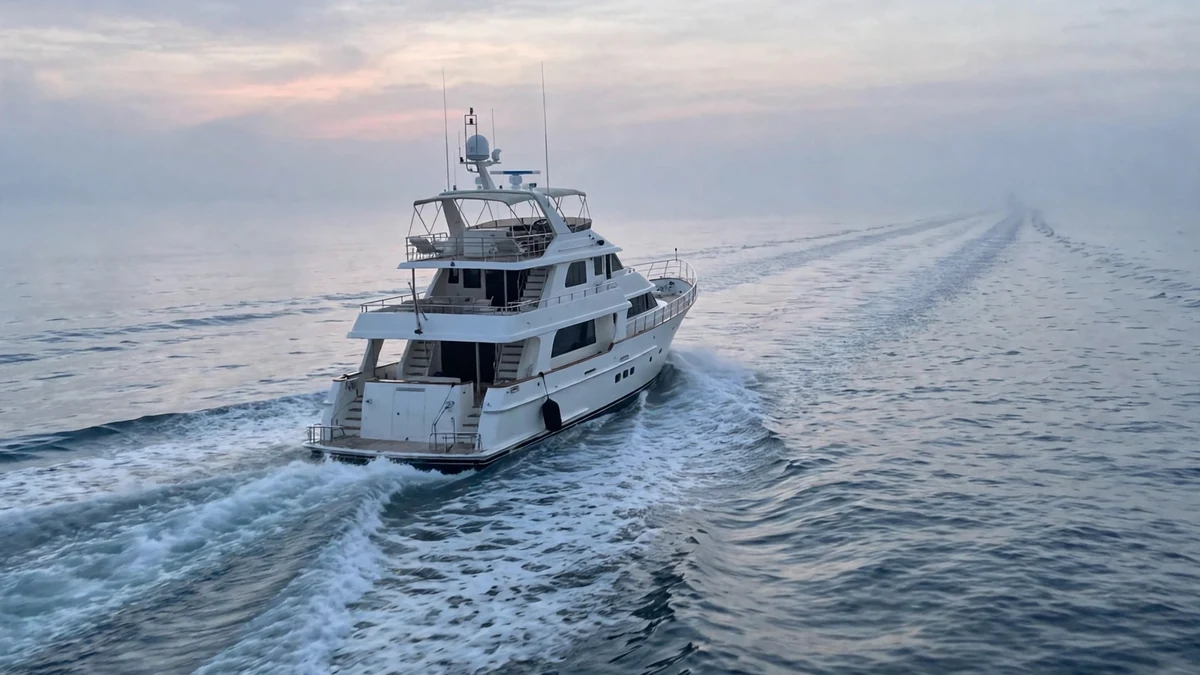
The numbers that matter
Here is the shape of a large modern luxury trawler yacht — the figures that define it, from the hull to the fuel tanks.
| Specification | Typical luxury figure |
|---|---|
| Length | 65–85 ft (20–26 m) |
| Beam | 18–22 ft (5.5–6.7 m) |
| Draft | 5–7 ft (1.5–2.1 m) |
| Displacement | 80–150 tonnes |
| Engine power | 600–1,000 hp (single engine) |
| Cruising speed | 8–10 knots (15–19 km/h) |
| Maximum speed | 12–14 knots |
| Fuel capacity | 4,000–8,000 gallons |
| Range | 3,000–5,000 nautical miles |
| Price (new) | Estimate: $5–15 million |
The figure that explains everything else is the range. Three to five thousand nautical miles at eight knots is the difference between a coastal cruiser and an ocean crosser. A trawler yacht can leave Florida, cross the Atlantic, and arrive in Europe with fuel to spare — a journey that would take a fast planing yacht several fuel stops, if it could make it at all. The range comes from the hull, not the tanks: a displacement hull sips fuel at low speed, burning perhaps 8 to 12 gallons an hour where a planing hull at twenty knots burns ten times that.
The single engine is the second half of the same logic. One large diesel, run gently at 60 percent of its rated power, will outlast two smaller engines run hard, and it is simpler to maintain a thousand miles from a shipyard. The trade-off is obvious — lose that engine and you are adrift — so trawler yachts carry a wing engine, a small get-home motor that can push the boat at four or five knots. It is insurance, not propulsion, and it is the reason a single-engine ocean crosser is a sensible choice rather than a gamble.
The displacement hull: slow on purpose
A displacement hull never climbs onto the plane. It pushes water aside as it moves, and the faster it goes, the bigger the bow wave it must climb. There is a hard physical limit — the hull speed, set by the length of the waterline — beyond which pushing harder only burns fuel and makes a bigger wave. A sixty-five-foot trawler tops out around ten knots, and no amount of horsepower changes that. The hull is a contract: accept the speed limit, and in return you get efficiency, comfort, and range no planing boat can match.
The deep, full hull also gives the trawler its seakeeping. Weight sits low, the bow is high and flared to throw spray aside, and the motion in a seaway is slow and predictable rather than sharp and jarring. Passengers sleep, cook, and live aboard in conditions that would send a fast yacht’s crew to their bunks. The way a luxury trawler yacht works is built around this bargain, and every number on the spec sheet is a consequence of it.
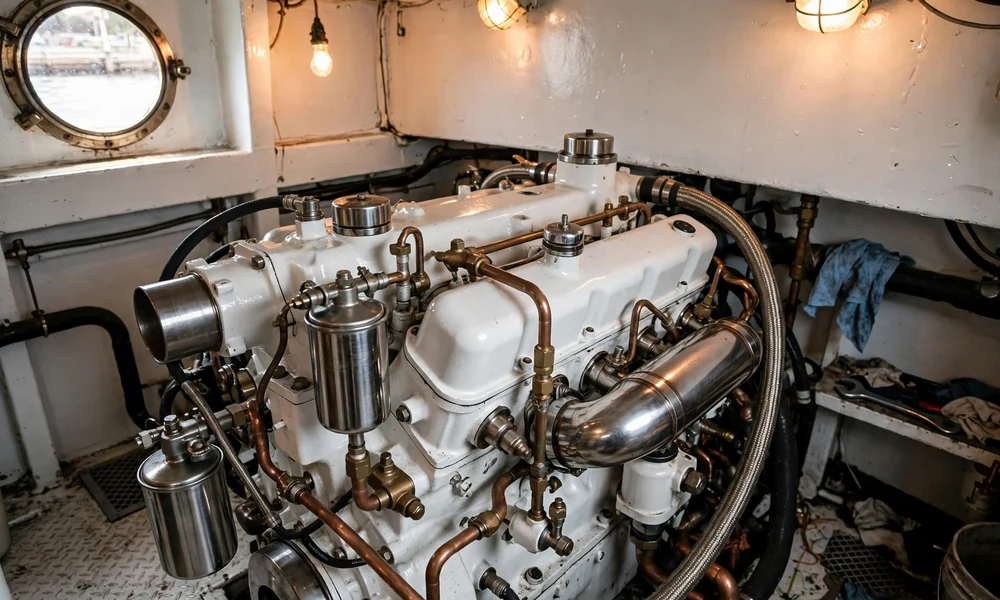
Stabilisers: the secret to a comfortable ride
The stabilisers are the most important numbers on the sheet that are not on the sheet. Fins mounted below the waterline, driven by hydraulic rams, counteract the roll of the sea dozens of times a minute. On a trawler yacht they are not an option; they are the reason the boat is liveable. Without them, a heavy displacement hull in a beam sea rolls slowly and deeply, and a week at sea becomes an exercise in endurance. With them, the same sea feels like a gentle sway.
Fuel, water, and living off the grid
Five thousand gallons of fuel is only part of the self-sufficiency equation. A luxury trawler carries a watermaker that turns seawater into drinking water at a hundred gallons an hour, batteries and a generator that run the boat silently overnight, and cold storage for weeks of food. The tankage numbers are really a calendar: fuel for a month, water indefinitely, food for as long as the freezers hold.
That independence is what the price buys. A new trawler yacht costs an estimate of $5 to $15 million, and the largest share goes into the hull, the engine room and the systems — the parts nobody photographs. The interior is luxurious but deliberately practical: fewer mirrors, more handholds. Compare it with the working boat it borrowed its shape from, and how a luxury trawler is made shows a commercial fishing vessel built for the same seas, minus the guest cabins. The commercial trawler works the ocean; the trawler yacht lives on it.
Price: what a new trawler yacht costs
A new luxury trawler yacht costs an estimate of $5 to $15 million, depending on size, range and finish. Running costs are the real commitment: fuel at ocean-crossing distances, annual maintenance of a heavy single engine, stabiliser servicing, and a crew of two or three. Budget an estimate of 5 to 10 percent of the purchase price per year to keep the boat in ocean-crossing condition. The reasons a luxury trawler is so expensive apply here too — the heavy build, the systems and the range all cost money before a single guest steps aboard — but the trawler yacht adds a second layer of cost: the freedom to go anywhere, built into the hull from the start.
A rare fact
Here is the detail the spec sheet hides in plain sight: a trawler yacht can cross an ocean on less fuel than a fast yacht burns in a weekend. A planing yacht running at twenty knots can burn 100 gallons an hour or more; a trawler at eight knots burns around 10. Over a 3,000-mile crossing, the fast boat would need ten times the fuel — which it cannot carry, so it cannot make the crossing at all. The trawler’s slowness is not a weakness it tolerates. It is the engine of its freedom: the slower it goes, the further it can go, and the further it can go, the more of the world it can reach.
Read that way, the trawler yacht’s spec sheet stops looking modest and starts looking like a map. Eight knots, five thousand miles, one engine, a full hull. The numbers describe a boat that trades speed for the entire planet, and for the people who buy them, that is not a compromise at all.


