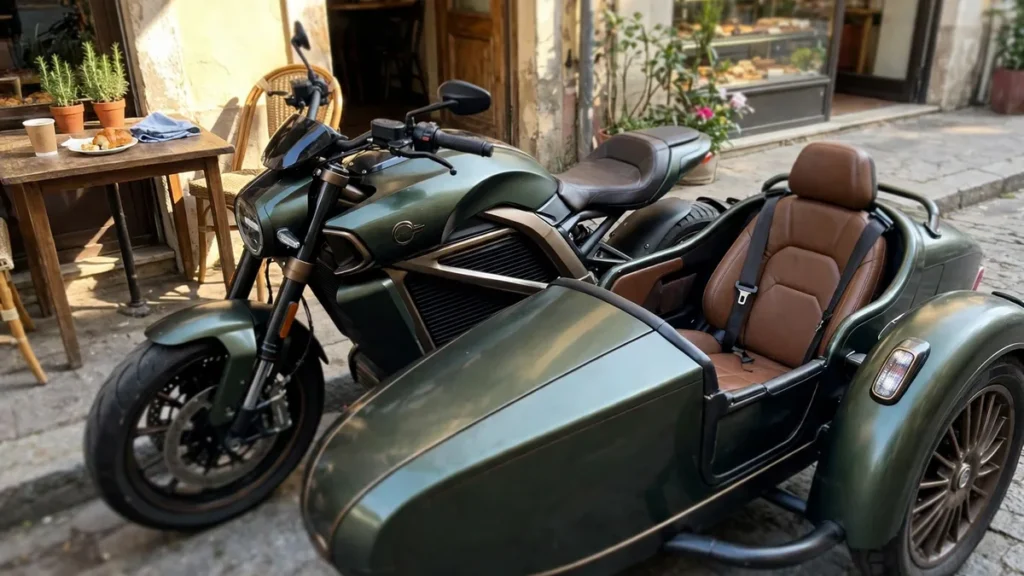
The motorcycle pulls up outside the cafe with something attached to its right side, and for a moment nobody is quite sure what they are looking at. It is a third wheel, a small car on its own wheel, bolted to the bike by a frame of steel tubes, with a passenger sitting inside it, waving, perfectly comfortable, while the rider parks without ever putting a foot down. That is the charm of a luxury sidecar motorcycle. It is also the reason for its price: a luxury sidecar outfit costs, as an estimate, roughly $30,000 to $120,000, which is more than many cars, for a machine that carries two people and a picnic. Here are the seven reasons why.
A sidecar outfit is not a motorcycle with a box bolted on. It is a machine designed as one, with three wheels that never agree about which way to go, and everything about it, from the frame to the brakes, has to be built for that argument. The build is a story of its own, and the guide to how a luxury sidecar motorcycle is made follows it from the chosen motorcycle to the finished outfit, three wheels and all.

1. You are buying two machines, not one
The first reason is the simplest: you are buying two machines, not one. A sidecar outfit is a motorcycle and a sidecar, and the sidecar is a vehicle in its own right, with its own wheel, suspension, brakes, body, seat and electrics. It has to be designed, built and finished to the same standard as the motorcycle, and it carries its own cost.
2. The motorcycle is rebuilt, not just fitted
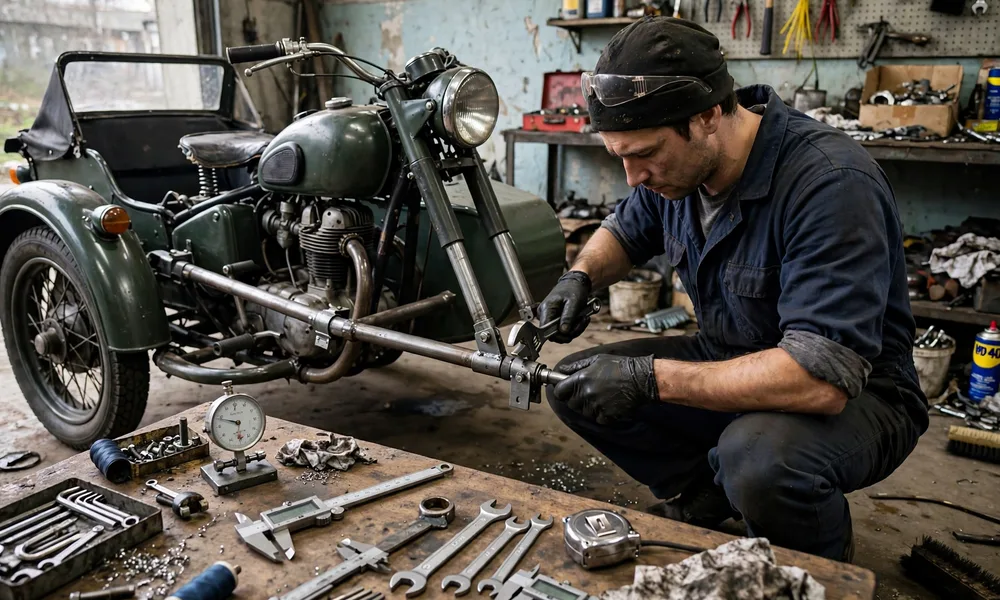
The second reason is the rebuild. A sidecar adds a great deal of weight and drag to one side of the bike, so the motorcycle itself has to be changed before anything else is fitted. The frame is checked for mounting points, and where they do not exist, lugs are welded on, because the sidecar must be attached at four points at least, and every one of them has to take the full force of braking, cornering and bumps without flexing. The front fork is often replaced with a leading-link fork, which keeps the steering light even with the extra weight pulling to one side, and the rear suspension is stiffened to carry the load. The final drive, the brakes and the clutch are all checked, because an outfit that weighs half as much again as the solo bike will wear them out fast if they are left as they were.
3. Three wheels that disagree need clever engineering
The third reason is the geometry. Three wheels never agree about which way to go. The motorcycle wants to lean, the sidecar wants to stay flat, and every corner, bump and braking manoeuvre pulls the outfit in a different direction. Getting the alignment right, the toe-in of the sidecar wheel, the lean-out of the motorcycle, the weight distribution across all three wheels, is a skilled job that takes hours of measuring, test riding and adjusting. A badly set up outfit is tiring and dangerous; a well set up one feels like it was always meant to be three-wheeled. That setup, done by a specialist, is a large part of what the buyer pays for.
4. The sidecar is a small coachbuilt car
The fourth reason is the bodywork. The sidecar is not a fibreglass tub. On a luxury outfit it is a small coachbuilt car, with a steel or aluminium body shaped by hand, painted to match the motorcycle, upholstered in leather, fitted with a windscreen, a dashboard, lights and sometimes a heater. The passenger sits in comfort that a motorcycle pillion never gets: a proper seat, legroom, a backrest and somewhere to put a bag. Building that body to the same standard as the motorcycle, and finishing it to match, takes the same craftsmen and the same hours as a small car body, and it is priced accordingly.
5. It is built in tiny numbers, by hand
The fifth reason is the numbers. Luxury sidecar outfits are built in tens or hundreds a year, not in thousands, and almost every one is built to order. There is no production line to spread the cost across, no shared parts bin to draw from, and no economies of scale. The frame is welded by hand, the body is shaped by hand, the paint is laid on by hand, and the whole outfit is assembled and set up by one builder or a small team. Hand-built machines cost more than mass-built ones, and a machine built one at a time costs the most of all. The numbers on the machine itself tell part of the story, and the guide to luxury motorcycle specs, explained shows how the base motorcycle is measured before the sidecar is added.
6. The brakes and suspension are doubled up
The sixth reason is the running gear. An outfit that weighs half as much again as the solo bike needs brakes and suspension to match, and the sidecar wheel needs its own brake, linked to the motorcycle’s brakes so the outfit stops straight instead of slewing sideways. The suspension on all three wheels has to be tuned together, so the outfit stays level over bumps instead of rocking. These are not standard parts. They are specified for one outfit, fitted by hand and tested on the road, and the cost of that work is carried by a single buyer.

7. It is a machine for a tiny, devoted market
The seventh reason is the market. Sidecar outfits are bought by a tiny, devoted group of riders, and the makers who serve them are small workshops, not factories. A small workshop cannot spread its costs across thousands of buyers, and it cannot afford to keep large stocks of parts. Every outfit is a project, every buyer is known by name, and every machine carries the cost of the workshop that built it. That is the price of rarity, and it is also the reason the machines hold their value: there are few of them, and the people who want them know exactly what they are looking for. The price of the motorcycle itself is a subject of its own, and the guide to why a luxury motorcycle is so expensive follows the same logic into the solo machine.
The rare fact
The rare fact is this: a sidecar outfit can be parked without ever putting a foot down, and it can carry a passenger, a dog and a picnic at the same time, yet it is still, legally, a motorcycle, ridden with a motorcycle licence in most places. Add up the seven reasons and the price stops looking strange. Two machines in one, a motorcycle rebuilt to carry it, geometry that takes hours to get right, a small coachbuilt car for a passenger, hand-built in tiny numbers, with doubled-up brakes and suspension, for a market small enough to know every buyer by name, is not an expensive motorcycle. It is a machine unlike anything else on the road, priced like one, and it earns its keep every time it pulls up outside a cafe and everyone turns to look.