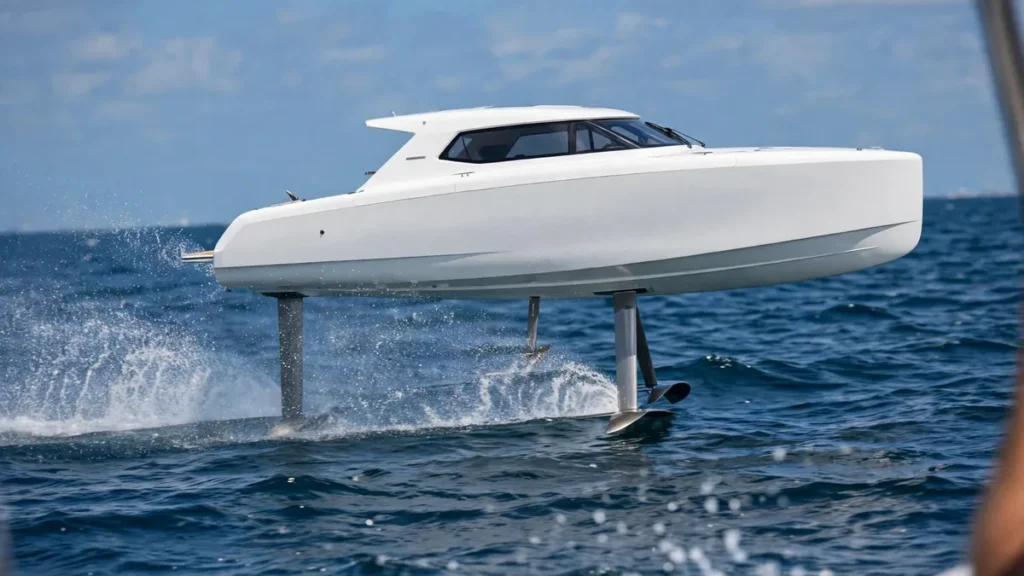
From the chase boat, a luxury trimaran looks impossible. Three hulls cut through the water at once, the middle one long and narrow, the two outer ones barely kissing the waves, and the whole boat leans so little that the guests on deck are still holding their drinks upright. It is doing twelve knots in a breeze that would have a single-hull yacht heeled hard over, and it is doing it with a deck as wide as a tennis court. The trick is not magic. It is geometry, and the spec sheet is where that geometry is written down.
What the specs mean, in plain language
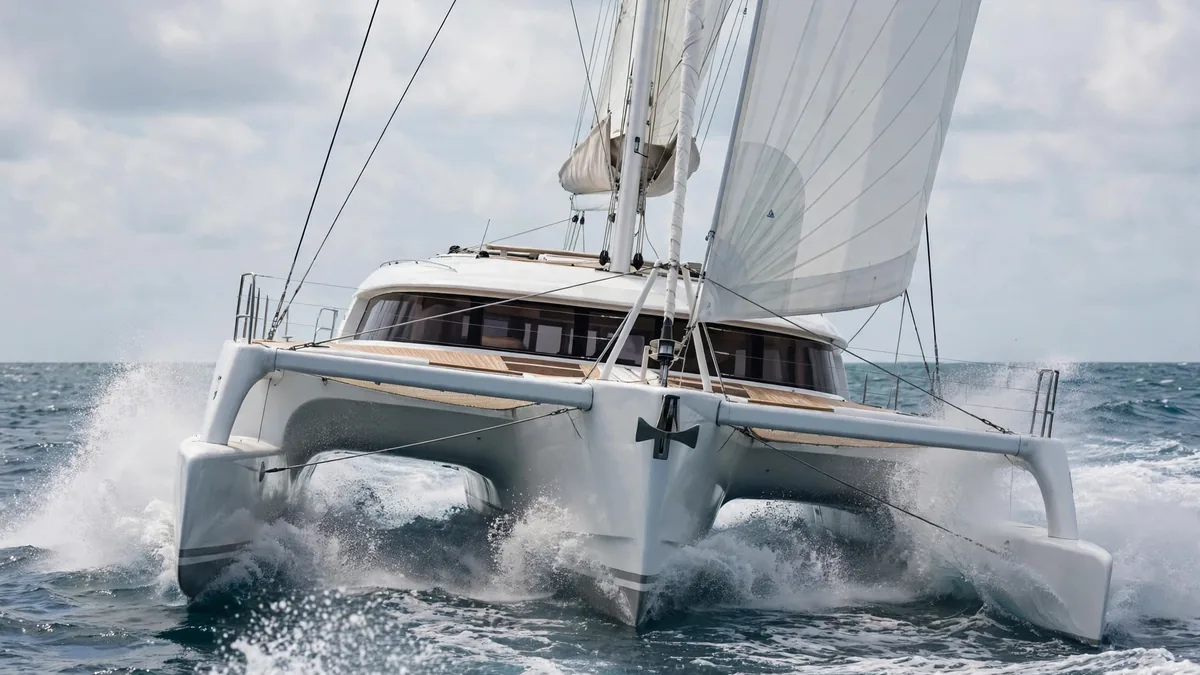
Start with length overall and beam, because on a trimaran the beam is the headline. Length overall is the main hull from bow to stern, often between about twelve and twenty-five metres on a luxury build. Beam is the width across all three hulls, and it can be nearly as wide as the boat is long. That width is what keeps the boat upright: when the wind pushes on the sails, the outer hull on the downwind side presses into the water and holds the boat level, like an outrigger on a canoe.
Displacement is the weight of the boat, and trimarans live or die by it. A light boat accelerates quickly, rides over waves instead of through them, and needs less sail area to reach a given speed. Builders chase lightness with foam-cored hulls, carbon fibre crossbeams and a ruthless attitude to heavy furniture.
The three hulls, explained one by one
The main hull is the long, narrow centre hull, and it carries the cabins, the saloon and most of the weight. Its fineness, the ratio of its length to its width, decides how easily it slips through the water. A long, slim main hull has little drag, which is why trimarans can sail fast in light winds where a heavier yacht would sit becalmed. The guide to how a luxury trimaran is made follows the main hull from its mould to the water, and the slim shape described there is the foundation of every other number on the sheet.
The two outer hulls are called amas, and they are the stability system. They are much smaller than the main hull, often little more than long floats with a small cabin or storage space inside. In calm water they barely touch the surface, and as the wind rises they press down and hold the boat upright. The distance between the amas and the main hull, and the volume of the amas themselves, decide how much wind the boat can carry before it needs to reef its sails. Bigger amas mean more stability and more speed in strong wind, but they also mean more weight and more drag in light airs.
The crossbeams that hold it together
The three hulls are joined by crossbeams, sometimes called akas, and these are the most heavily loaded parts of the whole boat. They take the twisting force of three hulls moving in different waves, and they carry the deck and the saloon between them. On a luxury build the beams are usually carbon fibre, because steel would be too heavy and aluminium would flex too much over such a long span. The beam structure is also where the folding or telescoping mechanism lives on some designs, letting the boat narrow itself to fit a standard marina berth. If the sheet mentions a folding beam, that single feature can halve the annual berthing bill.
The rig, the sails and the speed
The rig is the mast and the sails, and the sail area is the engine size of a trimaran. The sheet quotes the mainsail and headsail areas in square metres, and together they decide how much wind the boat can turn into speed. Luxury trimarans often carry a mast of twenty metres or more, with a rotating mast section that trims itself to the wind like a wing.
Speed is the number everyone asks about, and the sheet usually quotes a cruising speed and a top speed. A luxury trimaran can cruise at ten to fourteen knots in a fair breeze and touch far more in a strong reach, which is roughly twice the cruising speed of a single-hull yacht of the same length. The guide to how a luxury trimaran works explains the physics behind those speeds, and the key idea is simple: three narrow hulls make less drag than one wide one, so the same wind pushes the boat further, faster.

Stability, draught and the cabins
Stability on a trimaran is measured differently from a single-hull yacht. There is no heavy keel, so the boat does not right itself by weight; it stays upright because the leeward ama pushes back against the wind. The righting moment, if the sheet quotes it, is the force that holds the boat level, and a bigger number means the boat can carry more sail in more wind.
Draught is the depth of the main hull below the water, and on a trimaran it is usually shallow, often around one metre, because there is no deep keel to hide. That shallow draught lets the boat anchor close to a beach and slip into harbours that a deep-keeled yacht cannot enter. The guide to why a luxury trimaran is so expensive explains where the money goes, and the carbon crossbeams and the three separate hull moulds sit near the top of that list, because a trimaran is really three boats joined into one.
The spec sheet at a glance
| Specification | Typical luxury figure | What it tells you |
|---|---|---|
| Length overall | Roughly 12 to 25 metres | How long the main hull is, and how much space it holds |
| Beam | Roughly 7 to 12 metres | How wide the boat is, and how stable it feels |
| Displacement | Often 8 to 25 tonnes | How light the boat is, and how fast it sails |
| Sail area | Often 120 to 300 square metres | How much wind the rig can turn into speed |
| Mast height | Often 18 to 28 metres | How high the sails reach, and where the wind is strongest |
| Cruising speed | Roughly 10 to 14 knots | How fast it sails all day in a fair breeze |
| Draught | Often around 1 metre | How close to a beach it can anchor |
| Cabins | Often 3 to 5, sleeping 6 to 10 | How many guests it carries in comfort |
| Crossbeams | Usually carbon fibre, sometimes folding | How the three hulls hold together, and how it berths |

What it costs
A luxury trimaran typically costs an estimated $1.5 million to $10 million, depending on its length, its beam, how much carbon fibre is in the structure and how lavishly the interior is fitted. The estimate covers the boat alone, not the mooring, the crew or the running costs.
A rare fact
One detail few owners ever learn is that a trimaran can sail faster than the wind that pushes it. On a broad reach, the boat’s own speed adds to the apparent wind across the sails, and the sails keep pulling harder the faster the boat goes, up to the point where drag finally balances the drive.