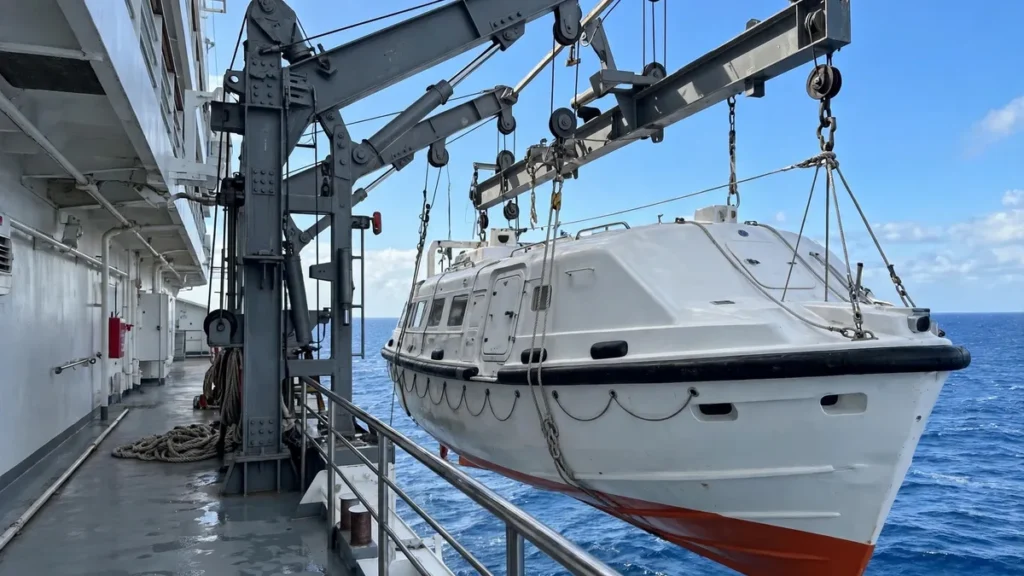
On the deck of a great ship, beside every bright orange lifeboat, stands a quiet steel arm that most passengers never notice. It is the davit, and it waits for years in sun and salt spray, doing nothing at all, until the one day it is needed. Then it must work perfectly, first time, with no second chance.
A luxury lifeboat davit is a crane with a single job: to swing a heavy lifeboat out over the water and lower it gently to the sea. This is how a luxury lifeboat davit is made, and why it is built to a standard no ordinary crane ever has to meet.

How It’s Made
Step 1: Forging the steel arm
The davit starts as a great curved arm of marine steel, forged and rolled into a shape like a shepherd’s crook. The curve is the clever part: it lets the arm reach out over the side of the ship while its foot stays bolted firmly to the deck, and it spreads the weight of the lifeboat along the whole arm instead of letting it hang from one point.
The steel is thicker than it looks, because the arm must hold a lifeboat full of people, and it must hold it while the ship rolls in a storm.
Step 2: Building the winch and the wire
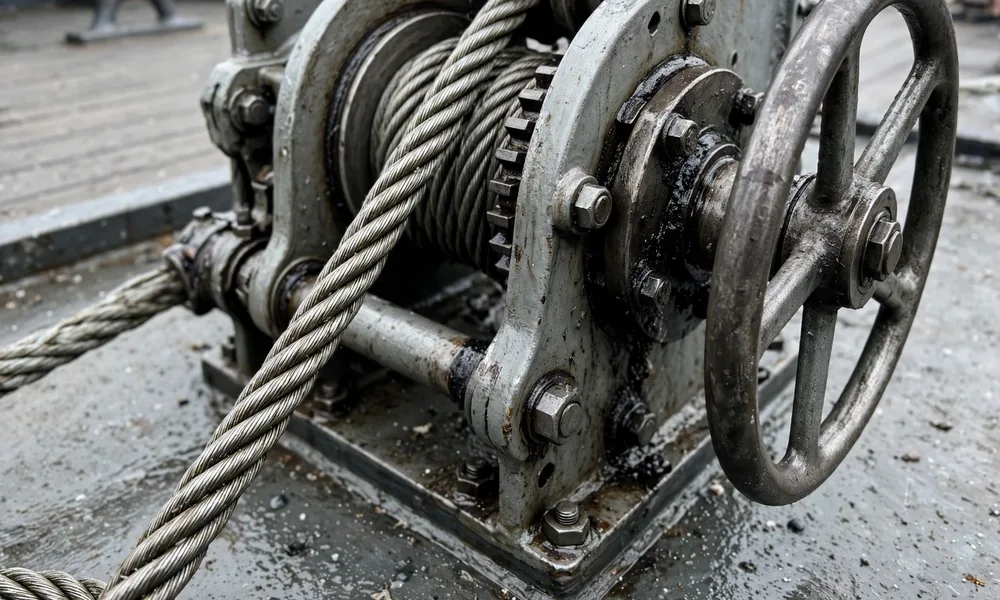
At the foot of the arm sits the winch, a great drum wound with wire rope, driven by a motor and a brake. The winch is the heart of the davit: it lifts the boat, it holds the boat, and it lowers the boat, and it must do all three without slipping, even if the power fails and the crew have to wind it by hand.
The wire rope is made of many fine steel strands twisted together, strong enough to lift the boat and flexible enough to wind neatly onto the drum. The brake is a simple thing, a set of pads that grip the drum, and it is set so the boat can only descend slowly, never in a rush.
Step 3: Fitting the falls and the release gear
Two wires, called falls, run from the winch up over the head of the davit and down to the ends of the lifeboat, so the boat hangs level between them. The falls are fitted with blocks, the pulleys that guide the wire, and each block is greased and checked so it turns freely when the boat is swinging out over the water.
At each end of the boat sits the release gear, the hook that lets the boat go when it reaches the sea. The hooks are made so they cannot open by accident while the boat is hanging in the air, and so they both open together when the crew pull the release, because a boat that drops from one end first would tip everyone into the water. The way a luxury ship lifeboat is so expensive shows the same thinking inside the boat itself, where every fitting is built for the worst day at sea.
Step 4: Bolting it to the ship
The davit is bolted to a steel foundation that is welded deep into the deck, tied into the frames of the ship below. The foundation spreads the load across a wide patch of deck, because the davit pulls hardest at the moment the boat swings out, when all the weight hangs far from the ship’s side.
Step 5: Testing the launch, again and again
Before the ship sails, the davit is tested with a full load. The boat is swung out over the side, lowered to the water, released, and hauled back up, and the test is repeated until the crew can do it smoothly in the dark. A davit that has never been tested is a davit nobody trusts, and trust is the whole point.
The test is also a test of the crew. They learn how the winch sounds when it is working well, how the boat feels as it swings out, and how long the lowering takes, so that on a real day they will not have to think about any of it. The davit is serviced on a strict schedule after that, with the wire, the brake and the hooks checked every few months for the life of the ship.
Step 6: The final polish and the paint
The last step is the finish. The davit is painted in the ship’s colours, usually a clean white or grey that shows rust early, so a spot of orange on the paint is a warning long before the steel is in danger. The moving parts are greased one last time, and the covers are fitted over the winch to keep the spray off.
A small plate is riveted to the arm, showing the weight the davit is rated to lift and the date it was last tested. It is the smallest part of the whole machine, and the most important one after the brake, because it tells the crew at a glance what the davit can do.
| Spec | Detail |
|---|---|
| Arm | Curved marine-steel arm like a shepherd’s crook, reaching over the ship’s side while its foot stays bolted to the deck |
| Winch | Motor-driven drum wound with wire rope, with a brake that lets the boat down slowly and a hand-wind backup |
| Falls | Two wire ropes over the head of the davit, holding the boat level between them as it swings out |
| Release gear | Hooks at each end of the boat that cannot open by accident and release together when the crew pull the lever |
| Foundation | Steel base welded deep into the deck and tied into the ship’s frames, spreading the load across a wide patch |
| Testing | Full-load launch tests before the ship sails, then wire, brake and hook checks every few months for life |
What One Costs
A luxury lifeboat davit is an estimated 100,000 to 500,000 dollars, depending on the size of the lifeboat, the height of the deck and how much of the system is custom built. The steel arm is only part of the price; the winch, the wire and the release gear all cost far more than they look, and the testing and the paperwork add up too. A small davit for a yacht sits near the bottom, while a great davit for a cruise ship, with a heavy boat and a long drop to the water, costs far more, and the way a luxury yacht anchor is specified shows the same idea elsewhere on deck, where a simple-looking piece of steel carries a very serious job.
A Rare Fact
Some modern davits can launch a lifeboat while the ship is still moving, sliding the boat down a track and letting it drop clear of the hull before the release gear opens. It is a trick borrowed from warships, and it means a ship that cannot stop can still get her boats away.

A luxury lifeboat davit is a crane that spends its life waiting: a forged arm, a winch and a wire, two falls and a pair of hooks, all bolted to a deck and tested until the crew trust it with their lives. It is never used on a good voyage, and that is exactly the point, and the way a luxury ship anchor winch works shows the same quiet strength in another deck machine, where a drum of wire and a strong brake do the heavy work.