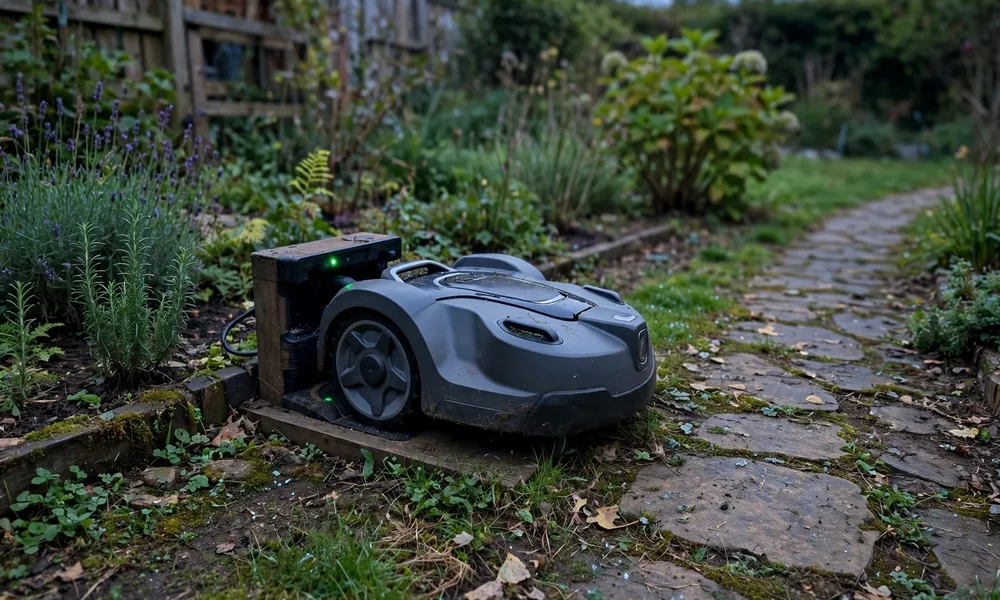
A robot lawn mower looks like a toy that escaped from the garage. It is low, round and quiet, it trundles around the garden on its own, and it seems impossible that such a small machine could have a spec sheet worth reading. Yet the sheet is where the mower hides its real character, because every number on it answers a question the garden asks: how big, how steep, how thick, and how long before the battery gives up.
The trick is that mower numbers do not mean the same thing as car numbers. A cutting width that looks narrow on paper can still cover a large lawn, because the mower works a little every day instead of a lot once a week. Read the sheet the way an engineer reads it, as a set of trade-offs rather than a list of boasts, and the mower starts to make sense.

Luxury Robot Lawn Mower Specs at a Glance
| Spec | Detail |
|---|---|
| Area capacity | About 500 to 5,000 square metres |
| Cutting width | About 18 to 28 centimetres, three or four pivoting blades |
| Cutting height | About 20 to 60 millimetres, adjustable from the app or the mower |
| Battery | About 18 to 25 volts, lithium-ion, 60 to 120 minutes per charge |
| Charging time | About 60 to 90 minutes at its docking station |
| Slope handling | About 35 to 45 percent gradient, with all-wheel drive on some models |
| Navigation | GPS with RTK positioning, camera vision, or a buried boundary wire |
| Noise level | About 55 to 65 decibels, quieter than a normal conversation at times |
These are typical figures for a luxury machine, not promises for every mower on the market. One maker may chase area, another may chase slopes, and the numbers only make sense when you read them together, because a bigger cutting width buys speed and costs agility, and longer battery life buys range and costs charging time.
Navigation and the Map in Its Head
Navigation is the mower’s brain, and it decides whether the lawn ends up striped like a football pitch or patchy like a bad haircut. The simplest mowers follow a buried boundary wire around the edge of the garden and wander inside it at random, bouncing off the wire like a slow pinball, and given enough hours they cover everything.
Luxury mowers carry a map in their heads. GPS with RTK positioning pins the mower down to within a few centimetres, and camera vision lets it see flower beds, trees and garden furniture, so it mows in straight lines and remembers where it stopped. The robot vacuum lidar specs show the same mapping idea indoors, where a machine that knows the room cleans it faster, and a mower that knows the garden wastes no battery revisiting grass it has already cut.
The boundary wire is fading away on the best models, and that matters more than it sounds. A wire must be buried around every bed and border, and a spade through the wire in spring means a dead mower until it is repaired. A wire-free mower sets its borders in an app, drawing no-go zones around the pond and the vegetable patch with a finger.
Battery, Blades and the Cut Itself
The battery is the mower’s working day. At about 18 to 25 volts it runs for about 60 to 120 minutes, then drives itself back to its dock and charges for about 60 to 90 minutes before heading out again. A big lawn is therefore cut in shifts, not in one run.
The blades are the mower’s quiet secret. Instead of one big spinning blade, a robot mower uses three or four small razor blades on a spinning disc, and they slice the tips off the grass rather than chopping it. The clippings are so fine that they fall into the lawn and feed it. The how a luxury robot vacuum works story shows the same small-machine thinking indoors, where a device that works often and gently beats one that works rarely and hard.
Cutting height runs from about 20 to 60 millimetres, and the range matters more than the brochure suggests. A lawn cut short in a heatwave burns and turns brown, while a lawn cut longer shades its own roots and stays green, and a mower that can raise its blades in summer and lower them in spring is a mower that keeps the lawn alive through the year. Some luxury models change the height themselves, reading the season from the app.
Slopes, Rain and the Garden It Must Survive
Slope handling is the number that decides whether a mower suits your garden at all. A figure of about 35 to 45 percent gradient means the mower can climb a bank that would make a person puff, and all-wheel drive models grip better on wet grass, where a two-wheel mower spins and tears the turf. That slope is where a weak mower gets stuck on its first day.
Rain is the mower’s working weather, not its enemy, within limits. A rain sensor tells the mower to stay docked in a downpour, because wet grass clogs the blades and the wheels slip, but a light shower is no reason to stop. The luxury robot arm specs show the same sealed, precise engineering on a bigger machine, where motors must work in dust and damp without failing, and a mower that lives outside all year needs that same toughness.
Weight and noise are the numbers the neighbours notice. At about 8 to 15 kilograms the mower is light enough to lift over a step, and at about 55 to 65 decibels it is quieter than a normal conversation at times, so it can mow at night without waking anyone.

As an estimate, a luxury robot lawn mower costs about $2,000 to $6,000, the navigation system about $500 to $1,500 of that, the battery and motors about $500 to $1,500 more, and the blades, shell and docking station about $500 to $2,000 on top. These are estimated ranges, not quotes. What never changes is that the mower is built in small numbers by hand, and a machine built that way can never be cheap.
A Rare Fact From the World of Robot Lawn Mowers
Here is a detail few gardeners ever learn: a robot mower can make a lawn greener without any fertiliser. The tiny clippings it leaves behind break down in days, returning nitrogen to the soil, and because the mower cuts a little every day, the grass is never shocked by a sudden short cut. Gardeners who switch to a robot mower often find their lawn thickens within a season.
What the Specs Mean for You
If you are comparing luxury robot lawn mowers, start with four numbers: area capacity, slope handling, navigation and battery life. A capacity that covers your lawn with room to spare, slopes of 35 percent or better, GPS or vision mapping rather than random wandering, and a battery that recharges itself are the marks of a mower worth its price. Cutting width matters less than the brochures suggest, and the boundary system matters more than anyone admits, because a mower that needs a buried wire is a mower that owns your weekends. The best luxury robot lawn mower is the one you forget entirely, keeping the grass perfect while you never lift a finger.