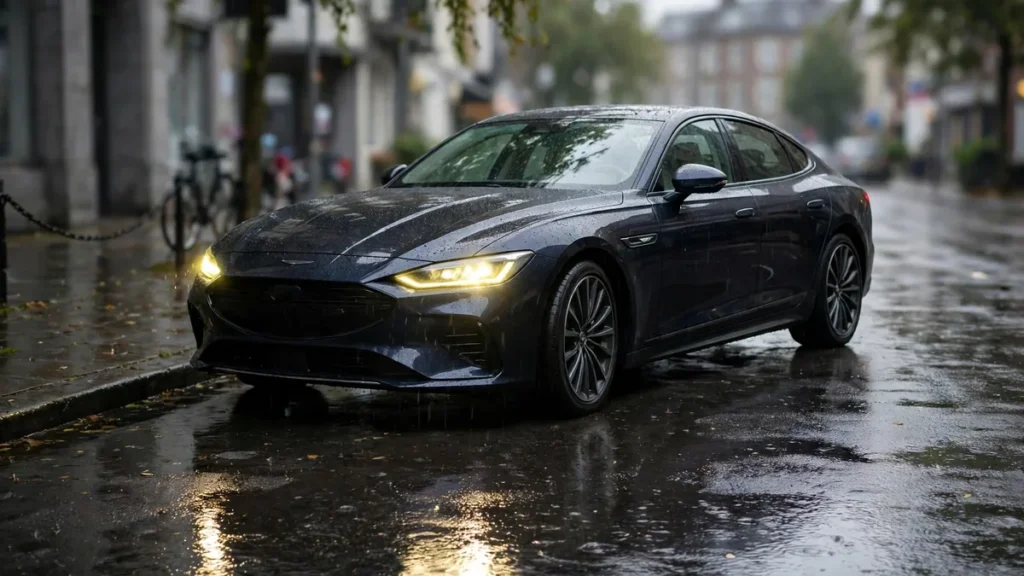
The motorway was empty just after dawn, and the big saloon settled into its lane like it had been built for exactly this road. The driver had been behind the wheel for two hours, yet his shoulders were loose, the cabin was quiet enough to hear the indicator tick, and the car seemed to float over the broken patches of tarmac that would have rattled an ordinary car. Nothing about the journey felt like work, and that was the point. A luxury sedan is not a car that shouts about itself. It is a car that makes a long drive feel like nothing at all.
Its spec sheet, though, can look like a wall of numbers that mean very little on their own. Power, torque, wheelbase, drag coefficient, boot space, noise levels at speed: each figure tells part of the story, and the story only makes sense when you know which numbers matter and which ones are just there to fill the page. This guide decodes a luxury sedan spec sheet in plain words, number by number.

The spec sheet at a glance
| Figure | Typical range | What it tells you |
|---|---|---|
| Engine | 2.0 to 4.4 litre, turbocharged petrol or hybrid | How the power is made |
| Power | Roughly 250 to 550 horsepower | How hard the car can push |
| Torque | Roughly 350 to 750 Nm | How easily it pulls at low speed |
| 0 to 100 km/h | Roughly 4.5 to 7 seconds | How quickly it gathers speed |
| Top speed | Roughly 210 to 250 km/h, usually limited | How fast it can cruise |
| Weight | Roughly 1,800 to 2,300 kg | How heavy it feels on the road |
| Wheelbase | Roughly 2.9 to 3.2 metres | How much legroom the rear seats get |
| Boot space | Roughly 450 to 550 litres | How much luggage it swallows |
| Noise at 100 km/h | Roughly 60 to 65 decibels inside the cabin | How quiet the cabin stays |
| Fuel use | Roughly 6 to 9 litres per 100 km | How far a tank takes you |
Power and torque: the two numbers that work together
Power is the headline figure, and it tells you how much work the engine can do at full stretch. A luxury sedan with 400 horsepower will cruise at motorway speed with barely a whisper from the engine, and it will overtake without ever feeling strained. But power alone does not tell you how the car feels around town, and that is where torque comes in. Torque is the twisting force the engine produces, and it is what you feel when you press the throttle from a standstill or pull away from a junction. A sedan with strong torque low in the rev range feels effortless in everyday driving, because it does not need to be revved hard to move. The two numbers work together: power gives the top end, torque gives the everyday push, and a good sedan balances them so the car never feels lazy or frantic. The way such an engine is put together is described in the guide to how a luxury sedan is made, from the body shell to the finished cabin.
Acceleration: quick enough, never frantic
A luxury sedan is rarely the fastest car on the road, and it does not need to be. The 0 to 100 km/h figure, usually somewhere between five and seven seconds, tells you the car can merge, overtake and climb a hill without fuss. What matters more than the raw number is how the acceleration feels. In a good sedan it is smooth and silent, the gearbox changing ratios without a jolt, the engine note kept well away from the cabin. The sedan buyer wants the speed to arrive quietly, and the spec sheet cannot show that, which is why the noise figure matters just as much. Look at the cabin noise level: a figure near 60 decibels at 100 km/h means you can talk in a normal voice at motorway speed, and that is the real luxury.
Wheelbase and weight: the secret of the ride
The wheelbase, the distance between the front and rear wheels, is one of the most honest numbers on the sheet. A longer wheelbase means more room for rear passengers to stretch their legs, and it also means a smoother ride, because the car bridges bumps rather than falling into them. Luxury sedans stretch this number as far as they can, which is why their rear seats feel like a lounge. Weight works the other way. A heavy car is harder to stop and slower to turn, but weight in a sedan is not all bad: it is what keeps the car planted and quiet at speed, and much of it is sound insulation, thick glass and solid seats. The balance between the two is what separates a good sedan from a merely big one, and the figures to compare are in the guide to luxury sports car specs explained, where a lighter, sharper car is decoded the same way.
Drag, boot space and fuel: the practical numbers
The drag coefficient measures how cleanly the car slips through the air, and a low figure means less wind noise and better fuel economy at speed. Boot space is simpler: around 500 litres means four large suitcases and a few soft bags, which is what a car built for long journeys needs. Fuel use is the number that has changed most in recent years, as hybrid systems have cut consumption without cutting power. A modern luxury sedan can cruise for a thousand kilometres on a tank, which matters more to its owners than the top speed ever will, since the top speed is limited anyway and rarely reached.
What a luxury sedan costs
A luxury sedan typically costs roughly $70,000 to $150,000 as an estimate, with the largest and most powerful models going higher, and the flagship versions with every option can pass $180,000. The price is estimated to include the hand-finished cabin, the acoustic glass, the air suspension and the driver assistance systems that come as standard, and it varies by brand, model and market. The money buys silence, space and time, and for the people who spend hours a day in their car, that is the whole calculation. A related comparison of speed and comfort is set out in the guide to luxury grand tourer specs explained, where a different kind of long-distance car is decoded number by number.
A rare fact
Some luxury sedans are fitted with rear seats that recline, massage and warm, and a few even have a small footrest that folds out of the back of the front passenger seat, turning the rear into something close to a first-class airline seat. It shows where the sedan’s priorities lie: the back seat matters as much as the driver’s seat, and the spec sheet’s wheelbase figure is what makes it possible at all.

A luxury sedan spec sheet is not a list of boasts. It is a promise about how a long journey will feel: quiet, smooth and unhurried. Learn to read the torque, the wheelbase and the noise figure, and the numbers stop being a puzzle and start being the reason the car exists at all.