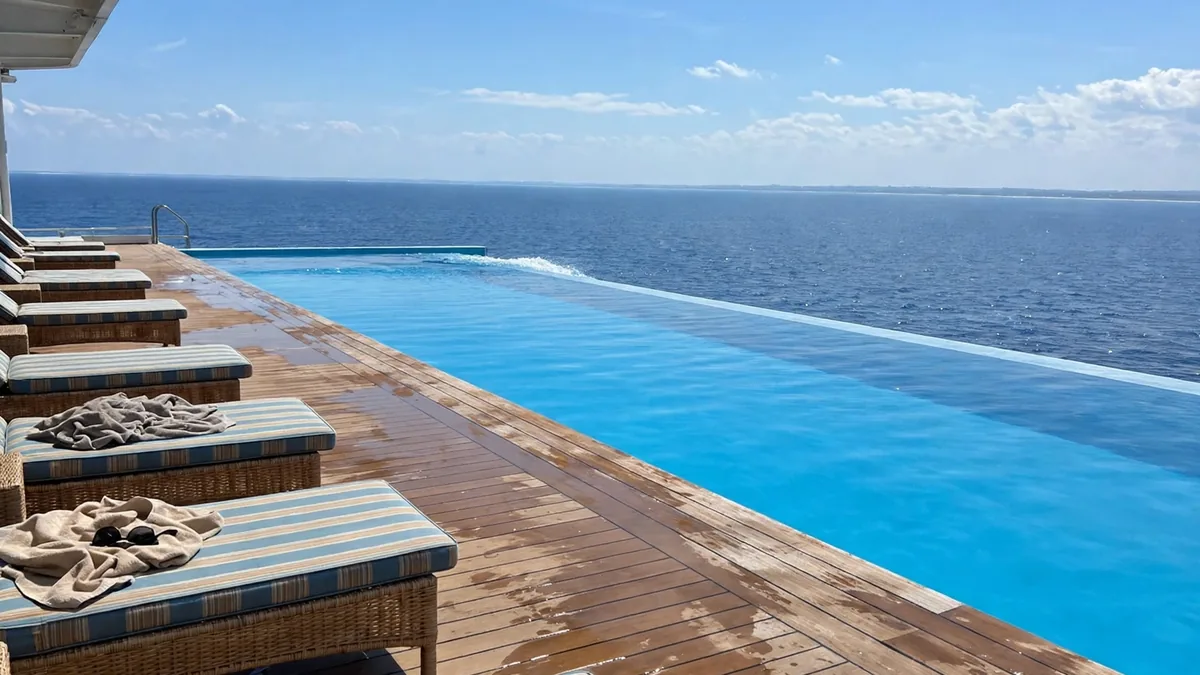
From the sun deck, the water runs to the edge of the ship and simply stops. Beyond it there is only sky and sea, and for a moment the pool looks like it has no far wall. Then a wave moves under the hull, the horizon tilts by a degree, and the water slides a little further toward the edge. That is the moment the specification sheet starts to matter.
A luxury ship infinity pool is a swimming pool on a large ship whose far edge is a weir, a low wall over which a thin sheet of water flows into a hidden basin below. The effect is a pool with no visible edge, but the engineering is the opposite of invisible: pumps, surge tanks, levelling, and stabilisation keep that sheet even while the ship moves. This is a plain translation of the numbers that matter.
1. The vanishing edge, and how the weir is measured
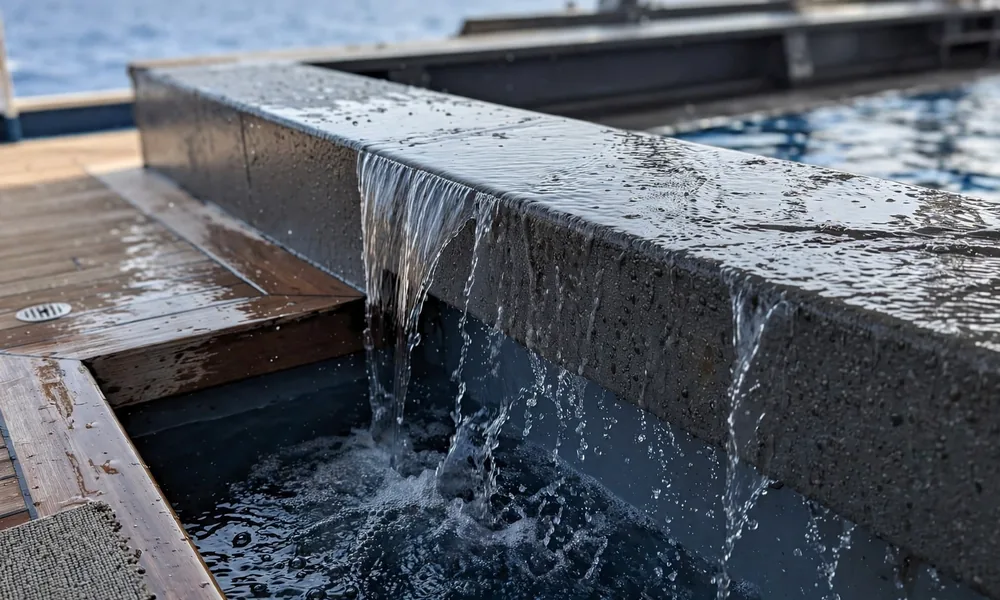
The weir is the low wall at the far edge of the pool, and its length, usually 5 to 12 metres on a large ship, is the first number on the sheet. Water flows over the weir in a sheet only a few millimetres thick, and it has to be even along the whole length. If one part sits even 5 millimetres higher than the rest, the water stops flowing there and the illusion breaks.
The figure to read next to the length is the weir tolerance, the amount by which the edge is allowed to vary from perfectly level. On a luxury ship pool the tolerance is usually 2 to 3 millimetres across the whole edge. The edge is machined and laser-checked, because the eye notices a broken sheet of water at once. The best pools on the water are ranked in the best superyacht pools, ranked.
2. Catch basin and surge volume, and where the water goes
The catch basin is the hidden tank below the weir, usually 2,000 to 6,000 litres in volume. The basin must hold the water that is in the air and on the weir at any moment, plus the surge that arrives when the ship rolls and pool water sloshes toward the edge.
The number to check next to the basin is the surge volume, the extra water the system can absorb when guests jump in or the ship rolls. A basin with too little surge capacity overflows onto the deck, while a generous one keeps the deck dry and the pumps fed. It sits below the pool, so its size also decides how much space the pool steals from the deck below.
3. Pool dimensions and depth, and why shallow wins at sea
On a luxury ship an infinity pool is usually 8 to 15 metres long, 3 to 5 metres wide, and 1.2 to 1.5 metres deep. The depth surprises people, because a pool on land is often deeper. At sea, shallow wins: every extra 100 millimetres adds tonnes of water high up in the ship.
The figure to read next to the depth is the water volume, usually 30,000 to 80,000 litres. That volume is the weight the ship carries on an open deck, where weight matters most. A pool that is too deep forces the designers to add structure below, while a shallow pool gives the same swim with far less load. How a conventional pool is built into a vessel is shown in how a luxury yacht pool is made.
4. Pumps and turnover, and the water’s round trip
Turnover is the time the pumps take to circulate the whole pool, usually 4 to 6 hours on a luxury ship infinity pool. The pumps push water from the catch basin, through filters and heaters, and back into the pool, while a separate stream flows constantly over the weir to keep the sheet even.
The figure to check next to the turnover is the pump flow rate, usually 30 to 80 cubic metres per hour. A bigger flow keeps the weir sheet thick and even, but burns more power. The weir flow never stops while the pool is open: the moment it does, the edge appears.
5. Stabilisation and the moving horizon
Stabilisation is measured in roll reduction, and a large ship’s fin stabilisers typically cut roll by 70 to 90 percent. That matters to an infinity pool more than to any other fitting on deck, because the pool’s edge is level with the horizon only when the ship is level. When the ship rolls, the water piles up on one side and the sheet thickens on the low side and thins on the high side.
The pool’s freeboard, the height of the rim above the water inside, is usually 100 to 200 millimetres. A generous freeboard gives the water room to slosh without spilling, while a low rim looks better in photographs and spills at the first roll.
6. Heating, filtration, and the salt-air problem
The heater for a luxury ship infinity pool usually runs at 50 to 150 kilowatts. The pool is kept at 26 to 30 degrees Celsius, and the heater works hardest at night and in cool weather, when the open deck loses heat fast. A pool that is too cold goes unused.
Filtration is measured in microns, and a luxury pool filter usually catches particles down to 10 to 20 microns. Salt air is the enemy here: it corrodes pumps, heaters, and fittings faster than fresh water ever would, so the equipment is built from marine-grade stainless steel and bronze. The price of getting it wrong is the subject of why a superyacht swimming pool is so expensive.
The Specifications at a Glance
Here are the numbers that matter most on a luxury ship infinity pool.
| Specification | Typical Luxury Range |
|---|---|
| Weir length | 5 to 12 metres |
| Weir level tolerance | 2 to 3 millimetres across the edge |
| Pool size | 8 to 15 metres long, 3 to 5 metres wide |
| Water depth | 1.2 to 1.5 metres |
| Water volume | 30,000 to 80,000 litres |
| Catch basin volume | 2,000 to 6,000 litres |
| Turnover time | 4 to 6 hours |
| Heater power | 50 to 150 kilowatts, 26 to 30 degrees Celsius |
What Does a Luxury Ship Infinity Pool Cost?
A luxury ship infinity pool is estimated to cost roughly $800,000 to $2,500,000 installed, depending on size and location on the ship. A modest pool on an upper deck is estimated at roughly $800,000 to $1,500,000, while a large pool with a long weir and a full heating and filtration plant is estimated at roughly $1,500,000 to $2,500,000. A replacement weir edge is estimated at roughly $20,000 to $60,000.
A Rare Fact
An infinity pool on a ship is levelled twice. The weir is machined level with the ship upright in still water, and the stabilisers do the second half of the job at sea, holding the hull level enough for the sheet to stay even. Without them, the pool would be ordinary, with a very expensive edge.
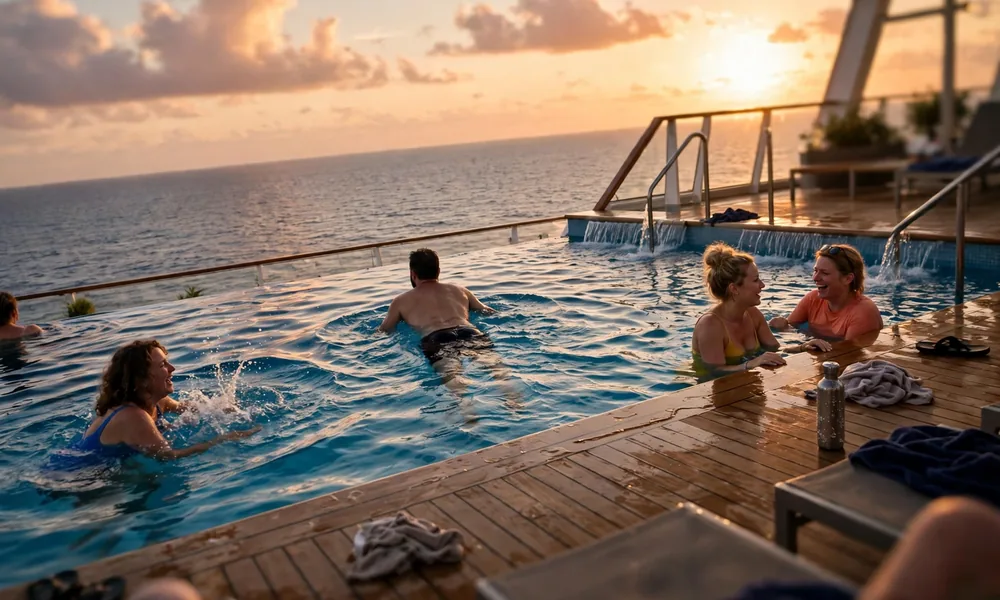
Once you know which numbers do the work, the sheet makes sense. Weir tolerance decides whether the edge disappears, basin volume decides whether the deck stays dry, and depth decides how much weight the ship carries for the view.


