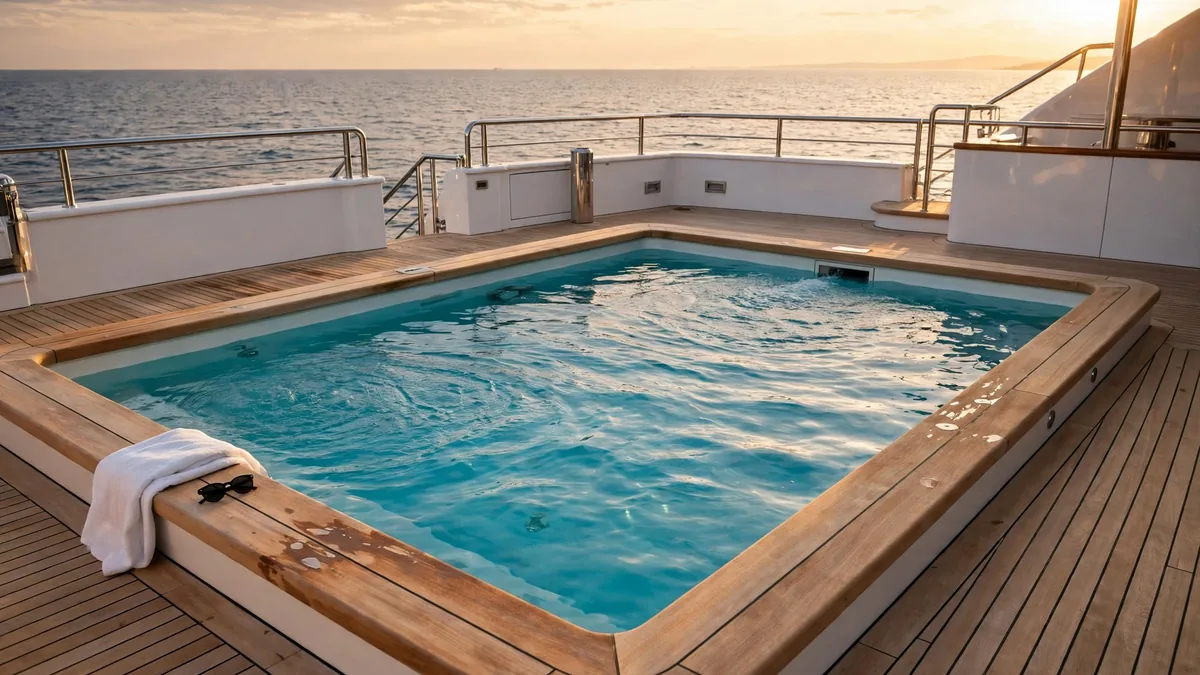
Stand on the aft deck of a large superyacht at sunset and you will see something that should not exist: a swimming pool, full of still turquoise water, floating on the open sea. The yacht is already a small floating hotel, and now it carries a pool as well — a hole full of water, cut into a vessel whose entire job is to keep water out. It is a strange, wonderful contradiction, and one of the most expensive fittings on any yacht, with a typical installation costing an estimated $500,000 to $2 million.
A superyacht pool is not a fibreglass tub dropped onto a deck. It is a piece of the ship itself, designed before the first steel plate is cut and built by specialists. Every tonne of water it holds changes how the yacht floats, every tile is laid by hand, and every moving part has to keep working in salt air for decades. Here is where the money goes.
Why It Costs So Much
1. The pool is designed into the ship, not added later
A pool cannot be an afterthought, because water is heavy and it sits high in the ship, where weight matters most. A modest plunge pool holds five to ten tonnes of water, and a large lap pool can hold thirty tonnes or more, and that weight moves the yacht’s centre of gravity. Naval architects calculate the vessel’s stability with the pool full, half-full, and empty, and they plan for the water sloshing from side to side when the yacht rolls. The pool’s position shapes the layout of the cabins and machinery below, so the design work alone runs into many thousands of hours before any metal is cut. That early design is expensive because so few firms in the world have ever done it well.
2. The structural shell has to be perfect
The pool tub is usually fabricated as a watertight steel or aluminium shell, welded into the yacht’s structure during hull construction so that it becomes part of the ship rather than something bolted on afterwards. The shell’s walls are stiffened with ribs and brackets, and every weld is tested, because a leak can send tonnes of water into the machinery spaces below. The shell is built with a slight fall towards the drains, and with access hatches for when a pump or a seal needs replacing. Building it demands the same exacting standards as a superyacht steel hull, because the pool is only as good as the structure beneath it, and rework at this stage is ruinously expensive.
3. The finish is laid by hand, tile by tile
Inside the shell, the pool is waterproofed with a membrane and finished with materials that can live permanently underwater in salt air. The classic choice is glass mosaic tile, laid by hand one tiny square at a time, and a large pool can need tens of thousands of tiles, each placed, grouted, and checked by a specialist tiler. Alternatives include polished stainless steel, which must be welded and finished to a mirror shine without a single flaw, or specialist resins that are applied in layers and cured under controlled conditions. None of this work can be rushed or automated, and the craftsmen who do it are a small, expensive group.

4. The moving floor is a machine in its own right
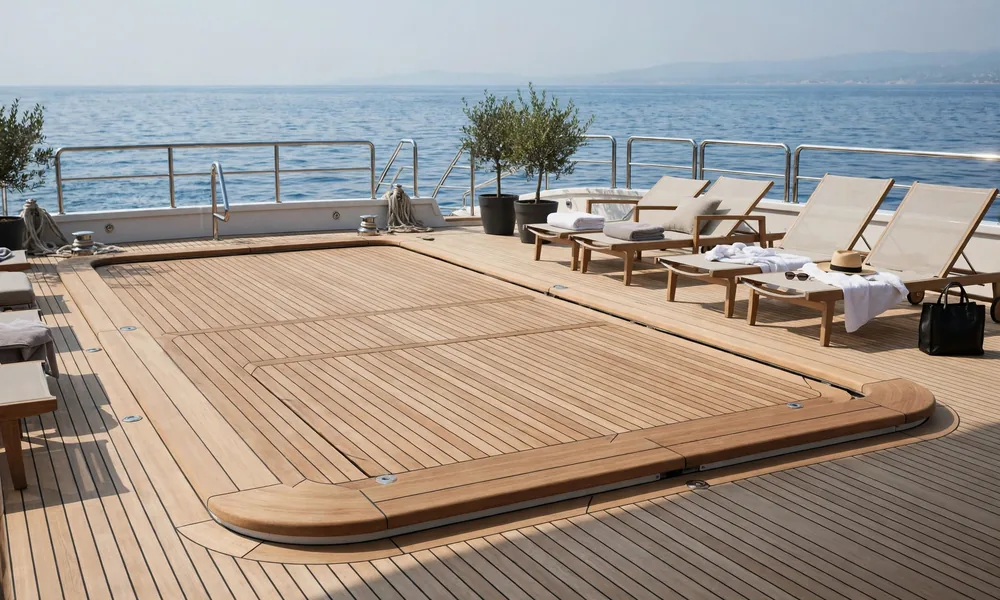
Many superyacht pools have a floor that rises to turn the pool into extra deck space, and that floor is a serious piece of engineering. It is a large, heavy platform — often the size of a small room — driven by hydraulic rams, sealed so that it moves smoothly and locks positively at every height, including part-way up as a shallow children’s pool. The hydraulics need redundancy so the floor can always be raised before a storm, and the seals must keep seawater out of the machinery for years. A moving floor can add an estimated $200,000 to $500,000 to the pool’s cost, and it is the feature owners most often ask for, because it doubles the usable deck.
5. The water treatment plant below deck
A superyacht pool is filled with fresh water, and keeping that water clean at sea takes a small treatment plant hidden below deck. Filtration, heating, and disinfection — usually a combination of ultraviolet light, ozone, or chlorine — run continuously, with pumps, heat exchangers, and chemical dosing systems that must work while the yacht is rolling. The water has to be heated to around 28°C even when the sea outside is cold, which takes a surprising amount of energy, and the whole system is plumbed in marine-grade materials that will not corrode. Fresh water itself is precious at sea, which is why large yachts invest so heavily in watermakers that turn seawater into drinking water, and the pool’s share of that system is part of its true cost.
6. Testing, certification, and the crew who run it
Before handover, the pool is filled and tested over days: leaks, water quality, heating, and the moving floor at every position. The yacht is taken to sea with the pool full, and the crew watch how the water behaves in a real seaway — whether it sloshes, whether the overflow tank copes, whether the floor stays locked. Classification societies inspect the structure and safety systems, and the crew are trained on its operation: balancing the water, raising the floor, winterising the system. All of that testing and training is billed, and it is what separates a pool that works for twenty years from one that leaks in its first season. It is the same logic that makes a superyacht’s other big toys expensive — a tender garage, for example, is cheap to describe and costly to build well.
Specifications
| Property | Typical Superyacht Pool |
|---|---|
| Length | 3–8 m (plunge) / up to 12 m (lap) |
| Water volume | 5–30 tonnes |
| Shell material | Steel / aluminium / stainless insert |
| Finish | Glass mosaic tile / stainless / resin |
| Moving floor | Hydraulic, full travel in ~1–2 min |
| Water treatment | Filtration + UV / ozone / chlorine |
| Heating | Heat exchanger / electric, to ~28°C |
| Glass floor/wall | Laminated tempered, load-bearing |
What the Money Buys
A superyacht swimming pool is priced as part of the yacht, not as a standalone item, but industry figures put a typical installation at an estimated $500,000 to $2 million depending on size, with the largest and most complex — glass-bottomed, moving-floor, infinity-edge pools — costing an estimated $3 million or more. The shell and structure are only part of it: the tiling, the glass, the hydraulics, and the water-treatment plant each add hundreds of thousands. All prices here are estimates, not quotes. What the owner gets for that money is not just a place to swim. It is a deck that transforms — pool in the morning, open sunbathing space in the afternoon — a piece of engineering that holds tonnes of water perfectly still on a moving ship, and a feature that only a handful of yards in the world can build at all.
Rare Fact
Some superyachts have pools with glass bottoms that form the ceiling of the owner’s cabin — the owner can lie in bed and watch the sunlight ripple through the water above, with the silhouettes of swimmers drifting across the ceiling. It is the most literal version of sleeping under the sea, and it only works because the glass floor is engineered to carry tonnes of water while staying perfectly clear.


