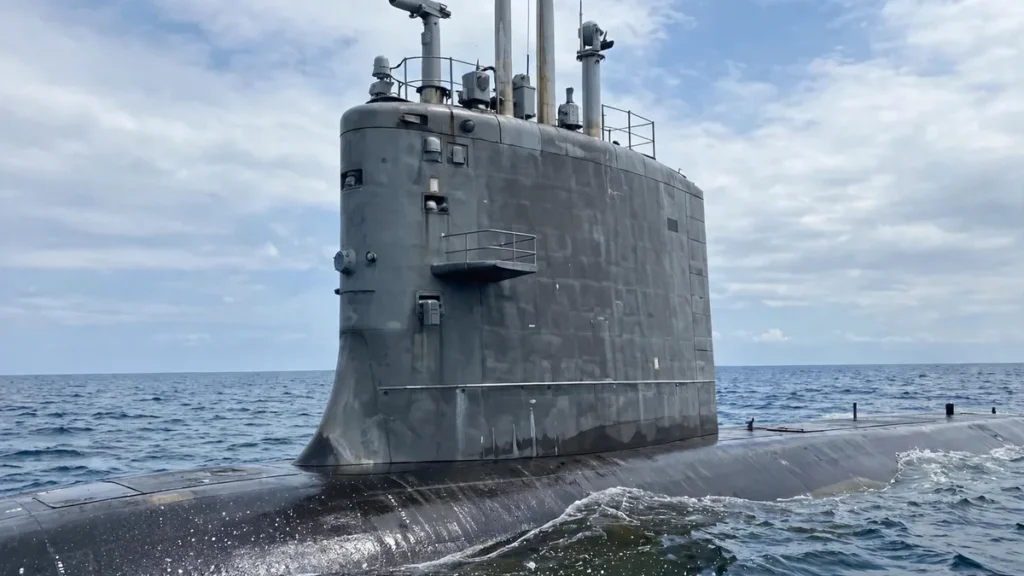
The first time you stand beside a private submarine in dry dock, the conning tower is the part your eyes go to first. It rises from the middle of the hull like a small building that has somehow been bolted to a boat, all flat sides and railings, with thin masts poking out of the top. It looks simple from the quayside, almost plain, but the spec sheet for that tower runs to pages, and every line on it answers a question about how the boat is driven, how it sees, and how its crew gets in and out. Read it properly and the tower stops looking like a lump on the hull and starts looking like the submarine’s front porch, lookout post, and front door rolled into one.
On a luxury submarine, the conning tower is better known to engineers as the sail or fin. It is the raised structure on top of the pressure hull, and it carries the masts, the bridge, and the main hatch. Nothing about it is decorative. Even its shape, sloping at the front and square at the back, is there to cut water resistance and keep spray off the bridge.
This guide reads the spec sheet line by line, from height and diameter to masts, hatches, and materials. It explains what each figure measures, why it matters on a real boat, and what separates a well-designed luxury tower from one that was drawn to look good in a brochure. If you can read this sheet, you can look at any private submarine and understand what its tower is really built to do.

The Spec Sheet, Line by Line
1. Height above the deck
The first figure is the tower’s height above the casing, the flat deck that runs along the top of the hull. On a luxury submarine this is typically three to five metres, tall enough to lift the bridge clear of waves and spray when the boat is running on the surface. The sheet should give the height from the deck to the top of the bridge.
2. Periscope and sensor masts
The masts are the thin tubes that rise from the top of the tower, and the sheet lists how many there are and what each one carries. A luxury boat usually has two optical periscopes or their modern camera equivalents, plus a radar mast, a communications mast, and a snorkel mast for running the engines just below the surface. The number of masts is a quick measure of how much the boat can see, hear, and say while staying almost completely underwater.
3. The bridge and its controls
The open bridge sits at the top front of the tower, a small platform with a low windscreen and room for two or three people. The sheet describes its size, its railings, and the controls fitted there: steering, engine telegraph, and a repeater for the compass and depth gauge. On a luxury boat the bridge is finished properly, with non-slip decking and handrails that are actually in reach when the boat rolls.
4. Hatches and access
The main hatch sits in the top of the tower or in its floor, and it is the crew’s way in and out. The sheet gives its diameter, usually around 600 to 700 millimetres, and whether it opens inwards or outwards. A wider hatch matters more than it sounds: crew in survival suits, or carrying equipment, need room to pass through quickly. The tower also contains the ladder down into the pressure hull, and the sheet should show its angle and the headroom at each step.
5. Structure and the pressure hull
Inside the tower’s outer fairing sits a pressure-resistant tube, the part of the tower that stays dry when the boat dives. The sheet gives its diameter and its wall thickness, and the depth rating it is built to survive. The outer fairing, by contrast, is free-flooding: water pours in when the boat dives and drains out when it surfaces, which is why the tower has vents and flood holes along its sides.
6. Materials, paint and finish
The tower’s fairing is usually steel or a composite shell over a steel frame, and the sheet lists the materials and the coating system. The paint matters more than vanity: it must resist salt water, survive constant wetting and drying, and stay quiet, because a flaking coating can cause noise underwater. The sheet should also list the weight of the whole tower assembly, which can run to many tonnes, because that weight sits high on the boat and affects how it rolls.

Typical Specifications
| Specification | Typical Luxury Figure |
|---|---|
| Height above deck | 3–5 metres to top of bridge |
| Pressure hull diameter | About 2–3 metres inside the tower |
| Periscope and sensor masts | 4–6 masts: periscope, radar, communications |
| Bridge positions | 2–3 crew, open bridge with windscreen |
| Main hatch diameter | 600–700 mm |
| Construction | Steel frame, free-flooding fairing |
| Finish | Dark low-sheen marine coating |
| Tower assembly weight | Several tonnes, estimated |
What It Costs
A conning tower is not sold on its own, so its price is always an estimate inside the cost of the submarine. For a luxury private submarine, the tower assembly, including masts, bridge fittings, hatches, and coatings, is typically estimated at $2 million to $5 million of the total build cost, with the most elaborate towers, carrying extra sensor masts and a fully fitted bridge, reaching the top of that range. The steel is the cheap part; the optics, sensors, and sealing are where the money goes.
Maintenance is a steady cost rather than a large one. The tower’s coatings need inspection and renewal every few years, the mast seals need regular service, and the hatch gaskets need replacing on schedule, because a small leak at the hatch is a serious problem on a diving boat. Owners should budget an estimated $50,000 to $100,000 a year for tower upkeep on a luxury boat, covering paint, seals, and mast servicing.

A Rare Fact
Here is something few people outside the submarine world know: the word “conning” comes from “conn”, the old naval term for steering a ship, and the conning tower was originally the armoured room from which a captain conned his boat in battle. On the earliest submarines it was a small armoured cylinder with slits to see through. On a modern luxury submarine the armour is gone, but the job is the same, and the tower still carries the boat’s eyes and its steering position. Even the smallest luxury boats keep the name. The name survived a century of redesign because the purpose never changed: it is the place from which the boat is driven.
Read the sheet with the questions in this guide, climb the ladder, stand on the bridge, and check the hatch with your own hands, and the right tower will announce itself by feeling solid, roomy, and dry where it counts. That is what the numbers are for: not to impress in a brochure, but to predict a working life of surfacing, diving, and coming home safely. Readers who want to see how these towers are put together can read how a luxury submarine conning tower is made, while how a luxury conning tower works and luxury submarine dive plane specs explained show its closest neighbours on the boat.